
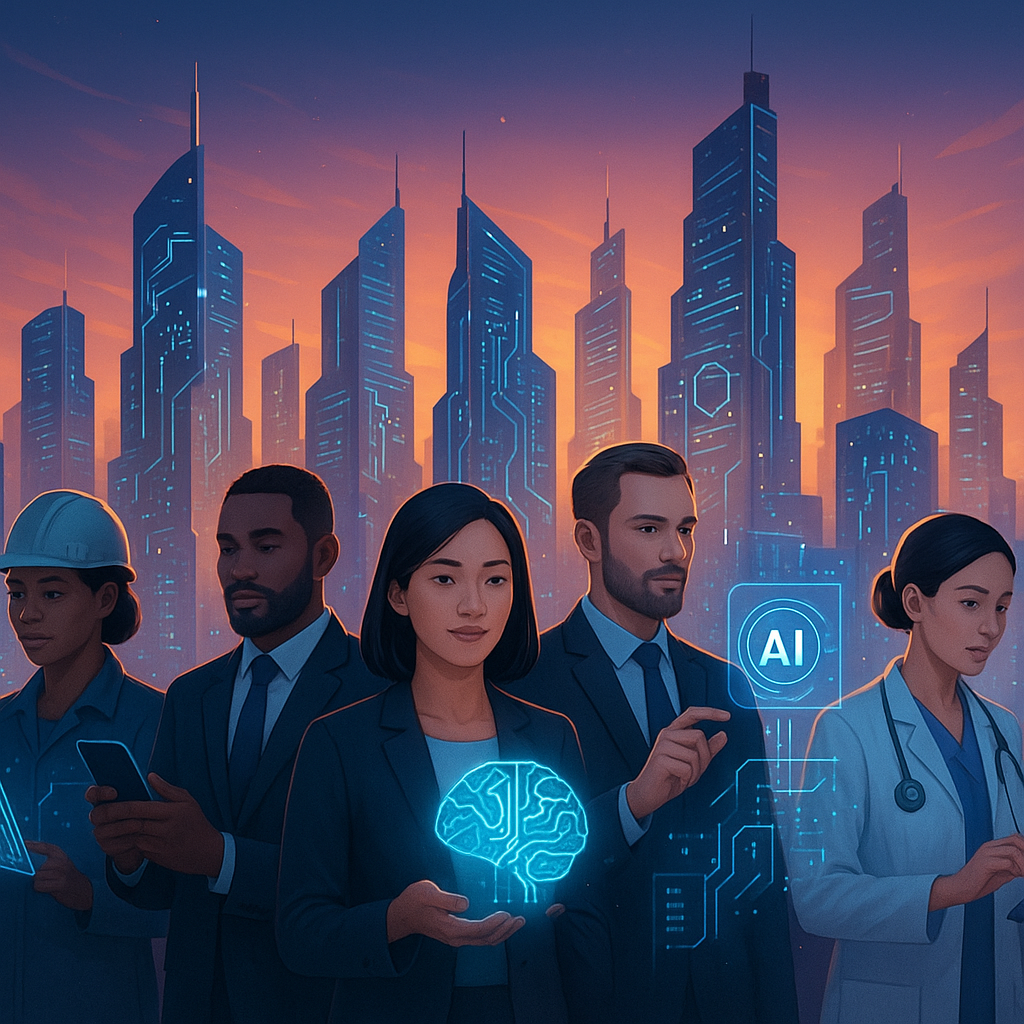
Unveiling AI’s Subtle Transformation Across Global Sectors
In a bustling logistics hub outside Rotterdam, autonomous drones coordinate with robotic loaders to streamline cargo handling with precision and speed previously deemed impossible. Meanwhile, in a hospital in Tokyo, AI-powered diagnostic systems analyze complex medical images instantaneously, flagging anomalies for specialist review with unprecedented accuracy. These scenes, once the realm of speculative fiction, are emblematic of a broader, quieter revolution: artificial intelligence has seamlessly woven itself into the fabric of diverse industries, fundamentally reshaping how organizations operate, innovate, and compete.
This transformation is not marked by singular headline-grabbing breakthroughs but rather an accumulation of incremental advances that, together, have propelled AI from experimental labs into indispensable tools across sectors. As of 2026, the global AI market valuation has surpassed $400 billion, underscoring its pervasive influence—not just in technology firms but in manufacturing, healthcare, finance, and even creative industries.
“Artificial intelligence today is less about replacing humans and more about augmenting capabilities and uncovering new possibilities,” notes Dr. Lena Harms, a leading AI strategist at the Global Institute for Digital Futures.
Understanding this subtle yet profound shift requires a deep dive into AI’s evolution, current state, and emerging trends that promise to redefine the next decade.
From Concept to Catalyst: Tracing AI’s Journey to 2026
Artificial intelligence’s origins trace back to the mid-20th century, with early pioneers like Alan Turing conceptualizing machines that could simulate human intelligence. The 1956 Dartmouth Conference famously coined 'artificial intelligence' as a discipline, planting the theoretical seeds. Yet, the decades that followed were marked by cycles of optimism and stagnation, often referred to as “AI winters,” due to limited computational power and data scarcity.
The 2010s ushered in a turning point. The convergence of massive data availability, cloud computing, and advanced algorithms—particularly deep learning—catalyzed practical applications. Tech giants like Google, Microsoft, and Amazon led the charge, embedding AI into search engines, voice assistants, and cloud services. By 2020, AI was no longer confined to research labs but a commercial powerhouse.
In the ensuing years, research milestones accelerated, notably in natural language processing, computer vision, and reinforcement learning. The emergence of foundation models—large-scale pre-trained AI systems—enabled unprecedented generalization across tasks. This period also saw the rise of ethical debates and regulatory frameworks, as AI’s societal impact became undeniable.
Today, AI’s trajectory is shaped by a blend of technical innovation and socio-economic integration. TheOmniBuzz readers interested in a detailed historical perspective may refer to our comprehensive timeline of AI breakthroughs.
Core Technologies Driving AI’s 2026 Landscape
At the heart of AI’s pervasive impact lie several key technologies, each advancing rapidly and enabling a spectrum of capabilities:
- Foundation Models: These massive models, trained on diverse datasets, serve as versatile engines for tasks ranging from language understanding to image recognition. OpenAI’s GPT-5 and Google DeepMind’s Gemini have set new standards in contextual comprehension and multi-modal reasoning.
- Edge AI: With advances in hardware miniaturization and energy efficiency, AI computations are increasingly performed locally on devices, reducing latency and enhancing privacy. This has revolutionized applications in IoT, autonomous vehicles, and personalized healthcare monitoring.
- Explainable AI (XAI): Transparency has become paramount as AI systems influence critical decisions. XAI techniques allow users to interpret AI reasoning, fostering trust and adherence to emerging regulations.
- Generative AI: Beyond analysis, generative models are creating content—text, images, music, and even synthetic data for training—transforming creative industries and accelerating innovation cycles.
- Reinforcement Learning: AI agents now learn complex strategies through interaction with environments, exemplified by breakthroughs in robotics and game-playing AI that adapt dynamically.
These technologies are not isolated; their interplay drives AI’s expanding capabilities. For example, integrating foundation models with edge AI hardware enables real-time language translation on smartphones, a feat unattainable just a few years ago.
“The synergy of these technologies is what turns AI from a tool into a partner across disciplines,” emphasizes Dr. Miguel Santos, CTO of Synapse AI Solutions.
AI in 2026: Breakthroughs and Industry Adoption
This year marks a watershed moment as AI adoption penetrates sectors beyond traditional tech hubs, delivering tangible business value and societal benefits.
Healthcare: AI-driven diagnostics now assist in over 70% of radiology departments worldwide, improving early detection rates of cancer and cardiovascular diseases by an estimated 25%, according to the World Health Organization's 2026 report. Personalized medicine, powered by AI analyzing genomic and lifestyle data, is becoming standard in oncology and chronic disease management.
Manufacturing: Smart factories equipped with AI-enabled predictive maintenance have reduced downtime by 40%, boosting productivity. Collaborative robots (cobots) work alongside humans safely, optimizing workflows. AI-driven supply chain analytics have improved demand forecasting accuracy by 30%, mitigating disruptions.
Finance: AI systems now manage risk assessment, fraud detection, and customer service at scale. Algorithmic trading powered by deep reinforcement learning outperforms traditional models by 15% on average. Regulatory technology (RegTech) leverages AI to ensure compliance amid complex global regulations.
Creative Industries: Generative AI tools are democratizing content creation. Film studios, advertising agencies, and game developers use AI to prototype concepts rapidly, reducing production cycles by months. However, this also raises nuanced debates on intellectual property and authenticity.
Public Sector: Governments employ AI for urban planning, traffic management, and public safety analytics. AI-driven climate modeling informs proactive environmental policies, addressing pressing global challenges.
These developments illustrate AI’s dual role as a productivity multiplier and a transformative force reshaping organizational cultures and workflows. For a detailed analysis of AI’s sectoral impact, see our feature Artificial Intelligence in 2026: Advances, Impact, and Future Directions.
Voices from the Frontlines: Experts Reflect on AI’s Current and Future Role
Industry leaders and academic experts increasingly emphasize a balanced outlook on AI’s promises and pitfalls. Ethical considerations, workforce transformation, and governance remain central themes.
“AI’s value is maximized when human expertise and machine intelligence collaborate effectively, not when AI operates in isolation,” says Professor Amina Qureshi from the Institute of Ethical AI.
Workforce displacement fears persist, but data from the International Labour Organization shows that AI-related job creation now outpaces displacement by a ratio of 1.3:1 in advanced economies. Reskilling initiatives and AI literacy programs are critical to harnessing this trend.
On the regulatory front, multilateral efforts such as the Global AI Accord, ratified by over 50 countries in late 2025, establish frameworks for safety, transparency, and data privacy. These regulations aim to prevent misuse while encouraging innovation.
Key expert insights include:
- Prioritizing transparency and explainability to build public trust.
- Ensuring equitable AI benefits across socio-economic strata.
- Fostering interdisciplinary collaboration between technologists, ethicists, and policymakers.
- Encouraging open-source AI development for democratization.
“The next decade will test our collective ability to steer AI towards inclusive growth and human flourishing,” warns Dr. Henry Lawson, Chair of the AI Governance Council.
Looking Ahead: What to Watch in AI’s Next Chapter
As AI continues its integration into everyday life, several trends and challenges warrant close attention:
- AI and Sustainability: AI’s potential to optimize energy consumption, reduce waste, and accelerate climate modeling is immense. However, the environmental footprint of training massive models remains a concern, prompting innovations in green AI.
- Human-AI Collaboration: Advances in brain-computer interfaces and augmented cognition suggest future AI systems may augment human decision-making in real time, enhancing creativity and problem-solving.
- Regulatory Evolution: Adaptive regulations will be required to keep pace with rapid AI innovation, balancing innovation incentives with societal safeguards.
- AI in Education: Personalized learning platforms powered by AI promise to revolutionize education accessibility and efficacy globally.
- AI Security Risks: The rise of sophisticated AI-generated misinformation and cyber threats necessitates robust defense mechanisms and international cooperation.
Preparing for these developments involves multi-stakeholder engagement, inclusive policymaking, and sustained investment in AI research and education.
For readers seeking to deepen their understanding of AI’s fundamentals and leadership integration, our articles Rethinking Intelligence and SCRUMstudy Agile Master with AI Certified (SAMAC™) provide valuable perspectives.