Unveiling AI’s 2026 Reality: From Fiction to Ubiquity
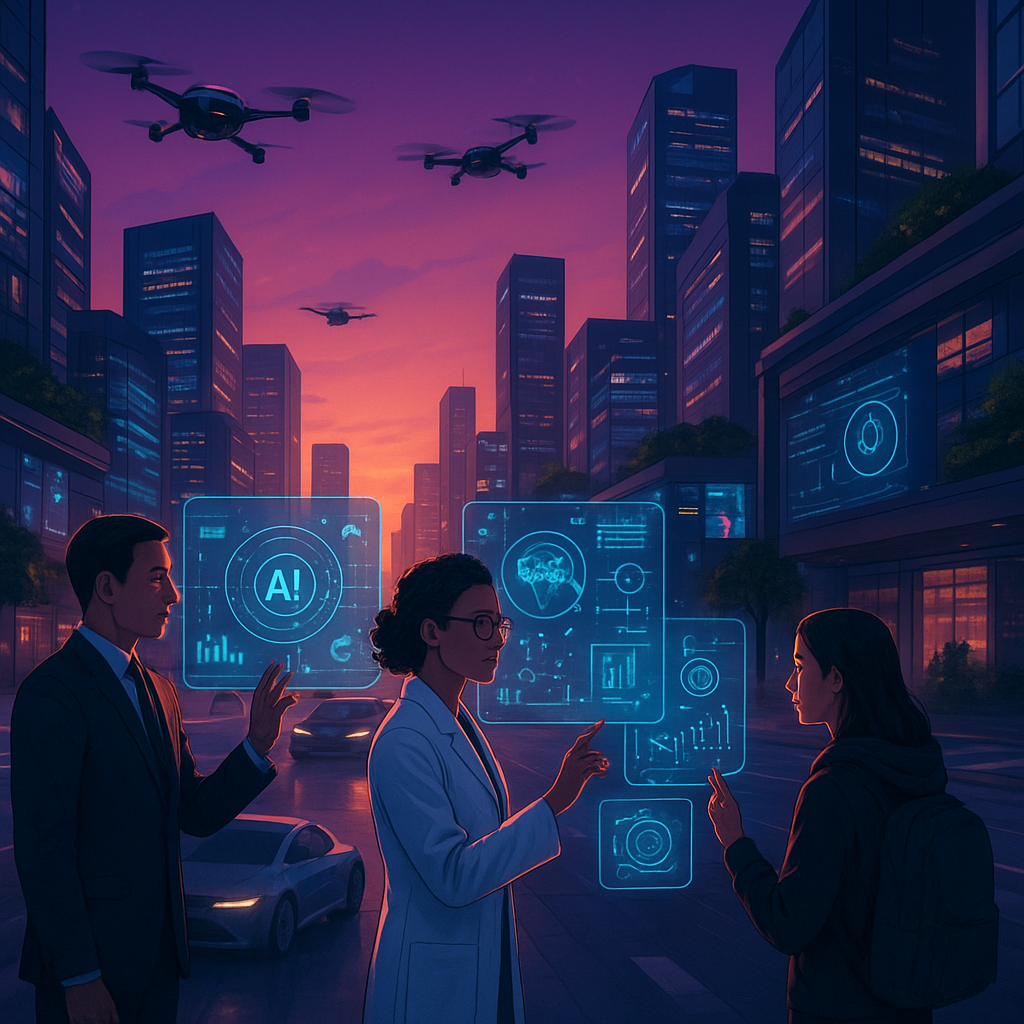
In early 2026, the AI-powered language model ChatGPT surpassed 1.5 billion active users worldwide, reflecting an unprecedented integration of artificial intelligence into daily life. This milestone underscores how AI has transitioned from niche research labs to mainstream applications that touch nearly every sector. From healthcare diagnostics to autonomous vehicles, and from creative arts to complex decision-making, AI technologies have become deeply embedded in the fabric of modern society.
Consider a typical urban morning: your smart assistant aggregates personalized news, optimizes your commute via traffic-aware routing, and even suggests meal plans based on your recent biometric data. These seamless experiences are powered by advances in machine learning, natural language processing, and sensor fusion that have matured significantly over the last five years. According to industry estimates, the global AI market reached $450 billion in 2025, growing at a compound annual rate (CAGR) of 27% since 2020, illustrating the vast economic and societal footprint of AI technologies.
“AI’s integration into everyday life is no longer speculative; it is a defining feature of the 2020s, reshaping how humans interact with technology and each other.” — Dr. Elena Moretti, AI Ethics Researcher
Historical Trajectory: How AI Reached Its 2026 Peak
The roots of artificial intelligence stretch back to the mid-20th century, with pioneers like Alan Turing and John McCarthy laying theoretical foundations. The decades since have seen waves of enthusiasm and setbacks, commonly known as AI winters, when progress slowed due to computational or conceptual limitations.
The revival began in the 2010s, driven by breakthroughs in deep learning, fueled by the exponential growth in computing power and the availability of vast datasets. By the early 2020s, transformer architectures revolutionized natural language understanding, enabling machines to generate coherent, context-aware text that rivaled human writing. This era also witnessed the rise of reinforcement learning agents mastering complex games and robotic control.
Key milestones leading to 2026 include:
- 2017: Introduction of the transformer model, enabling scalable language models.
- 2020–2022: Launch of multi-modal AI systems capable of processing text, images, and audio simultaneously.
- 2023: Deployment of AI in critical infrastructure like energy grids and autonomous public transport in major cities.
- 2024: Legislative frameworks on AI ethics and data privacy adopted globally.
- 2025: Advances in AI explainability tools enhancing trust and transparency.
This historical progression set the stage for the current environment where AI is not only a technological tool but an economic and social force.
Core Technologies Driving AI in 2026: A Data-Driven Analysis
At the heart of contemporary AI are several core technologies that have matured through rigorous research and commercialization. Notable among them are foundation models, which serve as versatile backbones for diverse applications. These include large-scale neural networks trained on diverse data sources, enabling zero-shot and few-shot learning capabilities.
According to Statista data, the average size of foundation models has increased exponentially, reaching upwards of 1 trillion parameters by late 2025. This expansion supports enhanced contextual understanding and creativity but also introduces challenges such as computational costs and environmental impact.
Beyond model size, innovations in algorithmic efficiency—such as sparse attention mechanisms and quantization—have substantially reduced inference latency and energy consumption. Companies like Novum AI and Synapse Systems have pioneered hardware-software co-design to optimize AI workloads, resulting in chips tailored for AI processing that outperform general-purpose GPUs.
AI’s core domains in 2026 include:
- Natural Language Processing: Advanced conversational agents, real-time translation, and sentiment analysis.
- Computer Vision: Enhanced image recognition, anomaly detection, and augmented reality applications.
- Reinforcement Learning: Autonomous robotics, supply chain optimization, and adaptive control systems.
- Multi-Modal AI: Integrating vision, text, and audio to create holistic understanding and generation capabilities.
“The synergy of model scale, algorithmic innovation, and specialized hardware has propelled AI from experimental to indispensable.” — Prof. Arjun Patel, AI Systems Architect
2026 Developments: AI at the Confluence of Innovation and Regulation
The year 2026 marks a distinctive phase where AI innovation converges with comprehensive governance frameworks. Regulators worldwide have introduced stringent standards for AI transparency, bias mitigation, and data protection. The European Union’s AI Act, fully enforced in 2025, mandates rigorous risk assessments for high-impact AI systems, influencing global compliance trends.
Simultaneously, the commercial landscape is expanding into new verticals:
- Healthcare: AI-driven diagnostics now assist in 60% of medical imaging interpretations globally, improving detection rates of diseases such as cancer and cardiovascular conditions.
- Education: Personalized AI tutors have been deployed in over 30 countries, adapting curricula to individual learning styles and progress.
- Finance: AI models underpin fraud detection, credit scoring, and automated trading, accounting for 45% of all transactions in major financial hubs.
- Environment: AI-powered climate modeling and resource management tools aid governments in sustainable urban planning and disaster preparedness.
Moreover, the emergence of AI-human collaboration frameworks is notable. Hybrid teams leveraging human intuition and AI analytical power have become the norm in sectors like research and creative industries. This shift is documented in the recent TheOmniBuzz article Software Development in 2026: Trends, Challenges, and Future Outlook, highlighting how AI enhances productivity while raising new ethical questions.
Expert Perspectives and Industry Impact: Voices from the Frontline
Industry leaders and AI ethicists emphasize the dual promise and responsibility inherent in AI proliferation. Dr. Helena Kim, CTO of Synapse Systems, notes, “AI’s transformative potential is matched by the imperative to embed fairness and accountability at every stage.” This view is echoed by NGOs advocating for global AI equity, warning against exacerbation of digital divides.
From a business standpoint, AI adoption has reshaped competitive dynamics. Enterprises investing in AI capabilities report:
- Average productivity increases of 35% in operations.
- Reduction in error rates by up to 40% in quality control.
- Accelerated innovation cycles, shortening product development timelines by nearly 20%.
However, there are concerns about workforce displacement. Governments and corporations are partnering on reskilling initiatives to prepare workers for AI-augmented roles, focusing on creative, strategic, and interpersonal skills less susceptible to automation.
“The future workforce will not compete with AI but collaborate with it, creating new paradigms of work.” — Lisa Zhang, Head of Global AI Policy Forum
Looking Ahead: What to Watch in AI’s Next Horizon
As AI continues to evolve, several trajectories warrant close attention:
- General AI Progress: Research towards artificial general intelligence (AGI) remains cautious but active, with milestones expected in reasoning, self-awareness, and cross-domain learning.
- AI Governance: International cooperation on standards and ethical norms will shape AI’s societal acceptance and impact.
- Human-Centric AI: Emphasis on explainability, user control, and emotional intelligence to foster trust and adoption.
- Integration with Emerging Technologies: Synergies with quantum computing, 6G networks, and bioinformatics will open novel applications.
Stakeholders from policymakers to developers are advised to balance innovation with responsibility. TheOmniBuzz’s coverage of emerging technologies provides valuable insights into these intersections, complementing AI discourse through connected topics like software development advancements (Software Development in 2026) and its economic implications.
In conclusion, artificial intelligence in 2026 stands as a testament to human ingenuity and complexity. Its continued trajectory demands vigilance, inclusivity, and foresight to ensure that AI serves as a force for societal good rather than division or harm.