Opening the Black Box: What Defines Artificial Intelligence Today?
Imagine a world where machines not only execute programmed instructions but also interpret context, learn from vast data streams, and independently adapt their behavior. This is the realm of Artificial Intelligence (AI) in 2026 — a discipline that has transcended its early science-fiction roots and become the backbone of transformative technologies worldwide. AI is no longer just about robots or voice assistants; it permeates sectors from healthcare diagnostics to climate modeling, from autonomous vehicles to personalized education.
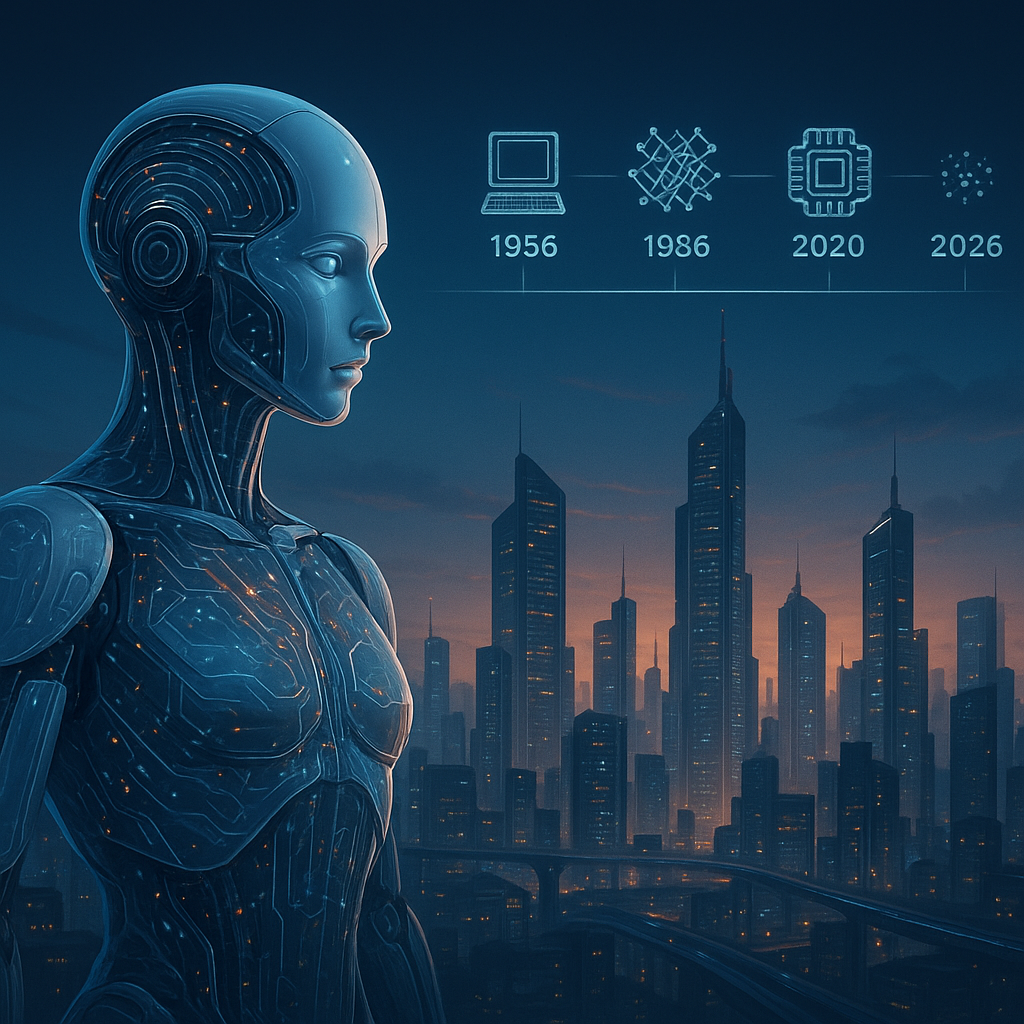
At its core, AI refers to the capability of machines to perform tasks that typically require human intelligence. This includes reasoning, learning, problem-solving, perception, and even creativity. However, the nuances of what constitutes AI have evolved significantly since the term was first coined in 1956 during the Dartmouth Conference. Today, AI encompasses a diverse set of methodologies, from classic symbolic logic to cutting-edge neural networks that mimic human brain processes.
“Artificial Intelligence is the science and engineering of making intelligent machines, especially intelligent computer programs.” – John McCarthy, 1956, often credited as the father of AI.
The landscape of AI is layered. Narrow AI, designed for specific tasks like language translation or facial recognition, dominates current applications. Meanwhile, the pursuit of Artificial General Intelligence (AGI), machines with human-like cognitive abilities across any domain, remains an aspirational goal yet to be realized.
Tracing the Roots: A Historical Context of AI Development
Understanding AI’s current state demands a journey through its history. The mid-20th century witnessed the birth of AI as a formal discipline, fueled by innovations in computer science and cognitive psychology. Early pioneers like Alan Turing proposed foundational ideas, including the famous Turing Test, which questioned if machines could exhibit indistinguishable human intelligence.
During the 1950s and 1960s, AI research focused on symbolic AI, where human knowledge was encoded into explicit rules and logic. Systems like ELIZA simulated conversation, while expert systems attempted to replicate decision-making in specialized fields. However, progress stagnated during the so-called 'AI winters' due to unrealistic expectations and limited computational power.
The resurgence came with the advent of machine learning (ML) in the 1980s and 1990s, shifting the paradigm from rule-based systems to data-driven models. Neural networks, inspired by biological neurons, gained traction but were initially limited by computational constraints and insufficient data.
The explosion of digital data and advances in processing power in the 2010s propelled AI into a new era. Deep learning architectures enabled machines to surpass human-level performance in tasks like image recognition and natural language processing. This breakthrough laid the groundwork for the AI ecosystem we see today, characterized by complex algorithms, vast datasets, and cloud-scale infrastructures.
Dissecting AI’s Core: Technologies, Techniques, and Metrics
At a technical level, AI comprises multiple branches and techniques, each suited for different problems. Machine learning, particularly deep learning, dominates, but other approaches like reinforcement learning, evolutionary algorithms, and symbolic reasoning still play critical roles.
Machine learning algorithms use statistical methods to identify patterns in data and make predictions or decisions without explicit programming for each task. Deep learning, a subset of ML, uses multi-layered neural networks to model complex relationships. Recent innovations include transformer models that revolutionized natural language understanding, enabling applications such as advanced chatbots and real-time translation.
Evaluating AI systems involves metrics specific to their tasks. Accuracy, precision, recall, and F1 scores measure classification performance. In generative AI, metrics assess creativity, coherence, and diversity. Beyond technical measures, ethical and societal considerations, such as fairness, transparency, and privacy, have become essential benchmarks.
- Machine Learning: Algorithms that improve performance with experience, including supervised, unsupervised, and reinforcement learning.
- Deep Learning: Neural networks with many layers, enabling high-level abstraction and feature extraction.
- Natural Language Processing (NLP): Techniques for understanding and generating human language.
- Computer Vision: Enabling machines to interpret and analyze visual inputs.
- Reinforcement Learning: Learning optimal actions through trial and error in dynamic environments.
While these technologies underpin modern AI, integration with robotics and sensor technologies is extending AI's reach into physical systems, forming the bedrock for autonomous vehicles, drones, and smart manufacturing.
“The real power of AI lies not just in algorithms, but in the fusion of data, computing, and domain expertise.” – Dr. Anita Kumar, AI researcher and consultant.
AI in 2026: Breakthroughs, Challenges, and Industry Shifts
The year 2026 marks a pivotal point where AI has matured into an indispensable asset for industries and governments alike. According to recent industry reports, global AI spending surpassed $500 billion in 2025, reflecting a compound annual growth rate exceeding 20% over the last five years.
Current developments emphasize AI's enhanced contextual understanding and ethical alignment. Models now incorporate multimodal learning—simultaneously processing text, images, and sensor data—enabling more holistic decision-making. Explainable AI (XAI) techniques have become a regulatory requirement in many jurisdictions, addressing concerns about opaque 'black box' algorithms.
Healthcare AI has revolutionized diagnostics and personalized medicine. AI-driven platforms analyze genomics, imaging, and electronic health records to tailor treatments. Autonomous vehicles are nearing widespread adoption, with AI systems demonstrating robust performance in complex urban environments.
Despite these advances, AI poses significant challenges. Data privacy remains a critical issue amid growing surveillance capabilities. Bias and discrimination embedded in training datasets continue to threaten equitable outcomes. Regulatory frameworks struggle to keep pace with rapid innovation, necessitating ongoing dialogue between technologists, policymakers, and civil society.
- Rise of foundation models: Large-scale pre-trained AI models fine-tuned for diverse applications.
- AI democratization: Tools and platforms empowering small businesses and individual developers.
- Human-AI collaboration: Hybrid systems augmenting human creativity and problem-solving.
- Energy-efficient AI: Innovations reducing the carbon footprint of AI training and inference.
- Global AI governance: International cooperation to set standards and ethical norms.
These trends illustrate a maturing AI ecosystem increasingly integrated with human workflows and societal structures.
Real-World AI: Case Studies Shaping the Future
Examining concrete examples illuminates AI’s transformative potential. In the financial sector, JPMorgan Chase's AI-driven fraud detection systems now analyze transaction patterns in real time, reducing false positives by 35%, according to their 2025 annual report. This efficiency not only saves billions annually but also enhances customer trust.
In environmental science, AI-powered satellite imagery analysis platforms assist in monitoring deforestation and predicting wildfire risks with unprecedented granularity. Projects like EarthSense leverage machine learning to process petabytes of data, enabling timely interventions critical for climate resilience.
Education technology has embraced AI for personalized learning pathways. Platforms using adaptive algorithms tailor curricula to individual student needs, improving engagement and retention. TheOmniBuzz's related coverage highlights how these systems are reshaping pedagogy and democratizing quality education globally.
Manufacturing industries employ AI-driven predictive maintenance systems to anticipate equipment failures before they occur. General Electric reported a 20% reduction in downtime across their global plants by integrating AI analytics, demonstrating tangible operational benefits.
“AI is not a distant future; it’s embedded in the fabric of modern enterprise and society.” – Maria Gonzalez, CTO at TechNext Innovations.
These cases underscore AI’s role as a catalyst for efficiency, sustainability, and innovation across domains.
Looking Ahead: What to Watch in Artificial Intelligence
As AI continues to evolve, several key themes will shape its trajectory. Foremost is the pursuit of trustworthy AI that balances innovation with accountability. Advances in federated learning and privacy-preserving techniques promise to reconcile data utility with confidentiality.
The convergence of AI with quantum computing is another frontier. Though still nascent, quantum-enhanced AI algorithms could exponentially accelerate certain computations, unlocking new possibilities in drug discovery and cryptography.
Workforce transformation remains a pressing concern. AI’s automation capabilities will redefine job roles, emphasizing the need for reskilling and human-AI collaboration frameworks. Policymakers are increasingly focusing on inclusive strategies to ensure broad societal benefit.
Furthermore, AI’s environmental impact is under scrutiny. Sustainable AI development practices and green computing initiatives are gaining momentum to mitigate the sector’s carbon footprint.
- Expansion of AI ethics frameworks: Emphasizing fairness, transparency, and human rights.
- Hybrid AI systems: Combining symbolic reasoning with neural networks for more robust intelligence.
- AI in space exploration: Autonomous systems supporting missions beyond Earth.
- Enhanced multimodal AI: Seamless integration of diverse data types for richer context.
- Regulatory evolution: Dynamic policies balancing innovation with societal safeguards.
For a deeper exploration of AI’s evolving intelligence paradigms, readers can refer to our in-depth piece on How Machine Learning Is Redefining Intelligence and Industry in 2026 and the comprehensive overview in Artificial Intelligence in 2026: Advances, Impact, and Future Directions.
The journey of AI is far from over. It remains a dynamic field where technical innovation, ethical reflection, and societal adaptation intersect. Understanding AI’s foundations, current capabilities, and future potential equips us to engage with this transformative technology thoughtfully and responsibly.