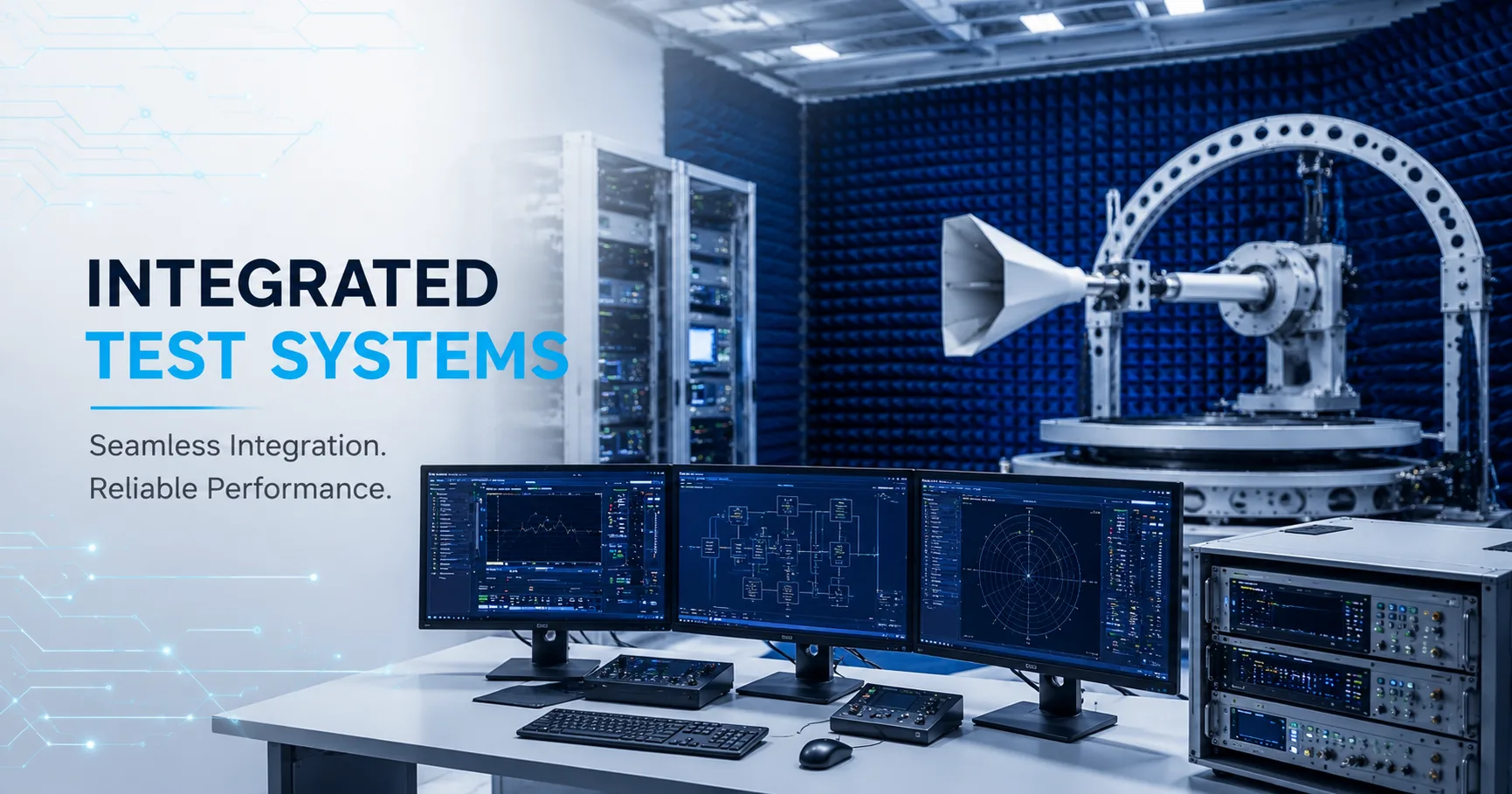
As products become more intelligent and interconnected, testing environments must also evolve. Modern RF laboratories, manufacturing facilities, and validation centers rely on multiple hardware and software components working together as one complete solution. An integrated support system helps unify these technologies, ensuring smooth communication, reliable operation, and long-term performance.
Today's integrated test systems combine instruments, automation software, control systems, positioning equipment, RF chambers, and data acquisition into a single platform. To guarantee that every subsystem operates correctly, system integration testing is performed before deployment, reducing risks and improving operational efficiency.
Whether supporting wireless communication, automotive electronics, aerospace systems, or industrial automation, integrated testing solutions help organizations accelerate product development while maintaining high testing accuracy.
Key Takeaways
- Connects multiple test technologies into one unified platform
- Improves workflow efficiency and automation
- Reduces manual intervention and operational errors
- Supports scalable testing environments
- Enables reliable system integration testing
- Enhances long-term performance and maintainability
What Is an Integrated Support System?
An integrated support system combines hardware, software, communication interfaces, and automation into a coordinated testing environment. Instead of managing separate instruments independently, engineers operate a centralized system that controls every stage of the testing process.
This integrated approach simplifies operations while improving consistency, repeatability, and productivity across testing facilities.
Understanding Integrated Test Systems
Integrated test systems are designed to bring together various technologies required for complete product validation.
These systems commonly include:
- RF measurement instruments
- OTA testing chambers
- Precision positioning systems
- Automation software
- Signal switching solutions
- Data acquisition systems
- Safety monitoring
- Centralized control interfaces
By integrating these components, engineers can execute complex test sequences with greater speed and accuracy.
The Importance of System Integration Testing
Before an integrated solution is delivered, every component must work together reliably. System integration testing verifies communication, synchronization, automation logic, and overall system functionality.
This process helps ensure:
- Proper hardware communication
- Software compatibility
- Stable automation workflows
- Accurate data collection
- Reliable measurement performance
- Safe system operation
Identifying integration issues early minimizes delays and improves overall system reliability.
Benefits of Integrated Testing Solutions
Organizations implementing integrated testing solutions gain several advantages:Improved Efficiency
Automated workflows reduce repetitive manual tasks and increase testing throughput.Greater Accuracy
Integrated systems minimize human error while ensuring repeatable measurement results.Simplified Operations
A centralized control platform allows operators to manage multiple instruments from one interface.Scalability
Additional instruments and testing capabilities can be integrated as future requirements evolve.Reduced Downtime
Well-integrated systems simplify diagnostics, maintenance, and troubleshooting.
Industries That Benefit from Integrated Test Systems
Integrated testing solutions support a wide range of industries, including:
- Telecommunications
- Automotive and connected vehicles
- Aerospace and defense
- Industrial automation
- Consumer electronics
- IoT device manufacturing
- Research and development laboratories
As products become increasingly connected, integrated testing environments continue to play a critical role in ensuring quality and reliability.
Key Considerations When Implementing an Integrated Support System
A successful integration project should consider:
- Compatibility between hardware and software
- Flexible system architecture
- Automation capabilities
- Future expansion requirements
- Cybersecurity and data management
- Operator usability
- Long-term maintenance and support
Planning these factors early helps organizations maximize system performance and return on investment.
Why Choose Orbis Systems?
At Orbis Systems, we develop advanced integrated support system solutions that simplify complex testing environments. Our integrated test systems combine RF measurement equipment, chamber solutions, positioning systems, automation, and control software into a single, efficient platform. Through comprehensive system integration testing, we verify that every subsystem works together seamlessly, delivering reliable performance, repeatable measurements, and long-term operational stability for industries ranging from telecommunications and automotive to aerospace and industrial manufacturing.
Learn more: https://www.orbissystems.eu/services/test-equipment-integration/
Frequently Asked QuestionsWhat is an integrated support system?
An integrated support system combines hardware, software, automation, and communication technologies into one coordinated testing environment.
What are integrated test systems?
Integrated test systems connect multiple testing instruments and technologies into a centralized platform for efficient, automated product validation.
Why is system integration testing important?
System integration testing ensures that all hardware and software components communicate correctly and operate together before deployment.
Which industries use integrated test systems?
Telecommunications, automotive, aerospace, electronics manufacturing, industrial automation, and research laboratories all benefit from integrated testing solutions.
How do integrated systems improve testing?
They increase automation, improve measurement accuracy, simplify operations, reduce downtime, and provide scalable solutions for future testing requirements.