
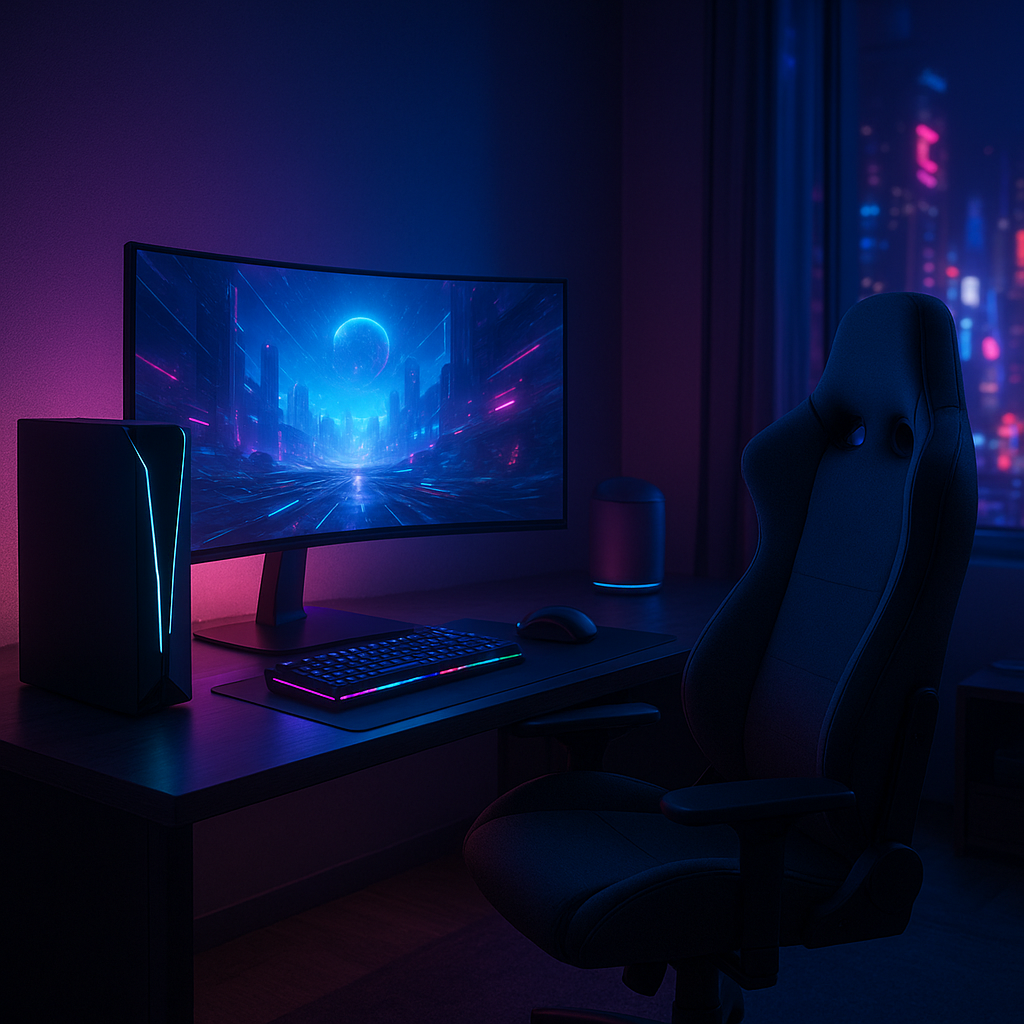
The Dawn of a New Gaming Epoch: Hardware as the Ultimate Enabler
In a sunlit gaming studio in Seoul, a professional esports player adjusts her custom-built rig, primed to compete in the 2026 World Cyber Games. Her setup, a carefully calibrated ensemble of the latest GPU architecture and ultra-responsive peripherals, represents the pinnacle of gaming hardware innovation. This scene, replicated worldwide in gaming dens and competitive arenas, underscores a subtle but profound transformation: the hardware powering games is no longer just a tool but a pivotal driver of the gaming experience itself.
As reported by industry analysts, the global gaming hardware market surpassed $70 billion in 2025, fueled by rising demand for immersive VR peripherals, high-frequency displays, and AI-accelerated GPUs. The stakes have never been higher; gamers demand not only faster frame rates but richer, more tactile interactions that blur the boundaries between virtual and physical worlds. This evolution is redrawing the contours of interactive entertainment, prompting a reassessment of how hardware shapes gameplay, storytelling, and competitive dynamics.
“Gaming hardware today is less about raw power alone and more about crafting a seamless, immersive experience that responds intuitively to players’ actions.” — Dr. Lian Chen, VR hardware specialist
This article explores the forces propelling gaming hardware innovation, from foundational shifts in technology to the emergent trends redefining user engagement in 2026. We will dissect the breakthroughs that are setting new performance benchmarks, analyze market dynamics, and offer expert insights on what gamers and developers should anticipate next.
Tracing the Trajectory: How Gaming Hardware Reached Its Current Pinnacle
The journey of gaming hardware from bulky, single-core processors to today's multi-teraflop behemoths has been marked by relentless innovation and shifting consumer expectations. Initially, the hardware landscape was dominated by incremental improvements in CPU clock speeds and memory capacities. However, the explosion of 3D graphics in the early 2010s catalyzed a paradigm shift, ushering in the era of dedicated graphics processing units (GPUs).
Throughout the 2020s, this trend accelerated with the integration of AI and machine learning directly into hardware components. NVIDIA’s RTX series, for example, pioneered real-time ray tracing combined with AI-driven upscaling, fundamentally enhancing visual fidelity. Meanwhile, AMD's introduction of chiplet designs improved parallel processing efficiency, enabling more cores without significant thermal penalties.
Peripheral hardware has also matured dramatically. Mechanical keyboards with customizable haptics, ultra-low latency wireless mice, and VR headsets with foveated rendering have each contributed to more immersive gameplay. The rise of cloud gaming further pressured hardware manufacturers to optimize for streaming capabilities, balancing local compute power with cloud offloading.
Industry observers note several key milestones that paved the way to today's ecosystem:
- 2016–2020: Introduction of real-time ray tracing and AI-enhanced graphics.
- 2021–2023: Shift towards multi-chip modules and modular GPUs for scalability.
- 2024–2026: Expansion of VR/AR peripherals with ergonomic and sensory innovations.
This progression reflects a broader trend: gaming hardware is no longer a static commodity but a dynamic platform evolving in symbiosis with game design and player expectations. For newcomers seeking guidance, our beginner’s roadmap to winning setups offers a detailed primer on harnessing these technologies effectively.
Analyzing 2026 Hardware Trends: Performance, Immersion, and Sustainability
In 2026, the gaming hardware landscape is defined by three converging themes: unprecedented raw performance, immersive sensory integration, and a growing emphasis on environmental sustainability. Each dimension reflects the industry's response to both technological possibilities and societal imperatives.
Performance breakthroughs continue to push the envelope. Leading GPU models, such as NVIDIA’s H2 series and AMD’s Radeon Xtreme 9000, now deliver upwards of 100 teraflops of compute power, enabling real-time 8K rendering at high frame rates. These advances have enabled developers to create expansive open worlds with complex physics and AI behaviors without compromising responsiveness.
On the immersion front, the integration of multisensory feedback has transformed gaming interactions. Haptic suits with micro-vibration arrays provide tactile sensations corresponding to in-game events, while advanced eye-tracking and brain-computer interface prototypes are beginning to surface in the consumer space. These devices offer more intuitive control schemes and foster deeper emotional engagement.
Sustainability has become a core design principle. The industry's carbon footprint concerns have prompted manufacturers to innovate in power efficiency and recyclable materials. For instance, the new generation of GPUs uses advanced silicon photonics to reduce energy consumption by 40% compared to 2024 models. Meanwhile, companies like Corsair and Logitech have introduced modular peripherals designed for easy upgrading and repair to minimize e-waste.
“The future of gaming hardware hinges on balancing blistering performance with responsible environmental stewardship.” — Maya El-Sayed, Lead Engineer at GreenTech Gaming
Here’s a snapshot of key 2026 hardware innovations shaping the market:
- AI-accelerated GPUs: Enhanced real-time ray tracing and physics simulation with dedicated AI cores.
- Multisensory peripherals: Haptic feedback suits, adaptive controllers, and immersive audio devices.
- Energy-efficient architectures: Silicon photonics and chiplet modularity to optimize power usage.
- Cloud-hybrid consoles: Seamless integration between local hardware and cloud processing.
These developments are not merely incremental; they represent a qualitative leap in how hardware supports complex, living game worlds and the players inhabiting them.
Voices from the Frontlines: Industry Experts Weigh In
To understand the implications of these hardware advancements, we interviewed several key figures shaping the gaming hardware ecosystem. Their perspectives highlight the intersection of technology, user experience, and market forces.
Dr. Lian Chen, a veteran VR hardware specialist, emphasizes the importance of user-centric design:
“Hardware innovation must prioritize ergonomics and intuitive interaction. The best technology is invisible to the player, seamlessly augmenting their agency.”She notes that companies investing in R&D for lightweight, wireless VR systems are setting new standards for player comfort and immersion.
Marcus Feldman, CTO of a leading esports hardware manufacturer, underscores competitive gaming demands:
“Latency and precision are non-negotiable in esports. Our focus is on ultra-low latency wireless connectivity and adaptive refresh rate displays that react to player input in milliseconds.”His firm’s latest mouse and keyboard combos are widely adopted in professional circuits, proving that hardware choices can directly influence competitive outcomes.
Maya El-Sayed articulates the environmental challenge: “Sustainability is no longer optional. We are pioneering new materials and power-saving techniques that reduce the lifecycle impact of gaming rigs without sacrificing performance.” Her company’s modular gaming desktop won the 2025 Green Innovation Award.
Collectively, these insights reveal a complex balancing act. Hardware developers must simultaneously deliver technical excellence, user comfort, and environmental responsibility — a triad that will define the next decade.
For readers interested in mastering these cutting-edge setups, our article on pro tips for ultimate performance and longevity offers in-depth strategies to optimize hardware investments.
Future Horizons: What’s Next for Gaming Hardware?
Looking ahead, several emergent technologies and market trends promise to further revolutionize gaming hardware. Developers and gamers alike should watch for these innovations shaping the medium’s future.
1. Brain-Computer Interfaces (BCIs): Though still nascent, consumer-grade BCI devices that translate neural activity into controls are expected to become more accessible by 2028. This shift could redefine input paradigms, enabling hands-free gameplay and new immersive narratives.
2. Heterogeneous Compute Platforms: The fusion of CPUs, GPUs, AI accelerators, and custom ASICs into unified chips will enhance efficiency and enable increasingly complex simulations, AI-driven NPCs, and procedural content generation.
3. Advanced Materials and Cooling: Innovations in graphene-based thermal management and phase-change materials will allow hardware to sustain higher clocks without overheating, extending lifespan and performance.
4. Edge Computing and 5G/6G Networks: The synergy of ultra-fast networks and edge compute nodes will diminish latency in cloud gaming, making high-end experiences accessible on thin clients and mobile devices.
“The convergence of AI, neuroscience, and materials science heralds a new chapter where gaming hardware transcends traditional boundaries.” — Industry analyst, Elena Morozova
Gamers and developers should embrace continual learning and adaptability. As hardware complexity grows, so too does the potential for tailored, personalized experiences that transcend current limitations.
In sum, gaming hardware is no longer a mere backdrop but an active participant in crafting the interactive worlds of tomorrow. To explore foundational concepts and guidance on building your own system, consider our comprehensive guide to first gaming hardware setups, which demystifies the path from basics to performance tuning.
Conclusion: Hardware as the Heartbeat of Gaming Innovation
The evolution of gaming hardware is a testament to human ingenuity and the relentless pursuit of deeper engagement. From the early days of pixelated displays to today’s hyper-realistic, multisensory environments, hardware advancements have continually expanded the possibilities of play.
As this article has shown, 2026 is a watershed year where performance, immersion, and sustainability converge. The insights from leading experts and the analysis of emerging trends illustrate a vibrant ecosystem poised for transformative growth. Gamers, developers, and industry stakeholders stand at the threshold of a new era where hardware innovation will shape not just how games look or run but how they feel and connect us.
For those ready to harness these advances, TheOmniBuzz offers a wealth of resources tailored to all skill levels, ensuring that the future of gaming hardware is accessible, exciting, and empowering.