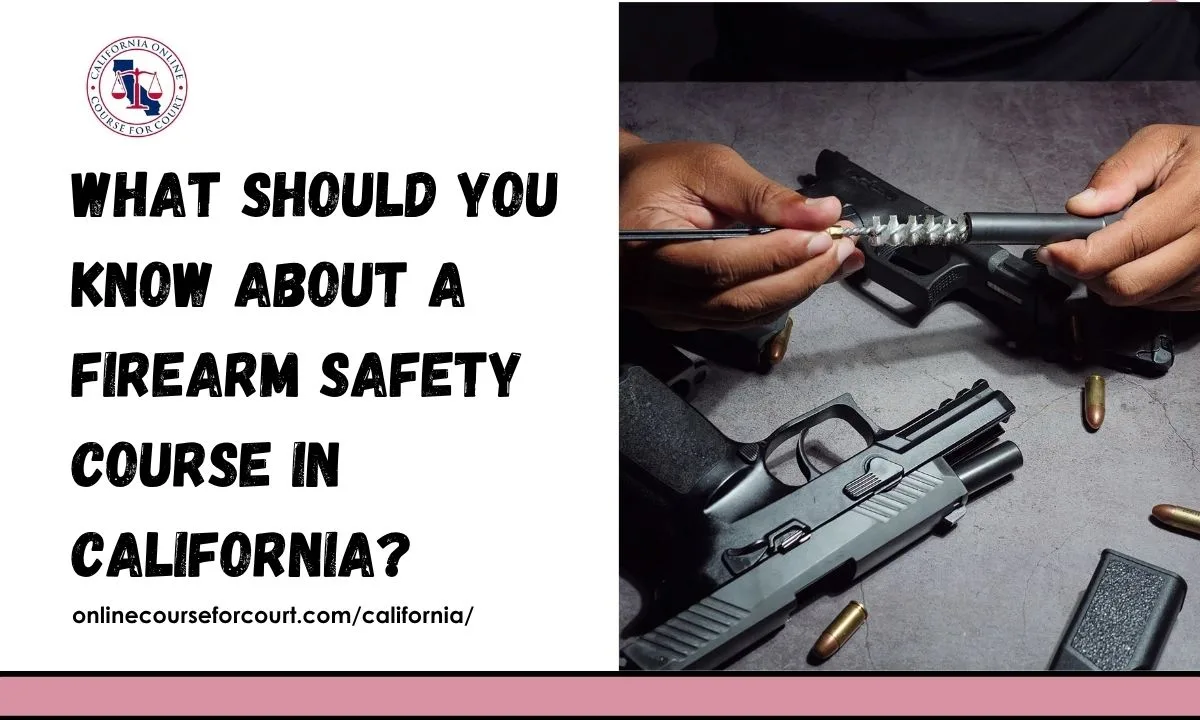
A Firearm Safety Course in California can provide education about safe handling, storage, legal responsibilities, and responsible decision-making. If a judge orders a firearm-related class, follow the exact course type, hours, deadline, and certificate instructions written in your court order or probation terms.
Why Might Someone Need a Firearm Safety Course in California?
A firearm-related court case can leave people unsure about what they are actually required to do. A judge may include educational requirements as part of probation, sentencing, diversion, or another legal agreement.
A Firearm Safety Course in California may be relevant when the written court requirement specifically calls for firearm safety education. However, the wording matters. A requirement for firearm safety is not automatically the same as California's separate Firearm Safety Certificate program.
This distinction is important because completing the wrong type of course can create unnecessary delays. Before enrolling, read the court order carefully and identify the exact course name, required number of hours, completion deadline, and documentation required by the court.
Court-ordered classes are generally educational programs intended to promote accountability, awareness, rehabilitation, and safer future decisions. The goal is not simply to finish a checklist. The education may also help a participant understand how safer choices can prevent another legal problem.
Does California Law Automatically Require a Court-Ordered Firearm Safety Class?
No. California does not have one statewide statute saying that every person involved in a firearm-related court case must complete the same firearm safety class.
The requirement usually comes from the specific circumstances of the case and the court's order. A judge may impose reasonable probation conditions when authorized by law. California Penal Code Section 1203.1 gives courts authority to impose conditions of probation and other reasonable conditions directed toward justice, accountability, and rehabilitation.
This means the exact requirement can vary between cases. One person may receive a firearm-related educational condition, while another person with a different case may receive a different condition.
The safest approach is simple: treat the written court order as the starting point. If the wording is unclear, ask the court clerk, probation department, defense attorney, or public defender what documentation is required before enrolling.
Is a Firearm Safety Course the Same as California's Firearm Safety Certificate?
No. These terms describe different things, and confusing them can cause problems.
California's Firearm Safety Certificate, commonly called an FSC, is connected to firearm purchase and acquisition requirements. The California Department of Justice explains that, subject to exemptions, a person generally must have a valid FSC before purchasing or acquiring a firearm.
The FSC program involves a test covering firearm safety and basic firearm laws. The California DOJ states that an applicant must score at least 75 percent on the FSC test.
A court-ordered educational course is different. It may be assigned as a condition of probation, diversion, sentencing, or another legal requirement. It does not automatically replace the FSC requirement, and having an FSC does not automatically satisfy a court order requiring a separate educational class.
Understanding this difference is one of the most important steps before choosing a program.
What Does a Firearm Safety Course in California Usually Teach?
A Firearm Safety Course in California used for educational purposes may cover several areas connected with responsible firearm awareness.
The exact curriculum depends on the provider and the court requirement. Common educational subjects can include safe handling principles, secure storage, transportation considerations, legal responsibilities, accident prevention, responsible decision-making, and understanding the risks associated with firearms.
A useful course should explain safety concepts in clear language. Someone completing a court requirement should be able to understand why basic safety practices matter rather than simply memorize isolated rules.
The course may also discuss the consequences of unsafe decisions. This can include risks to family members, visitors, children, and other people who may encounter a firearm.
Online education can provide information and awareness, but it should not be confused with live-fire instruction or hands-on firearms proficiency training.
How Does a Court-Ordered Firearm Safety Requirement Usually Work?
If your paperwork requires firearm safety education, the process can usually be approached in several straightforward steps.
- Read the court order carefully. Identify the exact course subject, required hours, deadline, and certificate instructions.
- Confirm unclear requirements. If the wording does not identify the required course or hours, ask your attorney, probation officer, or court before paying for a program.
- Choose a course that matches the order. Do not assume that any firearm-related class will satisfy a specific court requirement.
- Complete the required coursework. Follow the provider's attendance, lesson, quiz, and completion requirements.
- Obtain your completion documentation. Keep the certificate and any other records provided after completion.
- Submit proof as instructed. The court, probation department, attorney, or diversion program may specify how and when the certificate must be submitted.
- Keep a copy for your records. Save your completion certificate until your legal obligation has been fully closed.
The important point is that the court order controls the requirement. Course convenience should come after compliance.
What Should You Check Before Enrolling in a Firearm Safety Course?
Before paying for a course, compare the program with your paperwork.
First, check the number of hours. If your order requires a particular number of hours, do not assume that a shorter course will be accepted simply because the subject appears similar.
Next, check the format. Some requirements may allow online education, while others may require a specific provider, classroom setting, or instructor.
Then check the certificate. Find out what information appears on the completion document and whether your court requires the certificate to be sent directly to a particular office.
Finally, check the deadline. Completing the course after the deadline can create a separate compliance issue even if the course itself is appropriate.
If you are unsure, confirm the requirement before enrolling. A short phone call can prevent the expense and frustration of taking the wrong class.
What Is the Difference Between a Firearm Safety Course and a Weapon Safety Course?
A firearm safety course generally focuses specifically on firearms and the responsibilities connected with them. A weapon safety course can have a broader educational scope.
For example, a broader weapon program may discuss firearms alongside other weapons, safe decision-making, conflict avoidance, responsible conduct, and legal awareness.
The correct choice depends on your court paperwork. If the order specifically names firearm safety, do not automatically substitute a broader weapon course.
If the court order instead calls for a weapon safety course, the broader subject may be more appropriate.
For people whose paperwork specifically calls for firearm education, the Firearm Safety Course in california is the more directly matched course title.
Can You Complete a Firearm Safety Course Online?
Yes, online education may be available when the court requirement permits an online format.
Online learning can be useful for people who work full-time, have family responsibilities, or live far from a classroom. A self-paced format can also make it easier to complete lessons around an existing schedule.
However, online availability does not automatically mean that every court will accept every online program.
The important question is whether the course matches the requirement in your case. If your order specifies a particular provider, classroom format, instructor, or hands-on component, those instructions should be followed.
An online educational course also should not be represented as live firearms training. Reading lessons and completing educational assessments cannot demonstrate physical shooting proficiency.
What Does California's Firearm Safety Certificate Law Actually Require?
California has separate statutory requirements involving the Firearm Safety Certificate.
Under California law, the FSC system applies to firearm purchases and acquisitions, subject to statutory exemptions. The California Department of Justice states that an FSC test covers firearm safety and basic firearms laws.
The DOJ also explains that the FSC test requires a score of at least 75 percent, which is 23 correct answers out of 30 questions.
The certificate is generally valid for five years from the date of issuance.
These requirements are important for understanding California firearm law, but they should not be confused with a judge ordering someone to complete an educational class.
If your court paperwork specifically requires a court-ordered class, ask whether the court wants an FSC, a separate educational course, or another form of documentation.
What Does California Penal Code Section 26850 Have to Do With Firearm Safety?
California Penal Code Section 26850 addresses a safe handling demonstration connected with certain handgun deliveries by firearms dealers.
The statute requires the recipient of a handgun to perform a safe handling demonstration under specified circumstances. The demonstration includes requirements involving muzzle awareness, trigger discipline, and safe handling steps.
This is another example of why legal terminology matters.
A safe handling demonstration under California firearm law is not automatically the same thing as a court-ordered educational class. They serve different legal purposes.
Therefore, someone should not assume that completing a general online class satisfies every firearm-related requirement in California.
The appropriate requirement depends on the transaction, court order, probation condition, or other legal circumstance involved.
Is There a County-Specific Firearm Safety Code Section?
No single county code section universally requires a Firearm Safety Course in California for people with firearm-related court cases.
California firearm purchase and transfer requirements are primarily governed by state law. Court-ordered educational conditions can also depend on the individual case and the court handling it.
Because no county was specified for this guide, it would be misleading to invent a county ordinance or claim that one county code section applies statewide.
For a specific case, the relevant local court may have its own administrative procedures, diversion rules, probation instructions, or documentation requirements. Those local requirements should be checked directly with the court or probation department.
The statewide legal authority is more useful for understanding the basic framework. California Penal Code Section 1203.1 gives courts authority to establish probation conditions, while separate firearm statutes govern issues such as FSC requirements and safe handling demonstrations.
Which Official California Government Sources Should You Check?
The California Department of Justice provides official information about the Firearm Safety Certificate program, firearm laws, testing requirements, exemptions, and related publications.
The California Legislature's official code website provides the statutory language for California Penal Code sections.
For general firearm safety certificate questions, the DOJ is the appropriate starting point. For a court-specific educational requirement, your court order and the court or probation department handling your case remain important.
You can also review the official California Firearm Safety Certificate study materials if you need to understand the state's FSC program.
These government resources are particularly useful because firearm rules can change. Relying on an old social media post or an outdated article can create confusion.
What Should You Do If Your Court Order Is Confusing?
If the court order uses a phrase you do not recognize, do not guess.
Start by identifying the exact words used in the order. For example, “firearm safety,” “weapon safety,” “Firearm Safety Certificate,” and “safe handling demonstration” may refer to different requirements.
Next, ask the issuing court or your attorney what the phrase means in your case.
If the order specifies a number of hours, ask whether that number is mandatory. If it identifies a provider or format, follow that instruction unless the court gives you different guidance.
You can also review other educational requirements carefully. A general guide such as 8 Hour vs 12 Hour vs 16 Hour Court Classes Which One Do You Need? can help explain why matching the required course length matters.
The goal is to complete the requirement correctly the first time.
What Happens After You Finish the Course?
After completing the required education, the next step is usually documentation.
Your provider may issue a certificate showing your name, course title, completion date, and other relevant information. Keep the certificate somewhere safe.
Then check your court order to determine where the proof must go.
Some people may need to provide the certificate to a probation officer. Others may need to submit documentation through a court clerk, attorney, diversion provider, or another designated office.
Do not assume that receiving a certificate automatically closes your obligation.
If the court requires you to submit proof, make sure that step is completed. Keep a copy of everything you submit, along with confirmation of delivery when available.
Can Completing a Firearm Safety Course Restore Firearm Rights?
No. Completing a safety course does not automatically restore firearm possession or purchasing rights.
A safety course is educational. It does not, by itself, erase a conviction, remove a prohibition, restore eligibility, issue a carry permit, or override another restriction on firearm possession.
This distinction is especially important for people whose cases involve a firearm prohibition.
If you are unsure whether you can legally possess or purchase a firearm, speak with a qualified California attorney about your specific circumstances. A course provider cannot determine your individual legal eligibility.
Completing a court-ordered educational requirement and having legal permission to possess a firearm are separate issues.
Why Can Firearm Safety Education Matter After a Court Case?
Firearm safety education can provide an opportunity to understand how unsafe decisions can affect other people.
A court order may be designed not only to impose a consequence but also to encourage accountability and prevent future problems. Education can reinforce the importance of secure storage, careful handling, responsible decision-making, and awareness of legal responsibilities.
For someone already dealing with legal stress, the process can feel intimidating. Breaking the requirement into manageable steps can make it easier.
Read the order. Confirm the requirement. Complete the correct course. Keep the certificate. Submit the documentation on time.
Those simple steps can reduce avoidable confusion while keeping attention on the actual legal requirement.
What Should You Remember Before Choosing a Firearm Safety Course?
The most important point is to match the course to your paperwork.
A Firearm Safety Course in California may be useful for a court-ordered educational requirement, but it should not automatically be treated as the state's Firearm Safety Certificate program.
California has separate firearm laws concerning FSC testing, firearm purchases, safe handling demonstrations, and other requirements. Courts can also impose probation conditions based on the circumstances of an individual case.
If you are unsure what your order requires, confirm it before enrolling.
Taking the correct class, completing the required hours, and submitting proof by the deadline can help you move through the educational part of your legal obligation with fewer surprises.
Frequently Asked Questions About a Firearm Safety Course in California
Is a Firearm Safety Course in California the same as an FSC?
No. An FSC is tied to California firearm purchase requirements.
Can a court order a firearm safety class?
Yes. A judge may impose reasonable educational probation conditions.
Does California have one county code for firearm safety classes?
No. There is no single county code applying statewide.
Can I take a firearm safety course online?
Yes, if your court requirement permits online education.
Does a safety course restore firearm rights?
No. Course completion does not automatically restore firearm rights.
Is Penal Code Section 26850 a court-class requirement?
No. It addresses handgun safe handling demonstrations at delivery.
Should I confirm the course before enrolling?
Yes. Match the course, hours, format, and deadline to your order.