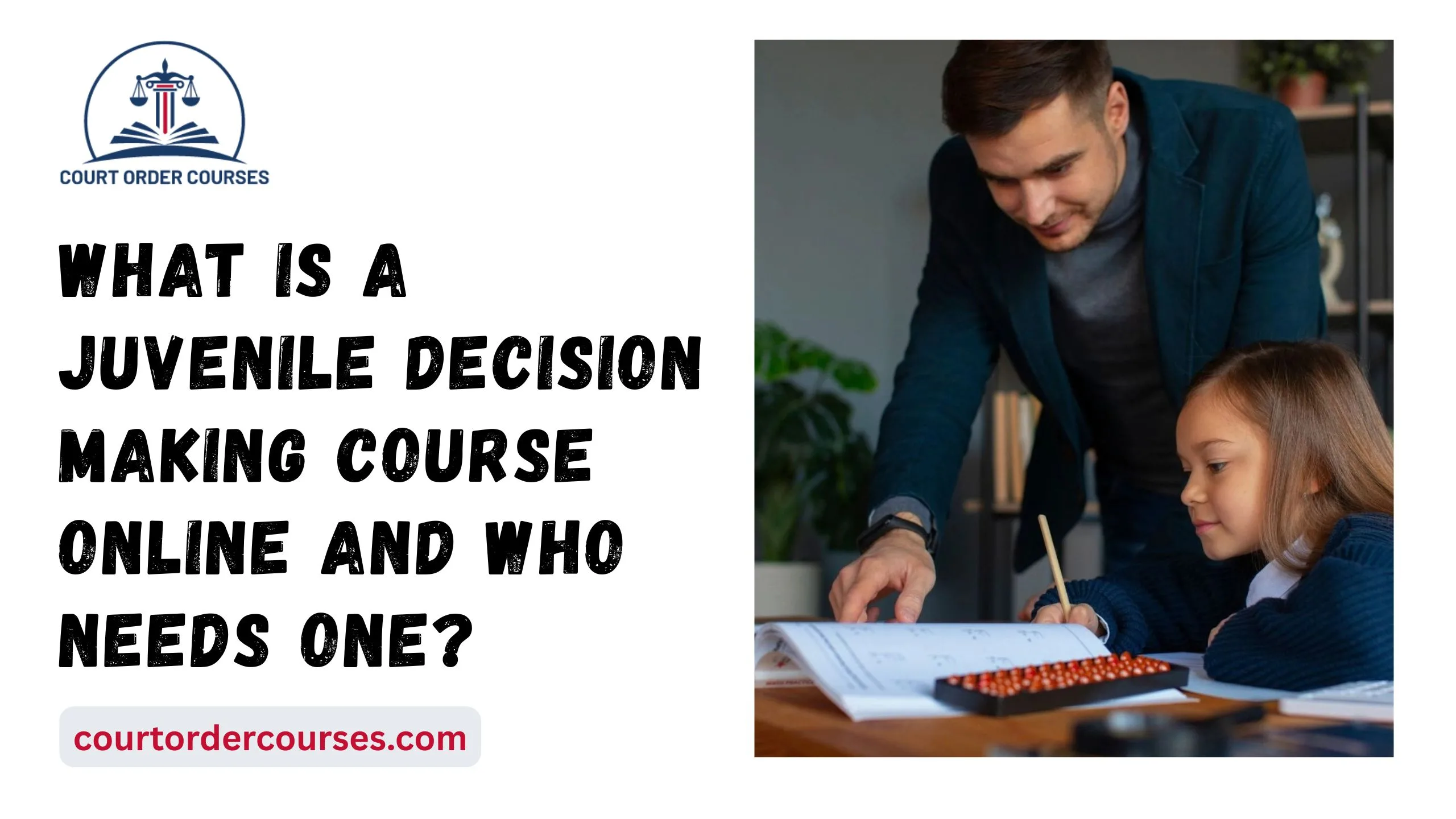
A juvenile decision making course online helps young people understand consequences, manage peer pressure, and develop better judgment. It may be required through a court, probation, diversion program, school, or another referring authority. The exact course length and requirements depend on the individual case and local program.
What Is a Juvenile Decision Making Course Online?
A juvenile decision making course online is an educational program created to help young people think more carefully about their choices and understand how decisions can affect their future. These courses commonly address accountability, consequences, peer influence, emotional control, communication, problem-solving, and responsible behavior.
For families dealing with a court-related requirement, the situation can feel stressful. Parents may not know what the course involves, how long it takes, or whether an online format is appropriate. The first step is to read the court order, diversion paperwork, probation instructions, or referral document carefully.
A Juvenile Decision Making Course can provide a structured way for a young person to work through these topics without attending a traditional classroom. Online programs may also allow participants to complete lessons around school and family responsibilities.
Why Might a Teenager Be Required to Take a Juvenile Decision Making Course Online?
A young person may be referred to a decision-making program after a juvenile case, diversion referral, probation requirement, school disciplinary matter, or another situation involving behavior and responsibility.
The purpose is generally educational rather than simply punitive. The lessons can encourage a teenager to slow down before making a decision, recognize possible consequences, and consider how choices affect other people.
Requirements vary significantly between jurisdictions. A course that is used in one local program may not be required in another. For that reason, parents should not assume that every juvenile case has the same educational conditions.
The best source for the specific requirement is the paperwork connected to the case or the authority that made the referral.
What Does a Juvenile Decision Making Course Teach?
A juvenile decision making course online usually focuses on practical situations that young people may recognize from everyday life. Instead of only explaining rules, the material can encourage participants to think about what happens before, during, and after a difficult choice.
Common subjects include understanding consequences, handling peer pressure, controlling emotional reactions, accepting responsibility, setting goals, communicating respectfully, and solving conflicts.
The goal is to help a young person develop a more thoughtful approach to decisions. A teenager may learn to identify a problem, consider different choices, think about possible outcomes, and select a response that is less likely to create additional problems.
These skills can be useful beyond the immediate legal or educational requirement.
How Does Online Decision Making Education Help Young People?
A juvenile decision making course online can give participants an opportunity to work through lessons at a manageable pace. This can be helpful when a teenager is already dealing with school, family responsibilities, appointments, or other obligations.
Online learning can also give participants time to reread material and consider questions before moving forward. A self-paced format may be less intimidating for someone who is uncomfortable discussing a legal or behavioral situation in a classroom.
The educational value comes from the subject matter, not simply from being online. The course should provide clear lessons that relate to decision-making, responsibility, consequences, and behavior.
Parents should still confirm that the selected format and course length match the actual requirement before enrollment.
Who Usually Takes a Juvenile Decision Making Course Online?
The people who take a juvenile decision making course online can vary depending on the reason for the referral. Some participants may have received a court or probation requirement. Others may be involved in a diversion program or school-related intervention.
The course may also be used by families who want their teenager to develop stronger decision-making skills without waiting for a serious problem to occur.
The important distinction is between voluntary education and a legal requirement. If the course was specifically ordered or assigned, the participant must follow the instructions attached to that requirement.
A parent should not assume that completing a general online class automatically satisfies a particular court or diversion condition.
What Skills Can a Teen Develop Through a Juvenile Decision Making Course?
A juvenile decision making course online can address several skills that are important during adolescence. Young people often face situations where emotions, friends, social pressure, or a desire to act quickly can influence their choices.
Decision-making lessons can encourage a participant to pause before reacting and consider what may happen next. They can also explain the difference between an immediate reaction and a deliberate decision.
Other areas may include communication, goal setting, emotional awareness, responsibility, conflict resolution, and recognizing negative influences.
These lessons are not intended to replace legal advice, counseling, or other professional services. They are educational tools designed to encourage more responsible thinking.
How Does Peer Pressure Affect Juvenile Decision Making?
Peer pressure can make an otherwise simple decision more difficult. A teenager may understand that something is risky but still feel pressure to participate because friends are involved.
A juvenile decision making course online can help participants recognize these situations before they become serious. Lessons may discuss how to identify pressure, communicate boundaries, leave uncomfortable situations, and think independently.
The objective is not to blame friends or assume that every social situation is harmful. Instead, young people can learn that they remain responsible for their own decisions even when other people are encouraging a particular action.
Learning how to pause and evaluate a situation can make it easier to avoid decisions made only because of social pressure.
How Do Consequences Fit Into a Juvenile Decision Making Course?
Understanding consequences is an important part of decision-making education. Young people may focus on what feels important in the moment without fully considering what could happen afterward.
A juvenile decision making course online can use realistic situations to demonstrate how one choice can lead to several different outcomes. The discussion may involve school, friendships, family relationships, personal safety, or legal consequences.
The purpose is not to frighten participants. It is to encourage them to consider both short-term and long-term effects before acting.
When a teenager understands that decisions can affect other people as well as themselves, it becomes easier to view responsibility as part of everyday life rather than simply a court requirement.
What Topics Should Parents Look for in an Online Course?
Parents comparing a juvenile decision making course online should look at the actual curriculum rather than relying only on the course title.
Useful subject areas can include consequences, peer pressure, emotional control, accountability, communication, conflict resolution, problem-solving, and long-term goal setting.
The course should also be presented in language that young people can understand. Practical examples can make educational material easier to connect with real situations.
Parents should also check the course duration, completion requirements, certificate information, and any instructions concerning submission of proof.
Most importantly, the course should correspond with the requirement given by the court, probation officer, diversion program, or other referring authority.
How Does a Juvenile Decision Making Course Online Work?
The exact process varies by provider, but the general process is straightforward.
What Should You Do First?
1. Read the requirement carefully.
Check the court order, diversion agreement, probation paperwork, or referral instructions. Look for the course name, required hours, deadline, provider requirements, and certificate instructions.
What Should You Confirm Before Enrollment?
2. Verify the course details.
Make sure the online format, course duration, and completion method fit the stated requirement. If anything is unclear, contact the authority responsible for the case before enrolling.
What Happens After You Register?
3. Complete the assigned lessons.
Work through the educational material and any quizzes, questions, or activities required by the course.
What Happens When the Lessons Are Finished?
4. Complete the final requirements.
Follow the provider's instructions for completing the course and obtaining the completion record.
What Should You Do With the Certificate?
5. Submit proof as instructed.
Keep a copy of the certificate and follow the court, probation, or diversion program's instructions for submitting proof of completion.
How Long Does a Juvenile Decision Making Course Online Take?
There is no single length that applies to every juvenile program. The required number of hours can depend on the individual case, jurisdiction, diversion program, probation requirement, or referring authority.
Court Order Courses currently provides several course-duration options, ranging from shorter programs to longer formats. The correct option should be based on the requirement rather than simply choosing the shortest available course.
That article explains why course lengths can differ and why the paperwork for the individual case matters.
Can a Juvenile Decision Making Course Be Completed at Home?
In many situations, an online program can be completed from home using a computer or compatible device. This can be convenient for families that need to work around school schedules or other responsibilities.
However, the fact that a course is available online does not automatically mean that it satisfies every local requirement.
A juvenile decision making course online should be compared with the actual instructions provided to the participant. If the paperwork specifies a particular provider, program, duration, or format, those instructions should be followed.
When the paperwork does not clearly explain the requirements, contacting the referring authority before paying for a course is the safest approach.
What Does Texas Law Say About Juvenile Diversion Programs?
Texas has a statewide legal framework for youth diversion. Current Texas law provides that youth diversion strategies can include educational programs, rehabilitation programs, and self-improvement programs involving areas such as self-responsibility, life skills, violence avoidance, anger management, wellness, and dispute resolution. The statute also allows a youth diversion plan to be created for a county, municipality, or individual court.
This is important because it shows why juvenile requirements can vary locally. State law provides the framework, while individual courts and local programs can develop their own youth diversion plans.
The relevant current Texas provisions are found in Texas Code of Criminal Procedure Chapter 45A, including Articles 45A.505 and 45A.506. The official Texas Legislature source should be used when checking the current statutory language.
The law does not establish one universal statewide number of hours for every juvenile decision-making course.
Does Every County Have the Same Juvenile Course Requirement?
No. Local juvenile programs can operate under different requirements.
Texas law specifically allows youth diversion plans to be developed for a county or municipality or for an individual court within a county or municipality.
That means a family should be careful when reading information about another county. A course requirement described on one county's website may not apply to a different county.
Because no specific county was identified for this article, no county-specific course requirement or county code section is being presented as though it applies nationwide. This avoids giving parents an incorrect legal requirement.
For a particular case, the court order, diversion agreement, probation instructions, or local juvenile program should control.
Is There a County Code Section for Every Juvenile Decision Making Course?
No. A specific county code section should not be invented when none has been identified.
A juvenile decision-making requirement may come from a court order, diversion agreement, youth diversion plan, probation condition, or local program rather than from a county ordinance specifically naming a course.
This distinction matters for families searching online. Seeing the words "juvenile decision making" on a course website does not establish that a county has legally required that exact course.
If a county is named in the actual case paperwork, parents can use that information to locate the applicable local program and verify its instructions.
What Should Parents Check Before Choosing an Online Course?
Before enrolling in a juvenile decision making course online, parents should compare the course information with the requirement they received.
Start with the number of hours. Then check whether the paperwork identifies a specific provider or type of program. Look at the deadline and determine how proof of completion must be submitted.
It is also worth checking whether the course is self-paced, what devices can be used, whether the participant must complete quizzes, and when the certificate becomes available.
If the requirement is unclear, asking the responsible authority first can prevent an unnecessary purchase or the completion of a course that does not match the case.
What If the Court Paperwork Does Not Clearly Name a Course?
If the paperwork does not clearly identify the course, do not guess.
A parent or guardian can contact the probation officer, diversion coordinator, court office, juvenile services department, or attorney handling the matter and ask what type of course is required.
Questions about the required number of hours, online versus in-person format, provider restrictions, deadlines, and certificate submission can usually be answered by the authority responsible for the requirement.
This is especially important when several online programs use similar names. The safest choice is the one that matches the actual instructions for the case.
Can Parents Help With a Juvenile Decision Making Course Online?
Yes. Parents can often help their teenager stay organized and complete the course on time.
A parent can help create a study schedule, make sure the teenager has access to a suitable device, and remind the participant about deadlines. Parents can also help review the course instructions and certificate submission requirements.
The participant should complete the required educational work personally. Parents should not complete quizzes, assignments, or other required activities on the teenager's behalf.
The purpose of the course is for the young person to engage with the material and demonstrate completion.
What Happens After a Juvenile Finishes the Course?
After completing the required lessons and any final assessment, the participant should follow the provider's instructions for receiving the completion record.
If a certificate is issued, keep a digital and printed copy when practical. Then follow the instructions from the court, probation officer, diversion program, or other authority regarding submission.
Completing the course may satisfy one part of a larger requirement, but it does not necessarily mean that the entire juvenile case is finished.
Other conditions may still need to be completed. Families should therefore keep track of every requirement separately.
What If the Teenager Misses the Course Deadline?
Contact the responsible authority as soon as possible rather than waiting.
A course provider generally cannot decide whether a court or diversion deadline can be extended. That decision belongs to the authority responsible for the case.
If a teenager is having difficulty completing the course because of school, family circumstances, technical problems, or another issue, explaining the situation promptly may provide a clearer path forward.
Keep records of communications and follow any new instructions that are provided.
Why Is Choosing the Correct Course Important?
Choosing the correct course matters because juvenile requirements are case-specific.
Two teenagers in the same state could have different requirements because their cases involve different courts, diversion programs, probation conditions, or local procedures.
A juvenile decision making course online can be convenient and educational, but convenience should not be the only factor used when selecting one.
The number of required hours, format, deadline, provider instructions, and certificate requirements should all be considered before enrollment.
Taking a few minutes to verify these details can save time and reduce stress later.
What Should You Remember About Juvenile Decision Making Courses?
A juvenile decision making course online can help a young person develop stronger judgment, understand consequences, and think more carefully before making difficult choices. For families dealing with a legal or diversion requirement, the course can also be one part of a larger compliance process.
There is no universal course requirement that applies to every juvenile case. Local rules and individual case conditions can differ.
In Texas, current youth-diversion law permits educational and self-improvement strategies and allows local youth diversion plans for counties, municipalities, and individual courts.
Because no county was specified here, no county-specific code section has been presented as a universal requirement. Before enrolling, check the actual paperwork and confirm the course requirements with the authority handling the case.
Frequently Asked Questions About a Juvenile Decision Making Course Online
Is a Juvenile Decision Making Course available online?
Yes. Online options are available, but requirements vary by case.
Is there one required course length for every juvenile?
No. Course length depends on the specific requirement.
Can a teenager complete the course from home?
Yes. Online programs can often be completed remotely.
Does Texas law set one course length?
No. Texas law does not establish one universal course length.
Does every county have the same requirements?
No. Local diversion plans and case conditions can differ.
Should parents verify the course before enrolling?
Yes. Confirm the provider, hours, format, and deadline first.
Does finishing the course automatically close the case?
No. Other court or diversion requirements may still apply.