Data privacy has moved from a background concern to a daily operational question for businesses in India. The Digital Personal Data Protection (DPDP) Act, 2023 sets out obligations for organisations that collect and process digital personal data, along with the rights of the individuals whose data they handle, known as Data Principals. Meeting those obligations is harder than it sounds once personal data is spread across websites, mobile apps, customer databases, HR systems, and third-party vendors.
That is where a DPDP Compliance Platform comes in. These tools bring consent management, privacy requests, data governance, and compliance records into one system, so teams are not chasing information across spreadsheets and inboxes. This article looks at ten platforms that Indian businesses may consider, and explains what to check before choosing one.
What Is a DPDP Compliance Platform?
A DPDP Compliance Platform is software that helps an organisation run its data protection and privacy work. What it covers depends on the product, but most tools handle some combination of consent, privacy requests, personal data tracking, and record-keeping.
Common capabilities include:
- Consent collection and management
- Consent withdrawal workflows
- Data Principal rights management
- Personal data discovery and mapping
- Privacy request management
- Grievance handling
- Cookie and tracker management
- Compliance documentation
- Audit trails and activity logs
- Privacy reports and monitoring
Feature sets vary a lot between vendors. Two tools may both claim "consent management," yet one might only handle website banners while the other links consent to backend data systems. It pays to test each platform against your own processes rather than relying on product labels.
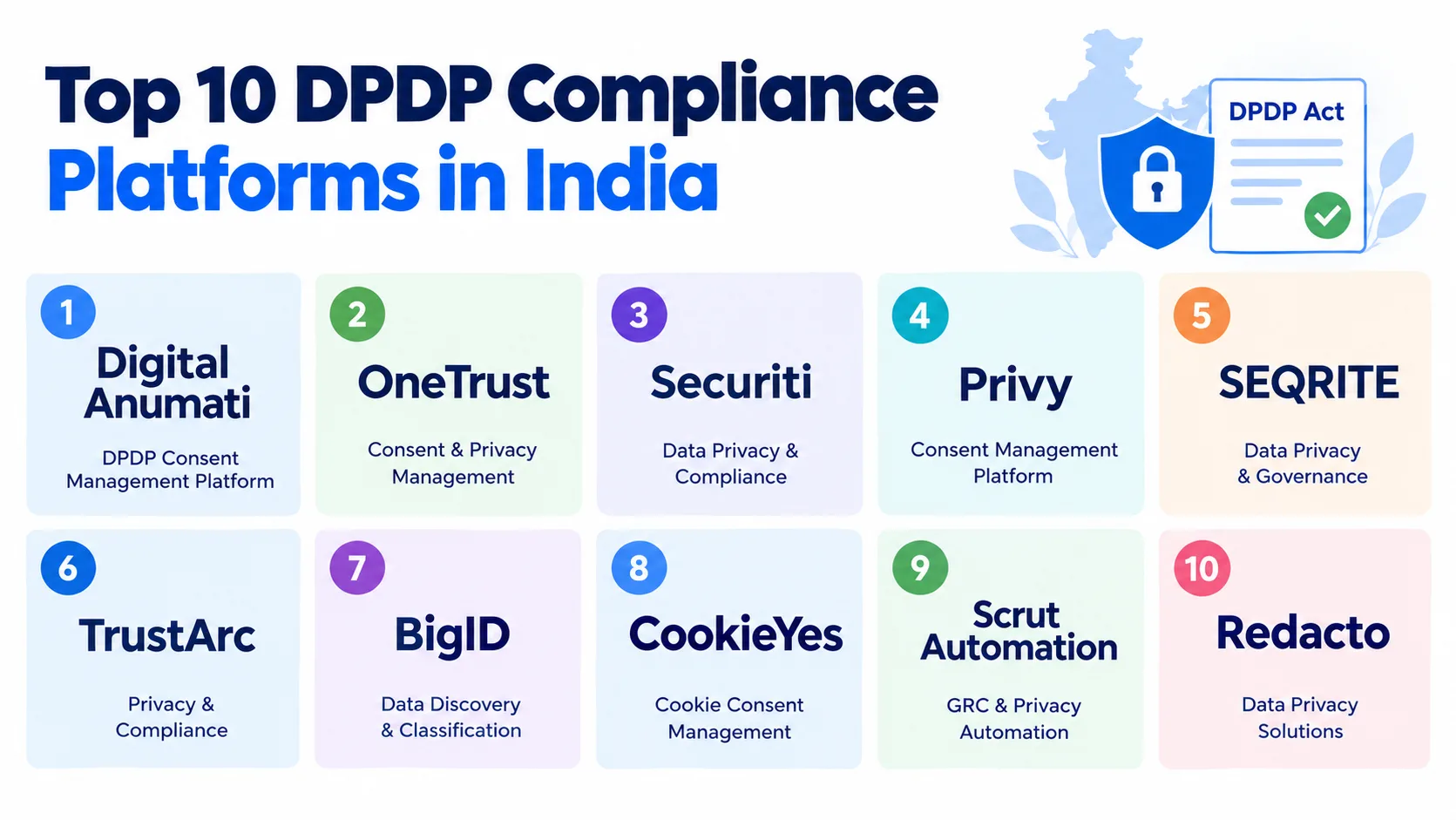
Top 10 DPDP Compliance Platforms in India
1. Digital Anumati
Digital Anumati is a DPDP Compliance Platform built with the Indian market in mind. It brings consent management, consent withdrawal, Data Principal rights handling, personal data discovery, data mapping, grievance handling, cookie and tracker governance, and audit trails into one centralized tool.
One feature the vendor highlights is support for more than 22 Indian languages, which can help businesses prepare privacy notices and consent screens for users who prefer different languages. The platform also offers APIs, SDKs, and integration options for connecting privacy workflows with existing websites, apps, and internal systems.
According to the vendor, the platform is aimed at sectors that handle large volumes of personal data, including banking, financial services and insurance (BFSI), healthcare, and education. Businesses should confirm specific capabilities and language coverage directly with the provider.
2. OneTrust
OneTrust is a global privacy management platform covering consent management, privacy operations, data governance, risk management, and regulatory compliance. Its breadth makes it a fit for organisations that need to coordinate privacy work across several countries and regulatory regimes.
For a business with operations both inside and outside India, OneTrust can serve as a broader framework for managing privacy programmes across markets. Teams with a narrower, India-only scope may find the range more than they need, so it is worth checking whether the scale matches the requirement.
3. Securiti
Securiti offers solutions for data privacy, security, governance, and data intelligence. Its focus is on finding and managing personal and sensitive information across complicated technology environments.
Because it combines data visibility with privacy workflows, Securiti can help businesses see how their data moves and is stored, which then supports more structured privacy operations. It is most worth evaluating for organisations with large data footprints spread across cloud platforms, databases, and business applications.
4. Privy by IDfy
Privy by IDfy is a privacy management solution for handling data protection activities and privacy operations. Its capabilities include consent management, personal data management, privacy workflows, and compliance processes.
It is a reasonable option for Indian businesses that want to organise privacy requirements and manage personal data in a more systematic way. As with any shortlisted tool, the details of coverage should be checked against your own requirements.
5. Seqrite Data Privacy
Seqrite Data Privacy is part of the wider Seqrite cybersecurity ecosystem, which centres on information security and data protection. The main appeal is for organisations that want their privacy and security functions to work from a single governance approach.
Businesses considering it should look closely at the privacy management features and integration options, then compare them against their specific DPDP obligations. Being part of a larger security suite does not automatically mean every privacy function is covered.
6. TrustArc
TrustArc is a privacy management platform that supports privacy programme management, risk assessments, compliance activities, and regulatory requirements. It suits organisations that need to coordinate privacy across different business units, systems, and jurisdictions.
For businesses running complex privacy programmes, TrustArc's assessment and governance tools are worth reviewing. Smaller teams may want to weigh how much of the programme structure they actually need to maintain.
7. BigID
BigID focuses on data discovery, data classification, privacy, and data intelligence. Its strength is locating where personal and sensitive information sits across databases, cloud environments, applications, and other data sources.
That visibility feeds directly into data mapping, privacy risk management, and wider governance work. BigID is most relevant for businesses that do not yet have a clear picture of where their personal data lives, since mapping that landscape is often the first real step in any compliance effort.
8. CookieYes
CookieYes primarily provides website cookie consent and privacy management. Its features include cookie banners, consent preference management, consent records, and other website-focused tools.
For businesses whose main concern is visitor consent on their websites, CookieYes can be a practical part of the privacy setup. It does not, however, cover the full scope of DPDP obligations on its own. Organisations should check whether its capabilities extend to the rest of their requirements, such as Data Principal requests and backend data mapping, or whether they will need additional tools.
9. Scrut Automation
Scrut Automation provides security and compliance automation for managing controls, evidence, risks, and compliance workflows. Its scope goes beyond privacy into broader governance, risk, and compliance activities.
Companies that want to manage security controls and compliance documentation in one structured system may find it useful as part of a wider compliance framework. Before committing, confirm which privacy-specific requirements it supports, since its core strength lies in the compliance side rather than privacy operations alone.
10. Redacto
Redacto is a privacy-focused solution aimed at helping organisations structure their personal data protection and privacy management work. Businesses exploring privacy software can assess whether its capabilities fit their data protection processes and compliance workflows.
As with any platform on this list, it should be reviewed on its features, integrations, and suitability for your operating environment before a decision is made.
Why Do Businesses Need a DPDP Compliance Platform?
As a company grows, personal data tends to spread. It gets collected by marketing, processed by operations, stored in HR systems, and shared with vendors, often without anyone holding a complete map of it.
Managing all of this through separate spreadsheets, email threads, and disconnected tools makes it hard to keep records accurate or to apply the same process everywhere. A missed consent withdrawal or a slow response to a Data Principal request can easily go unnoticed in that kind of setup.
A DPDP Compliance Platform puts these activities into one place. Depending on the product, it may help with:
- Collecting and managing consent
- Processing consent withdrawal requests
- Handling applicable Data Principal requests
- Discovering and mapping personal data
- Maintaining privacy documentation
- Managing website cookies and trackers
- Handling grievances and privacy requests
- Keeping compliance records and audit trails
- Monitoring privacy activity through reports
Centralisation gives teams better visibility, makes coordination easier, and helps privacy processes stay consistent as the business expands. Still, software alone does not make a business compliant. Policies, governance practices, security measures, and day-to-day procedures still need to be in place and followed.
Key Features to Look for in DPDP Compliance Software
Comparing product names is a weak way to choose a tool. A better approach is to start from your own data-processing activities, technical setup, and obligations, and then test platforms against those needs.
1. Consent Management
Look for tools that can collect, record, manage, and process withdrawal of consent, wherever consent is the basis for processing. The platform should connect smoothly with websites, mobile apps, and other digital services, since consent that is captured in one place but not respected in another creates real risk.
2. Data Principal Rights Management
Check whether the platform can receive, assign, track, and respond to applicable requests from Data Principals. A clear workflow helps teams see what is outstanding, who is responsible for it, and what has already been done, with records to show for it.
3. Data Discovery and Mapping
You cannot protect data you have not located. Discovery and mapping tools help build a picture of where personal data is collected, stored, processed, and shared, including which systems and data flows are involved.
4. Audit Trails and Records
A good platform should log relevant privacy activity and workflow events. Audit trails make it possible to review what happened, when it happened, and how a particular request or process was handled, which is often what matters most when questions arise later.
5. Integration Capabilities
Privacy software is only useful if it works with the systems you already run. APIs, SDKs, and plugins help connect privacy workflows to websites, apps, CRM platforms, databases, and internal tools. Ask vendors for specifics about the integrations they support and how much engineering effort each one needs.
6. Multilingual Support
Businesses serving customers across India may find that privacy notices and consent interfaces work better when they are available in more than one language. Multilingual support helps users understand what they are agreeing to, which supports more meaningful consent.
7. Scalability
Privacy requirements tend to grow with the organisation. More users, more applications, and more data sources all add complexity. Choose a platform that can handle your expected growth without making day-to-day privacy work harder than it needs to be.
Conclusion
Handling digital personal data responsibly is now a core concern for businesses operating in India. A DPDP Compliance Platform can bring consent management, Data Principal requests, data discovery, privacy workflows, and audit records into one structured system, which makes ongoing compliance easier to manage.
The right choice depends on your size, industry, technology stack, and the kinds of personal data you process. Compare features, integrations, scalability, language support, and fit with your actual requirements before deciding. And keep in mind that a platform supports compliance without guaranteeing it. Clear policies, sound security practices, trained staff, and steady governance are still what make the difference.
Frequently Asked Questions
Q1. What is a DPDP Compliance Platform?
It is software that helps organisations manage privacy activities such as consent, Data Principal requests, data mapping, and compliance records.
Q2. Why do businesses need a DPDP Compliance Platform?
It helps businesses organise their personal data processes, gain better visibility into what they hold, and rely less on disconnected manual workflows.
Q3. What features should DPDP compliance software include?
Useful features often include consent management, data discovery, privacy request workflows, audit trails, integrations, reporting, and data mapping.
Q4. Is Digital Anumati a DPDP Compliance Platform?
Yes. Digital Anumati is an India-focused DPDP Compliance Platform designed to support consent management and related privacy workflows.
Q5. Can DPDP platforms manage consent withdrawal?
Platforms with suitable consent management features can record, track, and process consent withdrawal requests.
Q6. Can these platforms manage Data Principal requests?
Some privacy platforms include workflows for receiving, assigning, tracking, and managing applicable Data Principal requests. Coverage differs between vendors, so confirm the specifics before buying.
Q7. Do DPDP Compliance Platforms support multiple languages?
Some platforms offer multilingual support for privacy notices and consent screens. The languages available vary by provider.
Q8. Can a DPDP platform integrate with existing business systems?
Many platforms offer APIs, SDKs, plugins, or other integration options for connecting privacy functions to existing websites and applications.
Q9. Does using a DPDP Compliance Platform guarantee compliance?
No. Organisations also need appropriate policies, security measures, contracts, governance processes, and trained staff. Software is one part of a broader compliance programme.
Q10. How should businesses choose a DPDP Compliance Platform?
Compare features, integrations, scalability, language support, data management capabilities, and fit with your specific privacy requirements before choosing a solution.