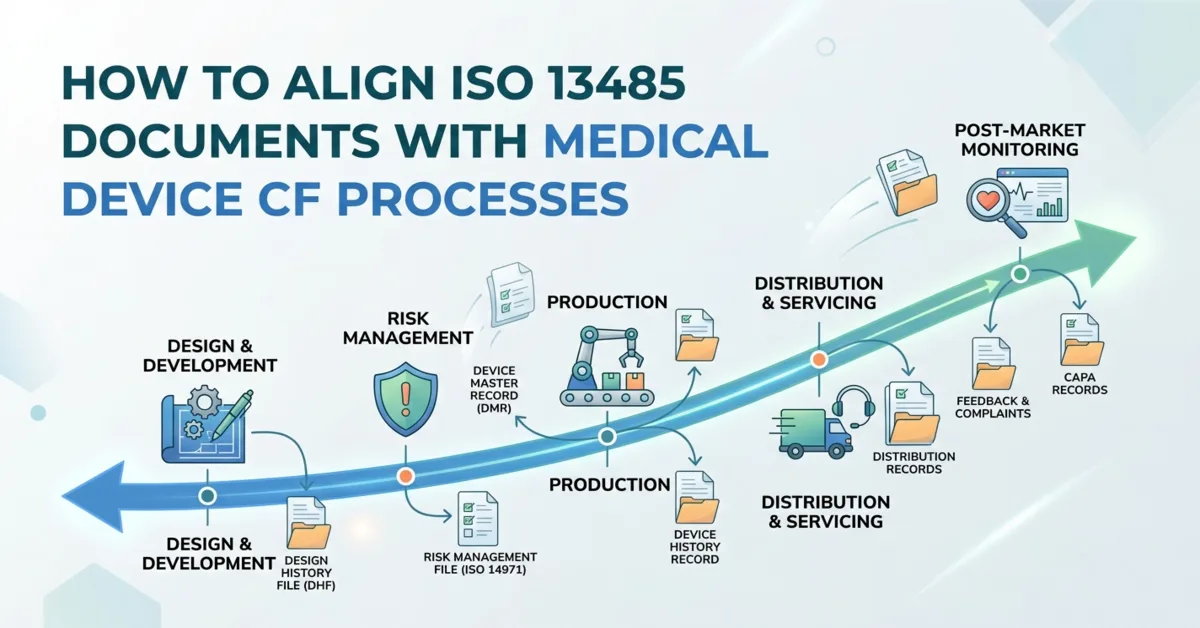
Medical device manufacturers must manage quality, safety, and regulatory requirements throughout a product’s lifecycle. From design and development to manufacturing, distribution, and post-market monitoring, each stage requires appropriate documentation. Aligning ISO 13485 documents with these activities helps maintain process consistency, support traceability, and improve quality management system (QMS) effectiveness.
Why Align ISO 13485 Documentation With the Medical Device Lifecycle?
ISO 13485 specifies QMS requirements for organizations involved in medical devices and related services. Documentation should reflect actual operations rather than exist only to satisfy audit requirements. Connecting documents with lifecycle processes clarifies responsibilities, reduces duplication, and helps identify gaps before they affect product quality or audit readiness.
1. Establish Documentation During Design and Development
Design and development require documented processes for planning, inputs, outputs, reviews, verification, validation, and design changes, as applicable. Design inputs define relevant functional, performance, safety, and regulatory requirements, while outputs provide information needed for production and verification.
Maintaining appropriate records helps demonstrate that development activities were completed as planned and enables teams to trace requirements throughout the design process.
2. Connect Risk Management With Quality Processes
Risk management should be integrated into relevant product and quality activities. Manufacturers need to identify hazards, evaluate risks, implement suitable controls, and assess their effectiveness.
Documentation should connect identified risks with design decisions, production controls, and verification activities. For example, a potential device failure may require updated specifications, work instructions, or inspection criteria. This approach keeps risk management connected to operational decisions rather than treating it as a separate documentation exercise.
3. Align Production and Quality Control Records
During manufacturing, procedures and work instructions help employees perform activities consistently. Depending on the device and process, relevant records may include production specifications, inspection results, equipment maintenance, process validation, and product identification or traceability.
Manufacturers should also control purchasing and externally provided processes. Where a process cannot be fully verified through subsequent monitoring or measurement, validation may be necessary.
Linking documentation to actual production activities supports consistent operations, investigation of nonconformities, and evidence of process control.
4. Maintain Traceability After Product Release
Documentation responsibilities continue after manufacturing. Organizations should maintain applicable records relating to storage, distribution, installation, servicing, customer feedback, and post-market activities.
Complaint handling, corrective actions, and nonconformity management should connect with relevant quality processes. When recurring complaints indicate a possible product issue, manufacturers should evaluate the information, determine appropriate action, and retain supporting records. This helps identify trends and improve product quality and safety.
5. Review and Update Documents Regularly
Document control is essential for maintaining an effective ISO 13485 QMS. Organizations should ensure that documents are reviewed, approved, updated when necessary, and available where they are needed. Obsolete versions must be controlled to prevent unintended use.
Understanding ISO 13485 documentation change control can help manufacturers manage revisions systematically, evaluate their impact, and maintain records of approvals and implementation.
Internal audits and management reviews can further identify outdated procedures, missing records, and differences between documented processes and actual practices.
Simplify ISO 13485 Documentation With Structured Resources
Preparing documentation from scratch can require considerable time and coordination. A structured documentation package provides a starting point for developing a consistent QMS.
The ISO 13485 documents package includes editable MS Word resources covering key QMS requirements, such as a quality manual, procedures, SOPs, forms and templates, and audit checklists. Organizations can customize these resources to reflect their medical device types, operational processes, and applicable regulatory requirements.
Conclusion
Aligning ISO 13485 documentation with medical device lifecycle processes connects design, risk management, production, traceability, and post-market activities within a consistent quality system. Regular reviews and process-based records support effective implementation and audit readiness. Structured documentation resources can reduce preparation effort while helping manufacturers maintain a QMS suited to their operations.