
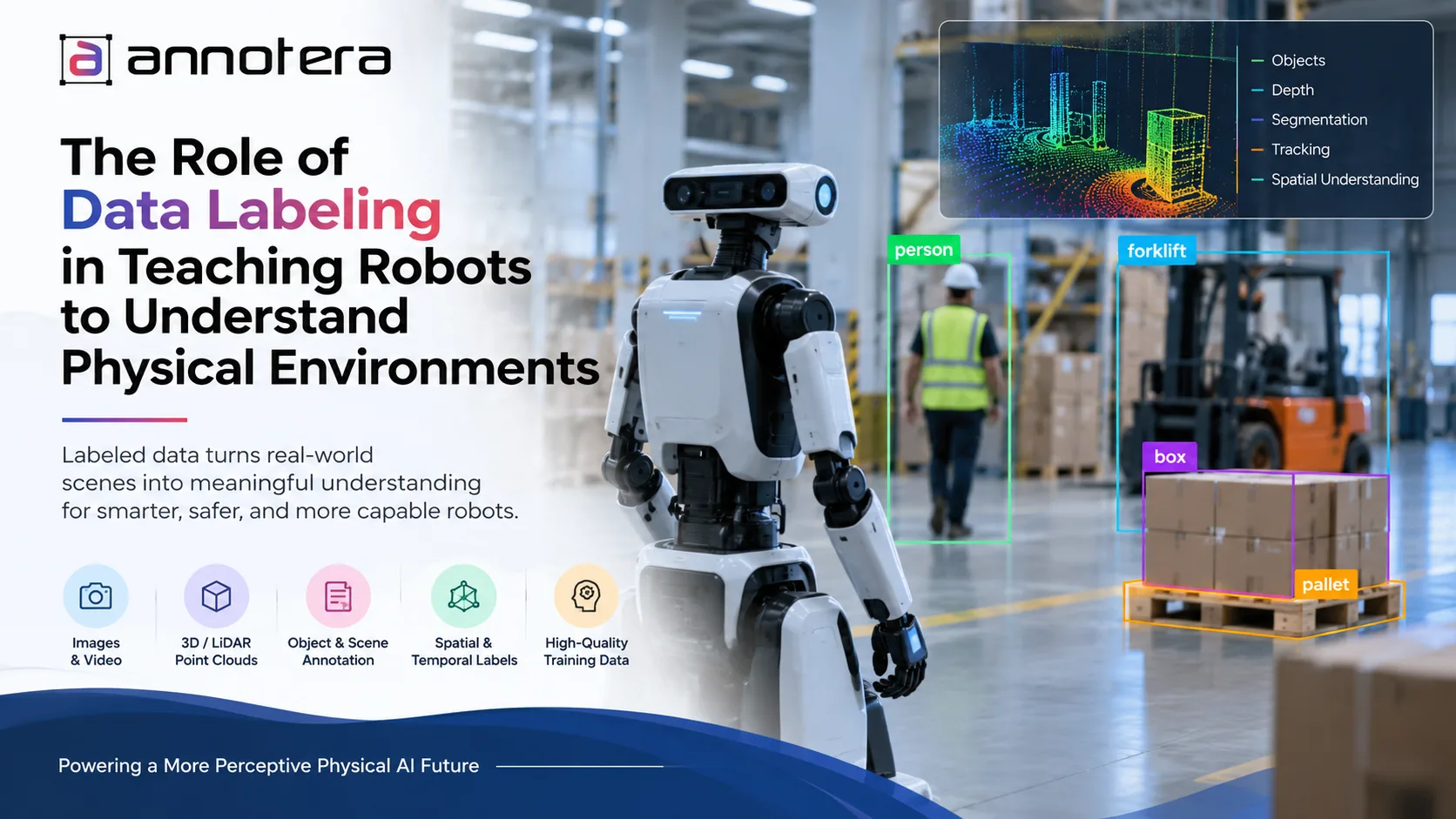
The Role of Data Labeling in Teaching Robots to Understand Physical Environments
Robots are increasingly moving beyond controlled factory floors into warehouses, hospitals, retail spaces, homes, farms, and outdoor environments. To operate effectively in these settings, robots must do more than detect objects. They need to understand what is around them, recognize changes in their surroundings, interpret human actions, estimate distances, and make decisions based on physical context.
This is where high-quality data labeling becomes essential. Raw sensor data may contain millions of images, video frames, LiDAR points, audio signals, and motion sequences, but this information does not automatically provide a robot with an understanding of the physical world. Carefully labeled datasets transform unstructured sensor observations into meaningful training signals that machine learning systems can use.
For companies developing intelligent robotic systems, robotics data annotation services provide the structured and scalable foundation required to train models that can perceive and interact with complex environments.
Why Robots Need Labeled Data
Human beings naturally recognize objects, spatial relationships, movement, and environmental context. A person looking at a warehouse can quickly identify a shelf, a package, a worker, an obstruction, and a safe path.
Robots must learn these concepts from data.
A camera may capture a worker walking toward a robot, but the machine learning model needs labeled examples to distinguish that person from equipment or background objects. Similarly, LiDAR sensors can generate detailed point clouds, but those points must be classified to help a robot understand whether they represent a wall, vehicle, pallet, human, or another obstacle.
Data labeling provides this semantic structure. Depending on the application, annotations can identify:
- Objects and their categories
- Object boundaries and shapes
- Human poses and movements
- Free space and obstacles
- Depth and distance information
- Spatial relationships
- Road, floor, or navigable areas
- Actions and events
- Environmental conditions
- Changes across sequential frames
These labels allow perception models to connect sensor inputs with real-world meaning.
Teaching Robots to Recognize Objects
Object recognition is one of the fundamental capabilities required for robotic perception. A robot operating in a warehouse, for example, may need to identify boxes, shelves, forklifts, workers, carts, and loading areas.
Bounding boxes, polygons, semantic segmentation masks, and instance segmentation labels can provide the training signals required to identify these elements accurately.
Segmentation is particularly valuable when robots need precise information about object boundaries. A robotic arm picking an item from a cluttered surface cannot simply know that an object exists. It may need to understand the object's exact shape and location to plan a reliable grasp.
High-quality labeling therefore helps models move from simple object detection toward more precise scene understanding.
Understanding Spatial Relationships
Recognizing individual objects is only part of physical-world understanding. Robots must also understand how objects relate to one another.
For example, a mobile robot may need to determine that a box is on a pallet, a worker is next to a machine, or an obstacle is blocking a planned route. These relationships can influence navigation, manipulation, and decision-making.
Annotations can capture spatial and contextual relationships within scenes, enabling models to learn patterns that are more meaningful than isolated object categories.
This becomes increasingly important for embodied AI systems, where perception must directly support physical action.
The Importance of Temporal Annotation
Physical environments are dynamic. Objects move, people change direction, doors open, vehicles approach, and lighting conditions shift.
For this reason, labeling individual images may not be enough. Robots often require temporal annotations across video sequences to understand how environments evolve.
Object tracking labels can connect the same object across consecutive frames. Action labels can identify activities such as walking, lifting, placing, reaching, or turning. Event annotations can mark moments when an object enters a scene, a collision risk emerges, or an interaction begins.
Temporal consistency helps models learn not only what is present but also what is happening.
This distinction is critical for autonomous robots that must anticipate events and respond appropriately.
Multimodal Data Makes Robot Training More Powerful
Modern robots frequently rely on multiple sensors rather than cameras alone. RGB cameras provide visual information, while depth cameras, LiDAR, radar, microphones, inertial measurement units, and other sensors provide complementary perspectives.
Each modality can contribute different information about the physical environment.
For example, RGB imagery can help identify an object, while LiDAR can provide its three-dimensional position. Combining annotations across modalities enables the development of models capable of creating richer representations of their surroundings.
This is why Physical AI training data increasingly requires multimodal annotation strategies. Training data must reflect the diverse sensory inputs that robots use to perceive and interact with the real world.
Labeling Human-Robot Interactions
Robots designed to work alongside people need to understand human behavior and intent.
A collaborative robot may need to recognize where a worker is standing, what they are reaching toward, whether they are carrying an object, and whether their movement creates a potential collision risk.
Human pose estimation, keypoint annotation, activity labeling, and interaction tagging can help models learn these patterns.
For example, labeling shoulder, elbow, wrist, and hand positions across video sequences can help a robot estimate human movement. This information can support safer motion planning and more responsive collaboration.
Data Quality Directly Influences Robot Performance
Poor annotation can introduce errors into robotic perception models. Inconsistent object boundaries, incorrect categories, missing labels, and temporal inconsistencies can cause models to learn unreliable patterns.
This makes annotation quality control particularly important.
Effective robotics datasets often use detailed annotation guidelines, multi-stage review, consensus checks, and quality audits. Difficult cases should be documented rather than handled inconsistently. Edge cases—including occlusion, unusual viewpoints, reflective surfaces, low-light environments, and partially visible objects—should also be represented in training data.
A diverse and accurately labeled dataset can help models perform more reliably outside the conditions represented in simple demonstrations.
Scaling Data Labeling for Robotics
Robotics projects can generate enormous volumes of sensor data. A single robot fleet operating continuously may produce thousands of hours of video and substantial quantities of three-dimensional sensor information.
Manually processing every data point can become expensive and time-consuming.
This is where specialized robotics data annotation services can help organizations scale dataset development while maintaining defined quality standards. Depending on the project, annotation workflows may combine human expertise with automated pre-labeling and validation processes.
The goal is not simply to produce more labels. It is to produce relevant, consistent, and accurate labels that support the specific capabilities a robotic system needs to learn.
Building Better Physical AI Systems Through Better Data
The next generation of robotics depends increasingly on models that can perceive, reason about, and act within physical environments. These systems require training data that represents the complexity of the real world—including objects, people, spatial relationships, motion, interactions, and environmental changes.
Data labeling provides the bridge between raw sensor observations and machine-understandable concepts. By turning visual, spatial, and temporal information into structured training signals, annotation helps robots develop stronger perception capabilities and make better-informed decisions.
For organizations building autonomous machines, investing in high-quality Physical AI training data is therefore not simply a data preparation task. It is a fundamental part of developing robots that can operate safely, accurately, and adaptively in real-world environments.
As robotic applications continue to expand, the quality, diversity, and contextual richness of labeled data will play an increasingly important role in determining how effectively machines understand the physical world.
Annotera supports organizations in developing high-quality annotated datasets for robotics and AI applications, helping transform complex sensor data into structured resources designed for advanced machine learning and robotic perception.