
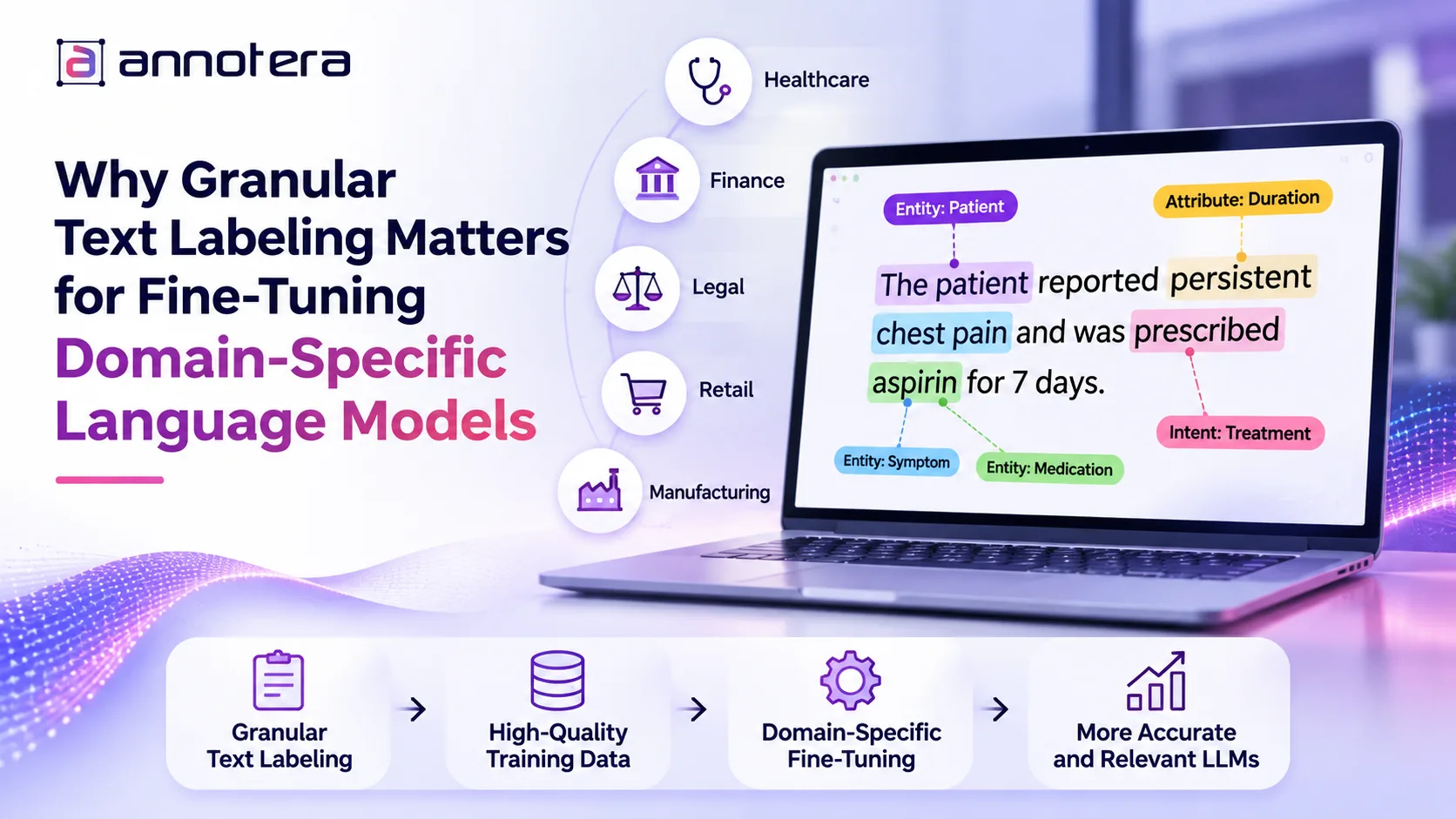
Large language models (LLMs) have transformed how businesses process information, automate workflows, and interact with customers. However, general-purpose language models often struggle when applied to specialized industries such as healthcare, finance, legal services, manufacturing, and retail. These sectors rely on domain-specific terminology, contextual relationships, and industry knowledge that require more than basic language understanding. Fine-tuning models with carefully structured training datasets helps address these limitations, and granular text labeling plays a critical role in this process.
Granular text labeling involves assigning detailed, context-aware labels to individual words, phrases, sentences, or entire passages. Instead of categorizing text using broad labels, it captures specific meanings, relationships, intents, and contextual signals. For organizations developing specialized AI applications, this approach improves training data quality and helps models produce more relevant, accurate, and consistent outputs.
Understanding Granular Text Labeling in AI Training
Traditional text annotation often focuses on identifying broad categories, such as positive or negative sentiment, general topics, or basic document classifications. While these labels provide useful information, they may not capture the complexity required for domain-specific language models.
Granular labeling introduces a more detailed annotation framework. It identifies entities, attributes, relationships, terminology, intent, sentiment, and contextual dependencies within unstructured text.
For example, in financial services, a sentence such as "The customer disputed the additional processing fee applied to the international transaction" contains several meaningful elements. A granular annotation process can identify the customer, transaction type, disputed fee, and underlying complaint intent separately.
This level of detail allows machine learning models to understand not only what a sentence communicates but also how its individual components relate to one another.
1. Improves Domain-Specific Contextual Understanding
Every industry has its own terminology, communication patterns, and contextual requirements. A general-purpose model may interpret certain technical expressions incorrectly because their meanings depend heavily on the domain.
Granular text labeling helps address this challenge by providing explicit contextual information during model training.
For example, the term "charge" can refer to a financial transaction, an electrical property, or a legal accusation. Similarly, "positive" may describe a medical test result, a financial outlook, or customer sentiment.
Detailed annotation helps distinguish these meanings by connecting expressions with their appropriate contexts. Named entity recognition (NER), terminology classification, semantic labeling, and relationship extraction can help models learn these distinctions.
As a result, fine-tuned models become better equipped to interpret specialized vocabulary and generate domain-relevant responses.
2. Enables More Accurate Intent Classification
Understanding user intent is essential for domain-specific AI applications, particularly conversational AI, customer support automation, and enterprise virtual assistants.
Basic text classification may identify a message as a customer inquiry or complaint. However, businesses often need more specific information to determine the appropriate response.
Granular labeling supports intent classification by identifying precise user objectives and distinguishing between closely related requests.
For example, a banking chatbot should differentiate between:
- Reporting an unauthorized transaction.
- Requesting a transaction reversal.
- Checking an international payment status.
- Asking about transaction processing fees.
Although these requests belong to the same broad financial category, each represents a different intent and requires a different response.
High-quality intent labels help fine-tuned language models recognize these distinctions, improving conversational accuracy and reducing incorrect or irrelevant responses.
3. Strengthens Named Entity Recognition and Relationship Extraction
Domain-specific language models frequently need to identify important entities and understand how they relate to one another.
Granular annotation supports this requirement through detailed entity labeling and relationship extraction.
In healthcare, for example, a medical report may contain references to symptoms, medications, diagnoses, procedures, and patient history. Annotators can label each entity separately and identify relationships between them.
Similarly, legal datasets may require identifying contractual obligations, involved parties, dates, regulatory references, and liability conditions.
These structured annotations help models understand relationships rather than treating text as a collection of disconnected words. This is particularly valuable for information extraction, document intelligence, semantic search, and automated knowledge discovery.
4. Reduces Ambiguity and Improves Training Data Consistency
Inconsistent labels can introduce noise into training datasets. When similar expressions receive different annotations without a clear contextual reason, models may struggle to learn reliable patterns.
Granular labeling reduces this problem by establishing detailed annotation guidelines, standardized taxonomies, and clearly defined labeling criteria.
A professional annotation workflow typically includes:
- Detailed annotation guidelines: Define label categories, contextual rules, and edge cases.
- Standardized taxonomies: Maintain consistent terminology and hierarchical label structures.
- Quality assurance: Review annotated samples to identify incorrect or inconsistent labels.
- Inter-annotator agreement: Measure consistency between multiple annotators.
- Adjudication: Resolve disagreements through expert review.
Working with a reliable text annotation company helps organizations implement these processes systematically, particularly when developing large-scale datasets for specialized language models.
5. Supports More Effective Fine-Tuning and Model Adaptation
Fine-tuning helps pretrained language models adapt to specific business requirements using curated domain-related datasets. However, the effectiveness of this process depends heavily on the relevance, accuracy, and structure of the training examples.
Granular labels provide more informative supervision, helping models learn specialized patterns and distinctions.
For instance, an enterprise building an AI-powered legal research assistant may need a model that can identify regulatory references, distinguish contractual clauses, recognize legal obligations, and classify case-related queries.
Detailed annotation makes these training signals more explicit, supporting targeted model adaptation.
When combined with high-quality instruction-response pairs, preference datasets, and expert-reviewed examples, granular text labeling can contribute to more reliable domain-specific model performance.
6. Improves Data Quality Across Complex Industry Applications
Different industries require different annotation strategies. A standardized approach may not adequately address the requirements of every specialized AI application.
Granular labeling enables organizations to customize their datasets according to specific operational needs.
Some important applications include:
- Healthcare: Identifying clinical entities, symptoms, medications, and relationships in medical documentation.
- Finance: Classifying transaction-related queries, financial entities, compliance references, and customer complaints.
- Legal: Extracting contractual clauses, obligations, parties, and regulatory terminology.
- Retail: Identifying product attributes, customer preferences, purchase intent, and feedback categories.
- Manufacturing: Labeling technical specifications, equipment-related terminology, maintenance records, and operational issues.
Organizations seeking scalable text annotation outsourcing services can benefit from structured annotation workflows that combine domain expertise, trained annotators, and multi-stage quality validation.
7. Makes Domain-Specific AI Systems More Scalable
As businesses expand their AI applications, their datasets must accommodate new terminology, evolving user requirements, and additional industry use cases.
Granular annotation creates a structured foundation that makes datasets easier to update, extend, and maintain. Hierarchical taxonomies allow teams to introduce new labels without unnecessarily restructuring existing annotation frameworks.
Furthermore, consistent metadata and annotation standards improve dataset traceability and support continuous model evaluation.
This becomes particularly important when organizations fine-tune multiple model versions or adapt existing models to different business functions.
How Annotera Supports High-Quality Text Annotation
Developing reliable domain-specific language models requires training data that accurately represents industry terminology, contextual relationships, and real-world communication patterns.
Annotera provides specialized text annotation outsourcing services designed to support organizations building and optimizing AI and machine learning applications.
Its annotation capabilities include named entity recognition, sentiment analysis, intent classification, text categorization, relationship extraction, and contextual labeling.
By combining structured annotation guidelines, trained human annotators, and quality assurance processes, Annotera helps businesses develop consistent, high-quality datasets for LLM fine-tuning, NLP applications, and enterprise AI workflows.
Whether organizations are building intelligent chatbots, automated document processing systems, or specialized knowledge discovery platforms, carefully annotated text datasets provide an important foundation for model development.
Conclusion
Granular text labeling is an essential component of fine-tuning domain-specific language models. It helps AI systems recognize specialized terminology, interpret contextual relationships, distinguish user intentions, and learn industry-specific language patterns more effectively.
Broad text categories alone may not provide the detailed supervision required for complex enterprise applications. By investing in structured annotation frameworks, businesses can improve dataset consistency, strengthen model adaptation, and build more dependable AI solutions.
Partnering with an experienced text annotation company such as Annotera enables organizations to access scalable annotation expertise and develop high-quality training datasets that support the next generation of specialized language models.