Data has become part of almost every modern technology environment. Applications generate information, business systems store transactions, customer platforms collect interactions, and analytical tools depend on prepared datasets. But collecting data is only one part of the problem.
Organisations also need processes that can move, clean, transform, store, and organize information so that it can be used reliably. This has created a technical area that sits between software systems, databases, cloud infrastructure, and analytics: data engineering. For IT professionals, understanding this area can provide a new perspective on how information moves through modern technology environments.
Online Data Engineering Course in India: Understanding the Workflow Behind Modern Data
It can introduce learners to the technologies involved in these workflows, but the larger concept is more important than any individual tool. Consider a simple business scenario. An Online Data Engineering Course in India retailer receives customer orders through its application. The order information needs to move from the application into systems where it can be processed and analysed.
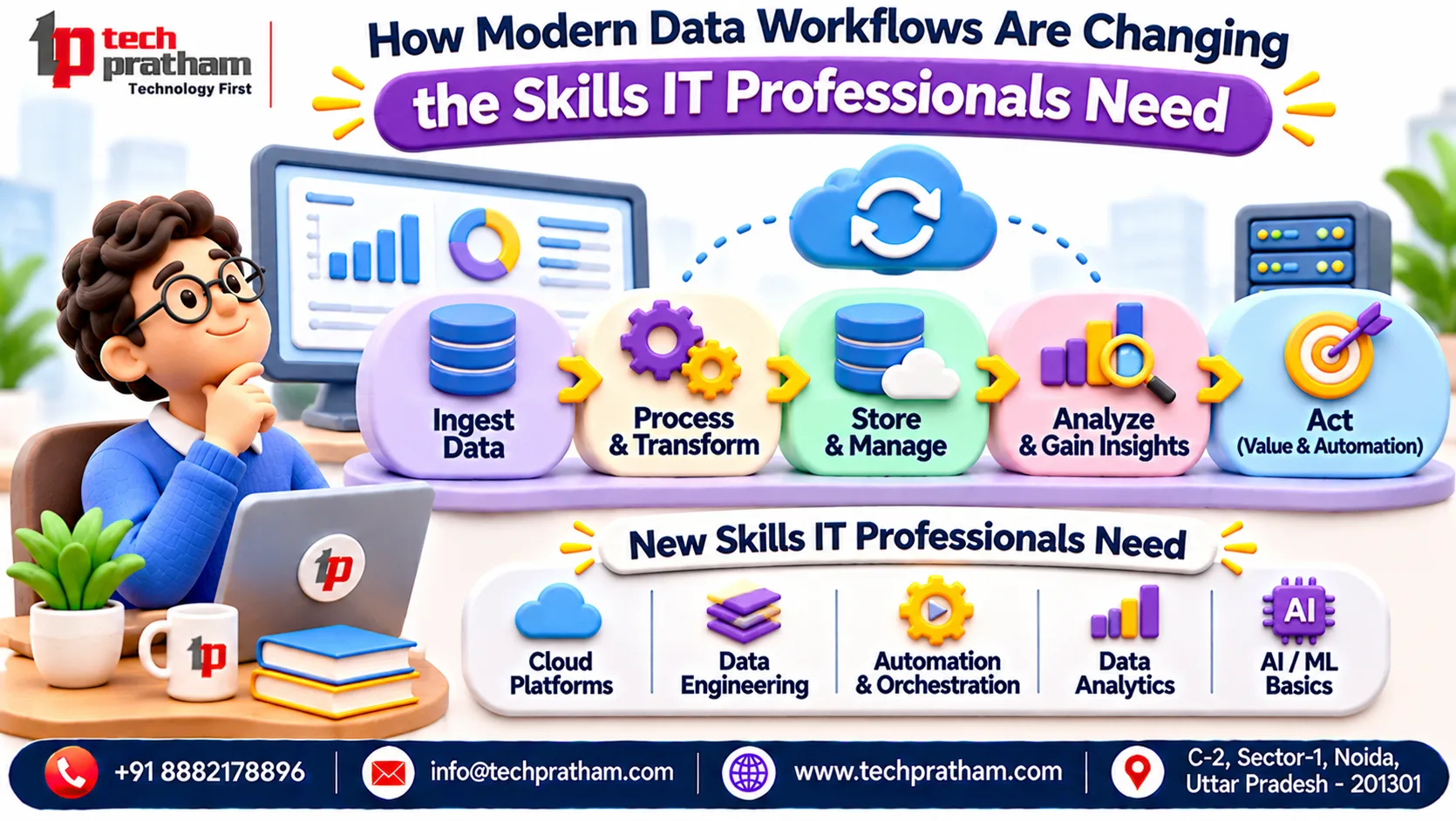
That process may involve several stages:
Data Source → Ingestion → Transformation → Storage → Analytics
Each stage creates a different technical requirement.
Data Sources Are Becoming More Diverse
Modern businesses rarely depend on one source of information. Data can come from relational databases, applications, APIs, spreadsheets, event systems, or external services.
These sources can produce different formats and structures. A data engineer therefore needs to understand how to inspect incoming information and identify potential quality problems.
For example, two systems may store customer identifiers differently. One may use a numerical ID while another uses a text-based reference. Connecting those sources requires more than simply moving the records.
Data Quality Is Part of Engineering
A common misconception is that data engineering is mainly about transferring information from one location to another. In practice, quality matters. Missing values, duplicates, inconsistent formats, invalid records, and unexpected changes in source structures can affect downstream systems.
A workflow that moves incorrect data efficiently is still a poor workflow. This is why validation and transformation are important parts of modern data systems.
Why SQL Remains Important
SQL provides a way to work directly with structured data. IT professionals who understand databases can use SQL to investigate records, join related datasets, calculate aggregates, and validate outputs. This knowledge also helps when working with larger data platforms because the underlying questions often remain similar.
- Where is the data?
- How is it related?
- What information should be selected?
- How should it be transformed?
Understanding these questions provides a strong foundation.
Python Adds Processing and Automation
Python can extend what a data professional is able to do. A Python program might read incoming files, process records, apply transformations, check data quality, or automate repetitive operations. For example, imagine receiving daily sales files from several branches.
A script could standardise the files into a consistent format before they are loaded into a central system. The value of Python is therefore not simply knowing the language. It is knowing how to apply programming to a data problem.
Pipelines Connect the Pieces
A pipeline brings individual tasks together. Instead of manually repeating a process, an automated workflow can execute a series of steps consistently.
A basic example might involve:
Extract → Validate → Transform → Load → Verify
As systems become more sophisticated, orchestration, scheduling, logging, monitoring, and error handling become important. This is where the role of a data engineer starts looking increasingly like systems engineering.
What Should Learners Look for in Training?
When evaluating a Data Engineering Course in India, learners should look for a curriculum that explains the relationship between technologies. A course should not simply list SQL, Python, cloud, Spark, and data warehouses as separate subjects. The learner should understand why each technology exists within a broader architecture. Projects are particularly useful here. A good project can require the learner to collect data, clean it, transform it, store it, and verify the final output.
Certification Is Only One Part of the Learning Journey
Data Engineering Certification Training in India may appeal to learners who want formal recognition of their education. However, the value of certification depends on what it represents. Before enrolling, understand whether the programme provides a course-completion credential or prepares you for an external examination.
More importantly, ask what practical experience you will gain.
- Can you build a pipeline?
- Can you troubleshoot an error?
- Can you explain your architecture?
- Can you identify a data-quality problem?
These abilities are important regardless of the certificate attached to the training.
Why Broader Data Engineering Training Matters
Modern data environments continue to evolve, so learning one specific tool is unlikely to be enough. Data Engineering Training should ideally develop transferable concepts.
If you understand ingestion, transformation, storage, validation, automation, and workflow design, you have a foundation that can help you learn new technologies later.
That is a better long-term approach than trying to memorize every platform available today.
The Bigger Skill Is Understanding Data Systems
The most valuable shift for an IT professional may be learning to think about data as a system. Instead of asking only how to run a particular command, start asking:
- Where does the information originate?
- How reliable is it?
- How should it be transformed?
- Where should it be stored?
- How will the process run repeatedly?
- How will failures be detected?
These questions connect technical skills to real-world data workflows. That is why modern Data Engineering Training in India education should focus on more than tools. It should help learners understand how information moves through technology environments and how reliable systems can be built around it.