Side sleeping seems straightforward until you notice what happens at the point where your head, shoulder, mattress, and pillow meet.
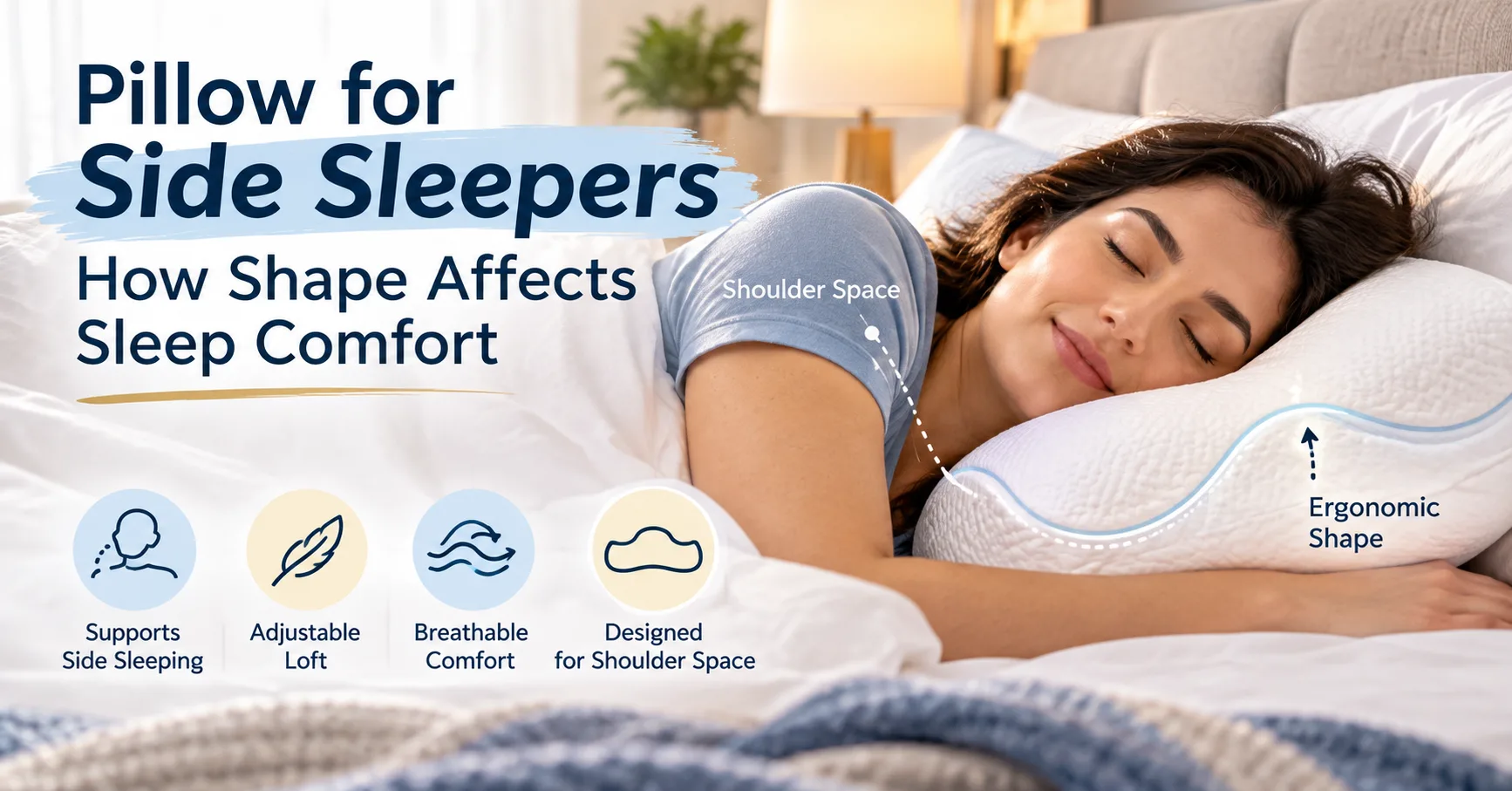
Unlike sleeping on your back, side sleeping creates a larger space between the mattress and the side of your head because the shoulder occupies part of that space. The pillow has to bridge that gap while still feeling comfortable beneath the head.
That is why choosing a pillow based only on whether it feels soft or firm can miss an important part of the picture. Shape, usable space, loft, and the way the pillow responds to pressure can all work together.
A small change in one of those elements can make a familiar sleeping setup feel noticeably different.
Pillow for Side Sleepers: Where Shoulder Space Matters
A traditional rectangular pillow provides one continuous surface. For some sleepers, that is perfectly comfortable. But side sleepers may have a different relationship with the edge of the pillow because the shoulder sits directly below it.
This is where pillow shape becomes interesting.
A design with a shoulder-oriented contour can create room for the shoulder while allowing the head to rest farther into the pillow. Instead of simply adding more height everywhere, the shape can change where the sleeper's body interacts with the pillow.
That concept is worth considering alongside the more familiar question of pillow loft.
For a broader look at how sleeping position can influence sleep-product choices, you can also read sleeping position and sleep essentials.
Fit Can Matter More Than Firmness
When people compare pillows, "soft" and "firm" are often the first descriptions they notice.
But firmness does not tell the entire story.
A pillow can have the right general firmness and still feel awkward if its height or shape does not suit the sleeper. Body proportions, shoulder width, mattress characteristics, and natural sleeping posture can all influence how a pillow feels.
Think of it as a fit problem rather than simply a firmness problem.
One person may prefer a relatively substantial pillow because of their proportions and mattress setup. Another person may find the same configuration too elevated.
That is one reason adjustable designs can be useful. Instead of treating pillow height as a fixed characteristic, an adjustable pillow allows the sleeper to make smaller changes based on personal preference.
Pillow for Side Sleepers: Finding the Right Relationship With the Mattress
The mattress is easy to overlook when discussing pillows.
Yet the mattress determines how far the shoulder sinks into the sleeping surface. A softer mattress and a firmer mattress can therefore create different relationships between the shoulder, head, and pillow.
This does not mean there is one universal pillow height that works for everyone.
Instead, it suggests that a pillow should be considered as part of the entire sleep setup.
A useful question is not simply, "How tall is this pillow?"
A better question might be, "How does this pillow behave when I am actually lying on my side?"
That distinction can lead to more thoughtful choices.
Materials Change How Shape Feels Under Pressure
Shape is only one part of the equation.
The material inside a pillow determines how that shape behaves when you put your head on it, shift position, or remove pressure.
Some materials respond gradually and contour more closely. Others recover their shape more quickly and feel more responsive. Some constructions emphasize airflow, while others focus more heavily on a molded sensation.
The important point is that material and shape do not operate independently.
A shaped pillow filled with one material can feel quite different from a similarly shaped pillow filled with another.
For a deeper explanation of this interaction, see how pillow materials respond to pressure.
This is also why simply seeing the words "memory foam" or "latex" on a product description does not tell you exactly how the finished pillow will feel.
Adjustable Loft Adds Another Layer of Personalization
Adjustability becomes particularly interesting when individual body proportions vary.
Instead of manufacturing every pillow with exactly the same amount of fill, an adjustable design lets the sleeper change the amount of material inside. That can provide more flexibility than a fixed-height pillow.
Eli & Elm's Side Sleeper Pillow is one example of this approach. Its current product information describes a U-shaped ergonomic design with a shoulder cutout, adjustable loft through removable fill, and a choice between latex noodle and shredded memory foam fills. It is offered in Queen and King sizes, and the product page currently lists a 45-night trial and five-year warranty.
The design is intended specifically for side sleeping, but the important idea is broader: customization can allow the sleeper to adjust the pillow rather than expecting one fixed configuration to suit everyone.
Pillow for Side Sleepers and the Role of Adjustable Shape
The U-shaped design is particularly relevant to the shoulder-space discussion.
Rather than treating the pillow as a simple rectangle, the design creates a contour around the shoulder area. The product page describes this shape as allowing the shoulder to rest within the contour while supporting the head and neck.
That does not mean the same setup will feel identical to every sleeper. Personal proportions and preferences still matter.
But it illustrates how pillow architecture can be just as interesting as the material inside it.
You can explore the Eli & Elm Side Sleeper Pillow as an example of a pillow built around this design philosophy.
Shape, Size, and the Space Around Your Head
There is another detail worth considering: a pillow does not exist in isolation.
Its dimensions affect how it occupies the bed and how much usable space remains around your head and shoulders. A larger pillow can create a different sleeping environment from a compact one, even if both provide similar loft.
For more on this topic, see pillow dimensions and usable sleeping space.
For side sleepers, this can be especially relevant because the shoulder, head, pillow, and mattress are already interacting within a relatively small area.
The Bigger Picture: Comfort Is About Interaction
A pillow is easy to judge in a store or product photograph.
You can touch it, look at its shape, and read its material description.
But the more useful question is what happens when all the pieces interact.
Your sleeping position affects where your body makes contact with the mattress. Your shoulder influences the distance between your head and the bed. The pillow's shape determines where support is available. The fill affects how that shape responds to pressure. And adjustable loft can give you another variable to fine-tune.
None of these factors exists completely on its own.
That is why a pillow for side sleepers should not necessarily be evaluated by a single characteristic such as softness, firmness, or height.
Final Thoughts
Good pillow design is often about solving a surprisingly small spatial problem: creating a comfortable relationship between the head, shoulder, mattress, and pillow.
For side sleepers, that relationship can make shape particularly interesting.
Instead of asking only whether a pillow is soft or firm, it can be useful to consider its shoulder space, shape, loft, dimensions, material response, and adjustability together.
The goal is not to find one configuration that works identically for everyone. It is to understand how these elements interact so you can make a more informed choice about your own sleeping setup.