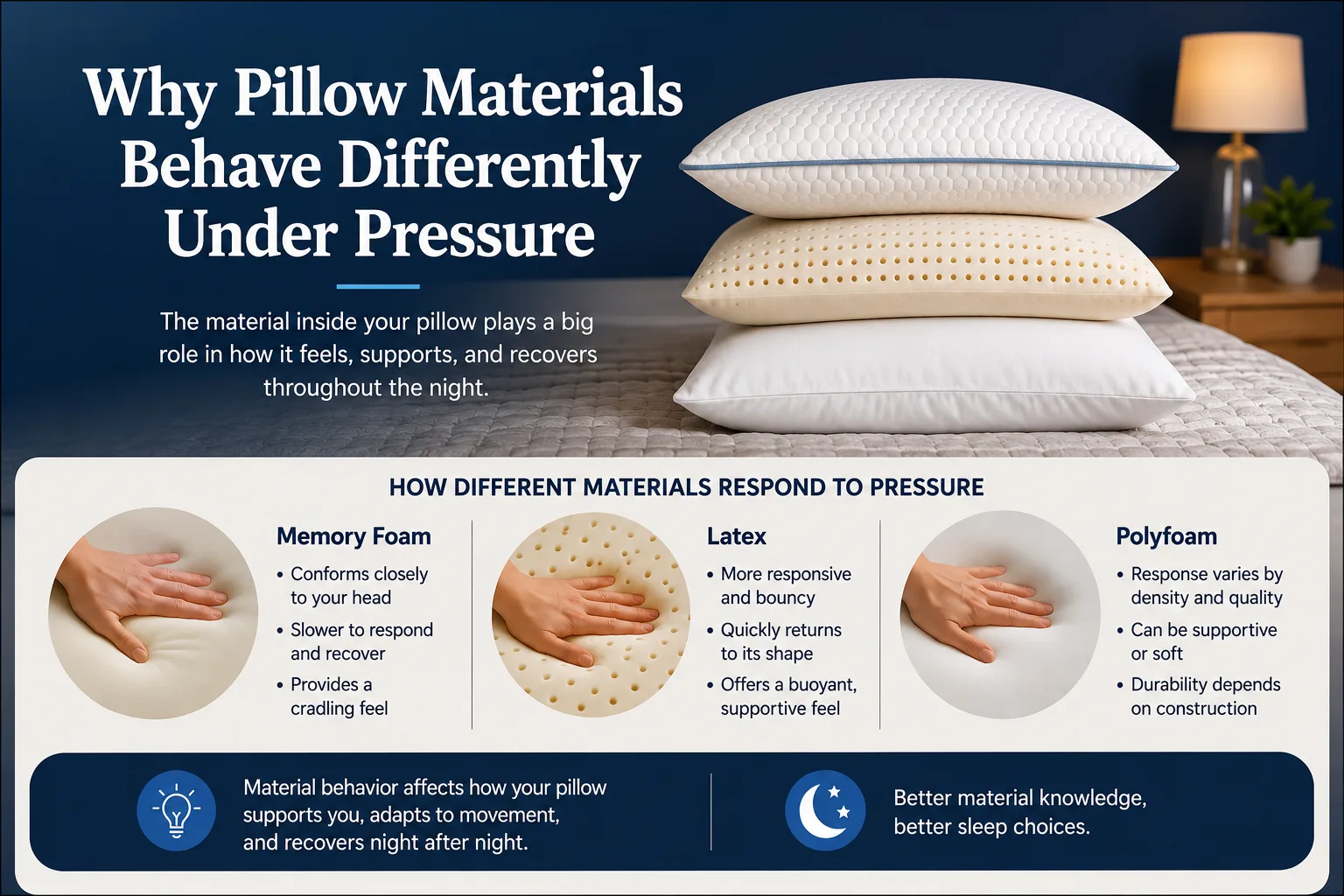
A pillow may look simple from the outside, but the material inside it is continuously responding to pressure during sleep.
When you place your head on a pillow, the material compresses. When you move, pressure shifts to another area. When you get up, the pillow begins recovering its shape. Different materials handle these changes in different ways.
That difference helps explain why two pillows can feel completely different even when they have similar dimensions or are marketed for similar sleepers.
Pressure Changes the Shape of a Pillow
The first interaction between a sleeper and a pillow happens when body weight is applied.
Pressure does not affect every part of the pillow equally. The area directly beneath the head receives more force, while surrounding areas may remain closer to their original shape.
As the sleeper moves, the pressure pattern changes.
This means the pillow is not simply being compressed once. It is repeatedly responding to changing forces throughout the night.
Research and testing methods used by Sleep Foundation similarly evaluate pillows according to characteristics such as compression resistance, conforming, moldability, and shape retention rather than treating all pillow materials as identical.
Memory Foam Responds Gradually
Memory foam is one of the clearest examples of a material whose behavior changes under pressure.
Memory foam is a viscoelastic polyurethane foam. Its viscosity and elasticity influence how it changes shape when pressure and heat are applied. It generally responds gradually rather than immediately returning to its original shape when pressure is removed.
That slower response contributes to the familiar contouring sensation associated with memory foam.
When pressure is removed, recovery also takes time. Sleep Foundation notes that memory foam can take several seconds to return toward its original shape, with temperature also affecting how flexible the material feels.
This behavior can make memory foam feel quite different from a material that quickly springs back after compression.
Latex Has a Different Response
Latex behaves differently from memory foam.
Sleep Foundation describes latex as a resilient material with a more buoyant feel. It tends to return toward its original shape more readily and generally contours less closely than memory foam.
That difference in responsiveness changes the sensation of pressure.
A sleeper moving their head across a latex pillow may experience a quicker response, while memory foam may provide a slower, closer contour.
Neither response is automatically better. They simply represent different material behaviors.
Polyfoam Can Vary Significantly
Polyfoam is another broad category where construction matters.
Unlike treating polyfoam as one uniform material, Sleep Foundation notes that its properties can vary according to formulation and density. Different versions can provide different levels of contouring, responsiveness, and support.
This is an important point when comparing pillows.
A label identifying a general material category cannot always predict exactly how the finished pillow will behave. Density, internal structure, shape, and manufacturing choices can all influence the result.
Pressure Response Is Not the Same as Firmness
Firmness and pressure response are related, but they describe different characteristics.
Firmness is about how much resistance a pillow provides when pressure is applied.
Pressure response describes how the material changes under that pressure and how it behaves when the force changes or disappears.
A pillow can feel relatively soft initially while still maintaining a useful structure underneath. Another can feel firmer but respond quickly when the sleeper changes position.
Sleep Foundation's pillow testing methodology separates firmness/support from characteristics such as conforming and moldability, illustrating why these qualities should not be treated as interchangeable.
Shape and Material Work Together
The material inside a pillow is only part of its behavior.
A shaped pillow can direct pressure toward particular zones, while a traditional rectangular pillow may distribute it across a more uniform surface.
This is particularly relevant for sleepers who spend much of the night on their side. A side-sleeping pillow can use its construction and intended shape to create a more specific relationship between the head, shoulder, and mattress.
However, the material still determines much of how that shape responds under pressure.
The final experience therefore comes from the combination of material and design rather than either one alone.
Temperature Can Change Material Response
Heat can affect certain pillow materials.
Memory foam is particularly sensitive to temperature because its viscosity changes as temperature changes. Sleep Foundation explains that memory foam tends to become more flexible with heat, which contributes to its characteristic response when the material is exposed to body warmth.
This helps explain why a foam pillow may not feel exactly the same when first touched as it does after being used for some time.
Temperature is therefore not just a comfort issue. It can influence material behavior as well.
Recovery After Pressure Is Removed
What happens after compression is just as important as what happens during compression.
Some materials recover quickly. Others take longer.
A fast-recovering material can feel more responsive when a sleeper changes position. A slower-recovering material can maintain a contour for longer before returning to its previous form.
Sleep Foundation's testing methodology distinguishes between shape retention and moldability, noting that highly moldable pillows can sometimes be less capable of holding a fixed shape.
These characteristics create different sleeping experiences rather than a simple good-or-bad hierarchy.
Why Repeated Movement Matters
A sleeper may change position many times during a night.
Each movement creates a new pressure pattern.
A material that responds quickly may adapt rapidly to the new position. A slower material may take longer to adjust.
This difference can be noticeable to sleepers who move frequently, while someone who remains in one position for longer may experience it differently.
That is one reason real-world use provides information that a quick showroom test cannot fully reproduce.
The Cover Is Part of the System Too
The core material gets most of the attention, but the pillow shell can influence the final feel.
Sleep Foundation's pillow research notes that both the fill and shell contribute to temperature regulation.
The cover can also affect the surface sensation and how the underlying material interacts with the sleeper.
A tightly fitted shell may create a different experience from a looser construction. Fabric choice can also affect airflow and surface feel.
The finished pillow is therefore the result of several layers working together.
Construction Can Matter More Than the Material Name
Consider two pillows that both use memory foam.
They may still feel very different.
One could use a solid foam core, while another uses shredded foam. One may have a structured contour, while the other has a conventional shape.
Sleep Foundation's current testing distinguishes between solid and shredded memory foam because they can provide different levels of structure and moldability.
This is why consumers should look beyond a single material label when trying to understand how a pillow behaves.
An Everyday Pillow Is Still a Designed Product
Pillows intended for regular everyday use can involve the same material decisions as more specialized designs.
An everyday memory foam pillow may be built around a balance of responsiveness, shape retention, surface comfort, and general usability.
The important question is not simply whether it contains memory foam. Its density, geometry, shell, and overall construction contribute to its behavior.
There Is No Universal "Best" Material
Different materials produce different experiences.
Memory foam may provide closer contouring and a slower response. Latex tends to provide greater resilience. Polyfoam can vary significantly depending on its formulation. Other fills have their own characteristics.
That diversity is useful because sleepers have different preferences.
Someone who values a slow, molded sensation may prefer a different material from someone who wants a quicker, springier response.
The goal is not to identify a material that wins for everyone. It is to understand how each material behaves and why those differences matter.
What This Means for Pillow Performance
Understanding pressure response gives consumers a better way to interpret product descriptions.
Words such as "supportive," "responsive," "conforming," or "soft" describe different aspects of a pillow. None of them fully explains how a material will behave throughout an entire night.
A more complete picture comes from considering:
- pressure response
- recovery speed
- shape retention
- conforming
- temperature response
- construction
- sleeping position
These characteristics interact rather than operating independently.
Expert Insight
Pillow materials behave differently because their physical properties determine how they compress, conform, distribute pressure, and recover when force is removed. Memory foam, latex, and polyfoam can produce noticeably different responses, while construction and temperature can further modify the experience.
Final Thoughts
The material inside a pillow is doing more than simply filling space.
Every night, it responds to pressure, body heat, movement, and changes in position. Different materials manage those forces differently, which explains why pillows with similar appearances can produce very different sensations.
Understanding these differences is more useful than relying on a simple label such as "soft," "firm," or "memory foam."
A pillow's real behavior comes from the interaction between its material, shape, construction, cover, and the person using it.
That is what makes pillow design more interesting than it first appears.