
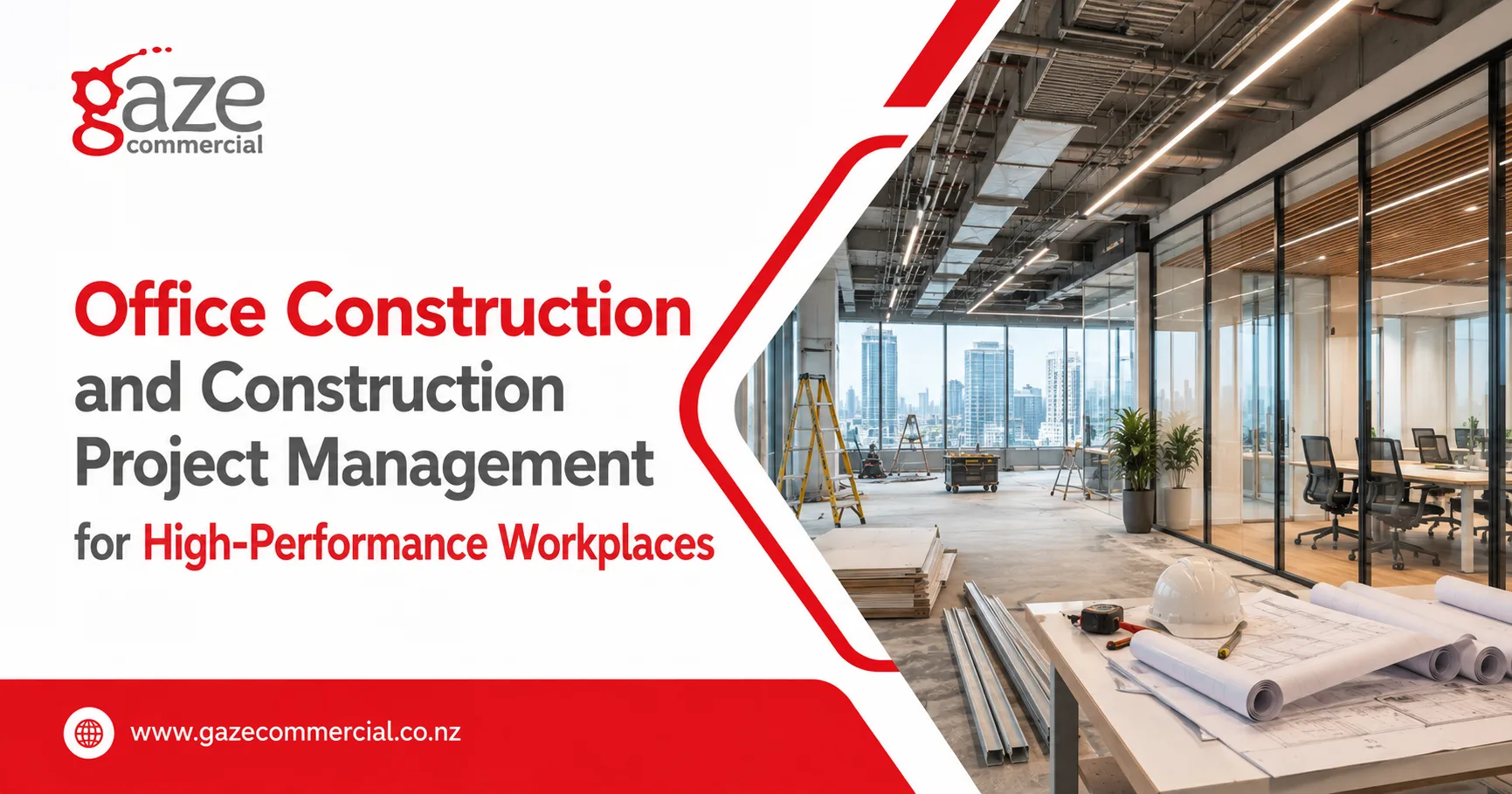
Construction project management for office projects is the coordination of planning, budgets, quality control, procurement, and communication across an entire build, so the finished workplace is delivered on time, within budget, and to the required standard. It brings project and cost management, quantity surveying, construction oversight, seismic compliance, and tenant advisory together under one accountable process.
Commercial office projects succeed or fail on how well they’re managed, not just how well they’re designed. A well-planned workplace fit-out or refurbishment can still run behind schedule, exceed budget, or fall short on quality if planning, cost control, and on-site oversight aren’t working together from day one.
This article covers what construction project management in NZ actually involves for office projects, how a well-managed build moves from concept to handover, and the questions businesses ask most before starting a workplace construction project.
What Services Support Office Construction Project Delivery?
Commercial office projects bring together several specialist disciplines, not just one contractor:
- Project and cost management — planning, scheduling, risk management, quality assurance, and stakeholder communication across the project lifecycle.
- Quantity surveying — cost estimation, procurement strategy, value engineering, contract administration, and financial reporting.
- Construction and seismic strengthening — delivering the physical build to design intent, including NBS and Importance Level compliance.
- Tenant advisory — helping businesses understand lease obligations, landlord responsibilities, and fit-out requirements before work starts.
Leaving these disciplines to operate in isolation is where most office projects run into trouble. A structured delivery process keeps architects, engineers, contractors, and suppliers aligned to one programme and one budget.
Why Does Project Oversight Matter More for Office Builds Than Other Construction?
Direct answer: Office projects need closer oversight because they’re usually delivered inside occupied buildings, around lease dates, staff relocations, and live business operations, not on vacant sites.
A missed handover date on an office project isn’t just an inconvenience. It can mean paying rent on two spaces at once, delaying a return-to-office plan already communicated to staff, or disrupting client-facing operations. Structured construction project management keeps programme, budget, and quality moving together, so a business isn’t left coordinating consultants and contractors itself when something goes wrong.
How Is an Office Construction Project Managed, Step by Step?
A well-managed build typically follows five stages:
- Develop the project plan — Timelines, responsibilities, and procurement strategy are set before construction starts, creating a clear roadmap.
- Implement cost control measures — Budgets are monitored continuously, catching financial issues while they’re still cheap to fix.
- Conduct regular progress reviews — Site meetings keep work aligned with programme objectives and surface problems early.
- Maintain clear communication — Consistent reporting keeps stakeholders informed of progress, risk, and key decisions.
- Monitor quality and delivery timeframes — Quality checks run alongside the programme, not just at completion.
Construction Management vs Project Management: What’s the Difference?
Project management coordinates the overall delivery process, planning, budgeting, procurement, and stakeholder communication. Construction management focuses on-site: contractor coordination, build quality, and construction sequencing.
Project management starts at feasibility and centres on scheduling, procurement, and reporting, aiming for cost and programme certainty. Construction management runs through the build phase itself, focusing on contractor coordination, sequencing, and quality checks on site, with build quality and delivery as the outcome. Both need to work together. A project can be well-planned on paper and still fall short if on-site coordination doesn’t match it, or vice versa.
How Does Quantity Surveying Support Better Project Outcomes?
Quantity surveying helps businesses manage costs, improve budget accuracy, and reduce financial risk throughout a project.
Feasibility studies, cost planning, value engineering, and ongoing financial reporting give businesses cost certainty at every stage, not just a final number at project close-out.
What Should a Business Look for in a Delivery Partner?
- Proven experience with commercial office fit-outs and refurbishments, not just general construction.
- A track record of delivering in occupied buildings with minimal disruption.
- Strength in cost control and quantity surveying, not just site management.
- Familiarity with seismic strengthening and NBS compliance for older commercial stock.
- Transparent, regular reporting rather than updates only at project milestones.
Gaze Commercial has supported businesses through workplace fit-outs, refurbishments, and seismic upgrades across New Zealand for more than 40 years, combining project management, quantity surveying, construction, and tenant advisory under one team.
Final Thoughts
A high-performance workplace depends on more than good design. It depends on how well the project is planned, coordinated, monitored, and delivered. Businesses that invest in structured construction project management are better positioned to avoid delays, control costs, and get a workplace that’s ready when it’s promised.
If your business is planning an office build, refurbishment, or seismic upgrade, Gaze’s delivery services bring four decades of construction project management experience to every stage, from initial planning through to final handover.
Frequently Asked Questions
What is included in Construction Project Management NZ?
It typically includes project and cost management, quantity surveying, construction and seismic strengthening, and tenant advisory — covering everything from initial planning through to final handover.
How does Construction Management NZ keep office projects on budget?
Through detailed cost estimation, value engineering, and continuous financial monitoring throughout the build, rather than reviewing costs only once the project is complete.
Can office construction happen while staff are still working in the building?
Yes. Staged construction and minimal-disruption strategies allow work to proceed around live business operations, particularly for refurbishments and seismic strengthening projects.
What’s the difference between project management and just hiring a builder?
Project management oversees the full lifecycle, planning, risk, cost, communication, and quality, while a builder typically focuses on the physical construction itself.
Why does seismic strengthening come up in office construction projects?
Many New Zealand commercial buildings require seismic assessment or strengthening to meet NBS and Importance Level standards, protecting both occupants and long-term asset value.
How early should construction project management start on an office project?
As early as possible — ideally at initial cost feasibility, before design is finalised, so budget, programme, and compliance requirements shape decisions from the outset.
Is construction project management necessary for a small office fit-out?
Even smaller fit-outs benefit from structured cost and programme management, since occupied-building constraints and lease timelines apply regardless of project size.
Does construction project management cover seismic strengthening?
Yes. Seismic strengthening is typically managed as part of the wider construction and compliance process, alongside NBS and Importance Level requirements.
Follow us on Social Media
Facebook: https://www.facebook.com/GazeCommercial/
LinkedIn: https://www.linkedin.com/company/gaze-commercial-ltd
Instagram: http://instagram.com/gazecommercial/
Pinterest: https://pinterest.com/GazeCommercial/