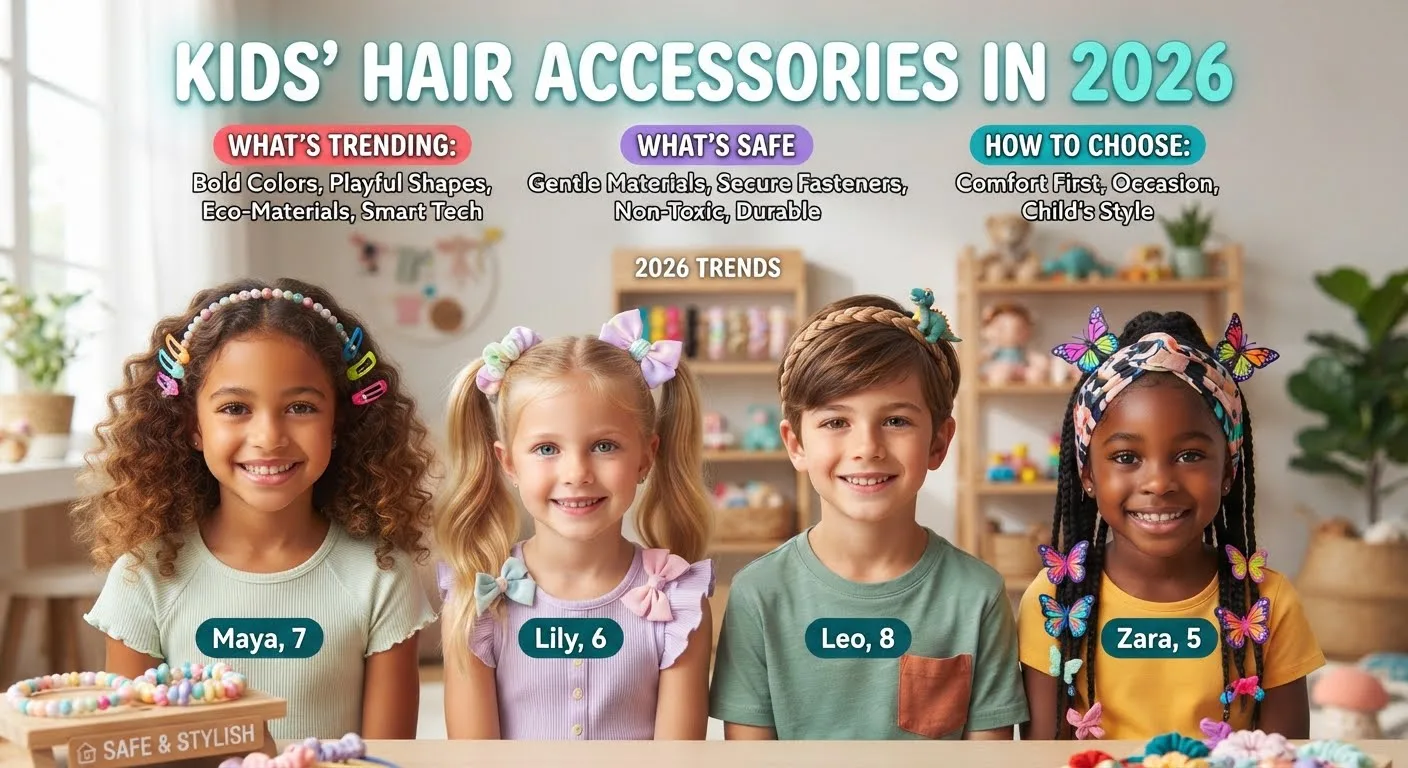
Walk past any school gate this year and look at the bags. More and more of them have something dangling off the zip: a bead charm spelling a name, a tiny plush, a clicker with two initials. Then look at the hair. The plain black clip has given way to bows, letters, rainbow stripes, and clips with a child's name printed across them.
It is a real trend, not just a feeling. Deccan Chronicle reported that Google searches for "bag charms" rose 168% in 2025 and Pinterest searches rose 700%. Children notice what older siblings and their favorite creators are wearing, and they ask for it.
That is fine. Accessories are one of the cheapest ways for a child to express themselves, and a clip they chose is a clip they will actually wear. But "cute" and "safe for a three-year-old" are not the same thing. Here is what is trending, and how to choose well for each age.
What's Trending in 2026
- Name and initial pieces. The biggest shift is personal. Clips with a child's name, letter-bead bag charms, initials on a clicker charm. They look good, and they also solve a practical problem: on a rack of identical school bags, the one with a name swinging off it gets picked up by the right child.
- Days-of-the-week sets. Sets of seven clips, one for each day, have become popular with younger children. Choosing Tuesday's clip on Sunday night turns a morning argument into a small ritual, and it helps little ones learn the days of the week.
- Bows, headbands, and Y2K-style clips. Bigger, brighter, and meant to be seen. Satin bows for functions, colorful snap clips for school.
- Matching sets. Siblings or a parent and child wearing the same initial or color family, especially for festivals and family photos.
- Bag charms everywhere. On school bags, lunch bags, pencil cases, and water bottle loops. For children, charms double as a quick way to spot their own bag.
If you want to see how these trends are being worn across ages this festive season, Zootii's festive trends guide has a round-up for kids, adults, and even pets.
The Types of Clips, and Who They Suit
- Snap clips (the "click-clack" metal clips). Light and easy to put in. Good for fine hair and short fringes. Watch for: very small ones are a choking risk for toddlers, and cheap ones can have rough metal edges or paint that chips.
- Alligator clips (the long, pinch-to-open type). Common on bows and ribbon clips. They hold a section of hair well. Watch for: the bow or decoration is usually glued on, and glue fails.
- Claw clips. Great for older children and thick hair. Watch for: hard plastic claws can pinch small fingers and scalps, and they are uncomfortable when a child leans back in a car seat or lies down for a nap. Plastic can also snap into sharp pieces if stepped on.
- Headbands. No small parts, which makes them a good option for toddlers. Watch for: tight bands that press behind the ears and cause headaches.
- Elastics and bobbles. Choose fabric-covered or seamless ones. Elastics with a metal join can snag and break hair.
Toddlers and Under-Threes: Be Extra Careful
The American consumer safety regulator, the US Consumer Product Safety Commission, bans small parts in toys meant for children under three and uses a test cylinder that approximates the size of a young child's throat. But here is the detail most parents never hear: the same rules list barrettes and clips among the grooming products that are excluded from the small parts ban. In other words, a hair clip is not tested the way a toy is. The safety check is yours to do.
The NHS gives the general rule plainly: young children put small objects in their mouths, and small objects should be kept out of their reach. For hair accessories, that means:
- For babies and young toddlers, prefer headbands or soft bows that are large, or nothing at all.
- Avoid tiny snap clips and anything with glued-on rhinestones, pom-poms, or beads until your child has stopped putting things in their mouth.
- Take clips out before naps, car journeys, and bedtime. A clip that is fine while she is playing is a different object when she is unsupervised.
- Count them in and count them out. If you put in two clips in the morning, look for two at bath time.
The 7-Point Check Before You Buy
Run through this in the shop or as soon as an online order arrives.
- Edges. Run a fingertip along every edge and the inside of the clasp. Nothing should scratch.
- Pull test. Give any decoration (bow, letter, charm) a firm tug. If it moves, it will come off.
- Size. For under-threes, if a clip or a part of it is small enough to disappear into a closed fist, think twice.
- Grip. It should hold without pinching. If it leaves a red mark on the scalp, or your child keeps pulling it out, it is too tight.
- Finish. Printed or painted surfaces should not flake when scratched with a fingernail.
- Weight. Heavy clips drag on fine hair and slide out. Lighter is better for young children.
- Honest labeling. A good seller tells you what the clip is for. Many decorative clips are meant for gentle use, not for sports, swimming, or rough play. That is not a flaw; it is useful information.
Scalp Comfort and Hair Health
Accessories should never hurt. Change where clips sit from day to day, so the same patch of hair is not under tension every morning. Avoid very tight ponytails for long school days. Loosen everything on hot, sweaty days and after sport. And let your child have a say. A child who says a clip hurts is usually right.
Bag Charms: Cute, but Think About Where They Go
Bag charms are mostly an older-child accessory, and they are also a smart way to make a school bag easy to identify. Clip them to a zip pull or a strap ring, not to a long dangling strap that can catch on a bench or bus door. Keep bead charms away from toddlers in the house, for the same reason as small clips. And check the clasp now and then; a lobster clasp that has opened up a little is the usual reason a charm goes missing.
The Short Version
Trendy and safe are not opposites. Choose bigger, simpler pieces for little ones, save the tiny clips and bead charms for children who have stopped mouthing things, check every accessory with your fingers before it goes anywhere near a child's head, and take clips out before sleep. Your child gets to wear the trend, and you get to stop worrying about it.