
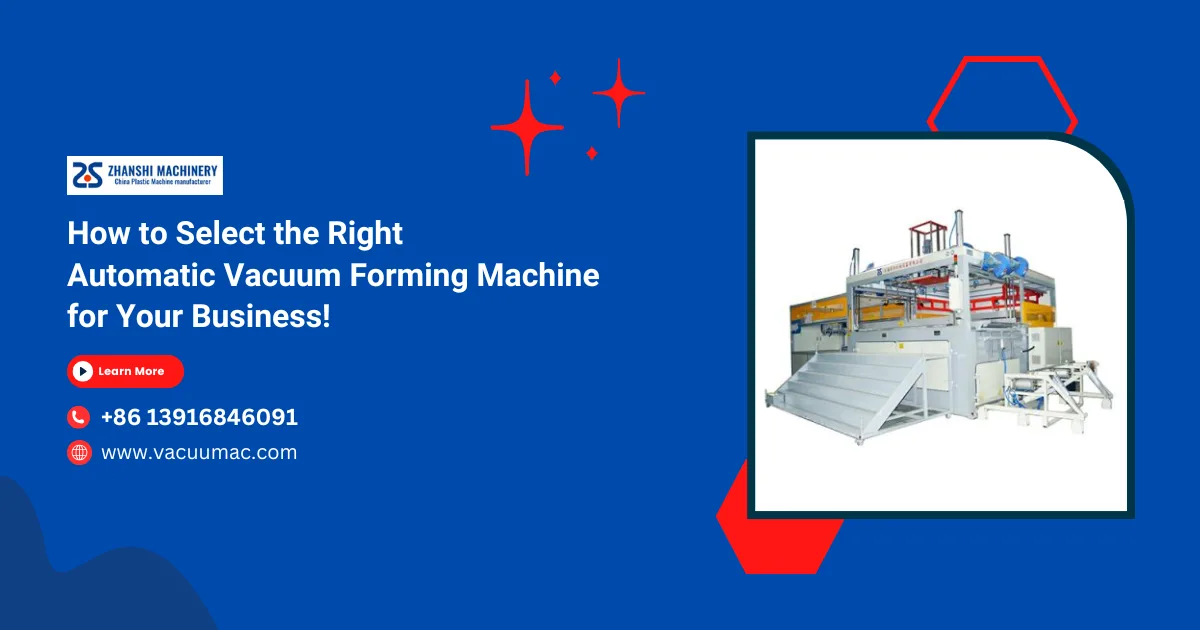
In today's ever-evolving manufacturing landscape, efficient and high-quality plastic forming solutions are crucial for businesses aiming to stay competitive. Whether you're in packaging, automotive, consumer goods, electronics, or any number of other sectors, your ability to produce custom plastic parts quickly, precisely, and cost-effectively can make or break your bottom line. One technology that is consistently at the heart of this capability is the automatic vacuum forming machine.
Adopting the right automatic vacuum forming machine can completely transform your operations, offering improvements in productivity, consistency, and flexibility that simply aren’t available with manual or semi-automatic machines. However, the rapid evolution of vacuum forming technology—paired with a marketplace filled with diverse suppliers and models—means that choosing the ideal system for your unique business needs is no small task. It's a major investment with significant implications for your operation's future growth, scalability, and profitability.
Understanding Automatic Vacuum Forming Machines
What is Automatic Vacuum Forming?
Vacuum forming is a type of thermoforming that uses heat and vacuum pressure to shape a sheet of plastic over a mold. The "automatic" in automatic vacuum forming machine refers to systems that automate the entire process—from feeding and heating the sheet to forming, cutting, stacking, and sometimes packaging—delivering maximal productivity, repeatability, and labor efficiency.
Key features of an automatic vacuum forming machine typically include:
- Automated sheet feeding and clamping
- PID-controlled heating with multiple heating zones
- Fully automated forming and cooling cycles
- Integrated cutting/trimming (in-mold or post-forming)
- Stacking and ejection systems
- Advanced PLC/HMI touch screen controls
- Data tracking for process optimization and quality assurance
Why Invest in an Automatic Vacuum Forming Machine?
For many businesses, the move to automatic equipment is not just a modernization step—it’s a strategic leap forward.
Benefits include:
- Significant labor reduction: Automated processes mean fewer operators are needed.
- Boosted consistency and quality: Every part is formed under tightly controlled, repeatable conditions.
- Reduced errors and waste: Advanced controls adapt to varying materials and minimize scrap.
- Increased throughput: Continuous, high-speed cycles mean much higher output.
- Enhanced flexibility: Modern machines can handle a wide range of plastic types, thicknesses, and part sizes with faster changeovers.
Key Considerations Before Selecting an Automatic Vacuum Forming Machine
1. Define Your Production Needs
Before contacting suppliers, clearly outline:
- The types of products to be made (trays, packaging, automotive, medical devices, signage, etc.)
- Sheet size and thickness ranges
- Volume of output (hourly, daily, annual)
- Tolerances and quality requirements
- Product complexity and special features (undercuts, textures, deep draw, multi-cavity, etc.)
- Types of plastic materials (PS, PET, ABS, PVC, PP, etc.)
With these factors clearly defined, it becomes easier to narrow down suitable models and machine configurations.
2. Machine Size and Forming Area
The forming area of your automatic vacuum forming machine must be adequate for your largest products, while not wasting energy and raw material when forming smaller parts.
- Forming area: Select a machine that fits your full range—from your smallest to your largest parts.
- Depth of draw: Make sure the forming depth (vertical travel) is sufficient for deeper products.
3. Heating and Temperature Control
Different plastics—and even different products—require precise heating profiles. Modern automatic vacuum forming machines offer:
- Multiple, independently controlled heating zones
- Fast, uniform heating with ceramic or quartz infrared elements
- PID controllers for stable, repeatable temperature management
Request data on heating speed, energy efficiency, and uniformity from each supplier.
4. Automation Level & Integration
- Stacking and counting: Automating downstream stacking will save labor and reduce handling damage.
- Trimming: Decide between in-mold or post-forming trimming, depending on edge finish and volume.
- Integration with robotics or secondary operations: Consider how the machine can fit into your current or future automated workflow, including robotic packing or inspection modules.
5. Controls & User Interface
- PLC/HMI: Choose a machine with user-friendly controls, touchscreen diagnostics, and recipe storage for quick changeover.
- Data tracking: The ability to monitor production, downtime, rejects, and maintenance schedules is crucial for lean manufacturing.
- Remote monitoring: Newer machines offer Industry 4.0 compatibility for remote diagnostics/support.
6. Material Versatility
Your business may need to process multiple types of plastic as customer demands change. Make sure your automatic vacuum forming machine is designed for the polymer families you use now, with margin for expansion.
7. Changeover Speed & Flexibility
- Quick tool change: Minimal downtime when swapping molds or forming plates.
- Adjustable clamp frames: Allow efficient handling of different sheet sizes and thicknesses.
- Programmable parameters: Fast and reliable setup for new products.
8. Safety & Compliance
Any major capital investment must meet national and international safety standards, including CE, UL, or ISO as required in your market.
Look for:
- Emergency stop systems
- Guarding and light curtains
- Overload and overheat protection
9. Supplier’s Capabilities and Support
- Customization: Leading manufacturers like Shanghai Zhanshi Mechanical Equipment Co., Ltd. offer tailored configurations, not just off-the-shelf standard models.
- Training: Comprehensive startup assistance for your operators and maintenance team.
- Documentation: Complete user manuals, schematics, and maintenance checklists—preferably in your working language.
- After-sales service: Availability of spare parts, remote diagnostics, on-site support, and preventive maintenance contracts.
The Shanghai Zhanshi Mechanical Equipment Co., Ltd. Difference
Choosing Shanghai Zhanshi means more than just investing in a top-tier automatic vacuum forming machine—it means gaining a dedicated partner for your production needs.
Key differentiators:
- Decades of experience with global client support.
- In-house R&D and custom engineering for unique industry challenges.
- End-to-end project management: From layout and utility planning to installation, training, and lifecycle maintenance.
- Rapid spare parts logistics, both domestically and internationally.
- Continuous technical training and process optimization updates.
- Proven quality: All systems conform to the latest CE/ISO certifications, with documented QA for every delivery.
Calculating ROI for an Automatic Vacuum Forming Machine
The long-term value of upgrading to an automatic vacuum forming machine includes:
- Reduction in headcount or labor reallocation to value-added jobs
- Increased output per square meter of floor space
- Consistently higher-quality finished parts
- Less downtime for maintenance and troubleshooting
- Flexible scalability for new product lines
We recommend working with our engineering team to customize an ROI analysis tailored to your actual production data, labor costs, and sales projections.
Case Study: Unlocking Efficiency in Large-Volume Packaging
A leading consumer goods company replaced three aging semi-automatic machines with a single Shanghai Zhanshi automatic vacuum forming machine. The result? 50% higher throughput, a 60% reduction in labor, improved product consistency, reduced scrap rates, and nearly zero unplanned downtime. The payback period on their investment was less than 18 months, and they are planning expansion with two more machines in the coming year.
Common Pitfalls to Avoid
- Over- or under-sizing: Buying a machine too big increases costs and energy use; too small limits future growth.
- Ignoring after-sales support: Machines require maintenance—ensure your supplier commits to ongoing support.
- Focusing solely on price: The cheapest machine may cost more long-term in downtime, repairs, and inefficiency.
- Underestimating training needs: Even the best equipment underperforms with untrained staff. Insist on operator and maintenance training.
- Not planning for integration: Upgrade projects are smoother with up-front planning for material handling, downstream automation, and ERP/MES connection.
Selecting the right automatic vacuum forming machine is a pivotal decision for any business looking to modernize or expand its production capabilities. The process is about much more than buying hardware—it's about future-proofing your operation for growth, quality, and efficiency.
Frequently Asked Questions (FAQ)
Q1: What materials can be processed on an automatic vacuum forming machine?
A: Most common thermoplastics are suitable, including ABS, PS, HIPS, PVC, PET, PP, PE, and more. Special grades (antistatic, food-safe, biodegradable) can often be processed as well.
Q2: How fast can an automatic vacuum forming machine operate?
A: Cycle times depend on part size, depth, material, and complexity, but top machines can produce 15–45 cycles per minute. Multi-cavity setups can deliver thousands of parts per hour.
Q3: How long does it take to change molds on a modern automatic machine?
A: Depending on the design, changeovers can be accomplished in 30–90 minutes. Some high-end machines offer even faster "quick-change" solutions.
Q4: Can I use recycled or regrind material in my automatic vacuum forming machine?
A: Many machines from Shanghai Zhanshi are compatible with recycled plastics, provided material quality and conditioning are controlled.
Q5: How do I size a machine if my product mix may change?
A: Choose a machine whose forming area and draw depth cover your current and future products. Opt for adjustable clamp frames and programmable controls for greater flexibility.
Q6: What kind of training is included?
A: Shanghai Zhanshi provides on-site operator and maintenance training, detailed manuals, troubleshooting guides, and online or phone technical assistance as needed.
Q7: What is the average lead time for a new automatic vacuum forming machine?
A: Standard models may be delivered in 2–4 months; custom-engineered lines may require more time for design and testing.
Q8: Are after-sales parts and servicing available internationally?
A: Yes, we support clients globally, with fast dispatch of critical parts and, where practical, local technician partnerships for in-person service.
Q9: Can the machine be integrated with robots or other automation?
A: Absolutely. Our machines are often used alongside robotics for stacking, packaging, inspection, and even custom assembly tasks.
Q10: How durable are Shanghai Zhanshi machines, and what type of warranty is offered?
A: Built for industrial use, our machines offer multi-year life under heavy cycles and come with robust warranties covering frame, electronics, and major components. Extended service contracts are available for critical operations.