
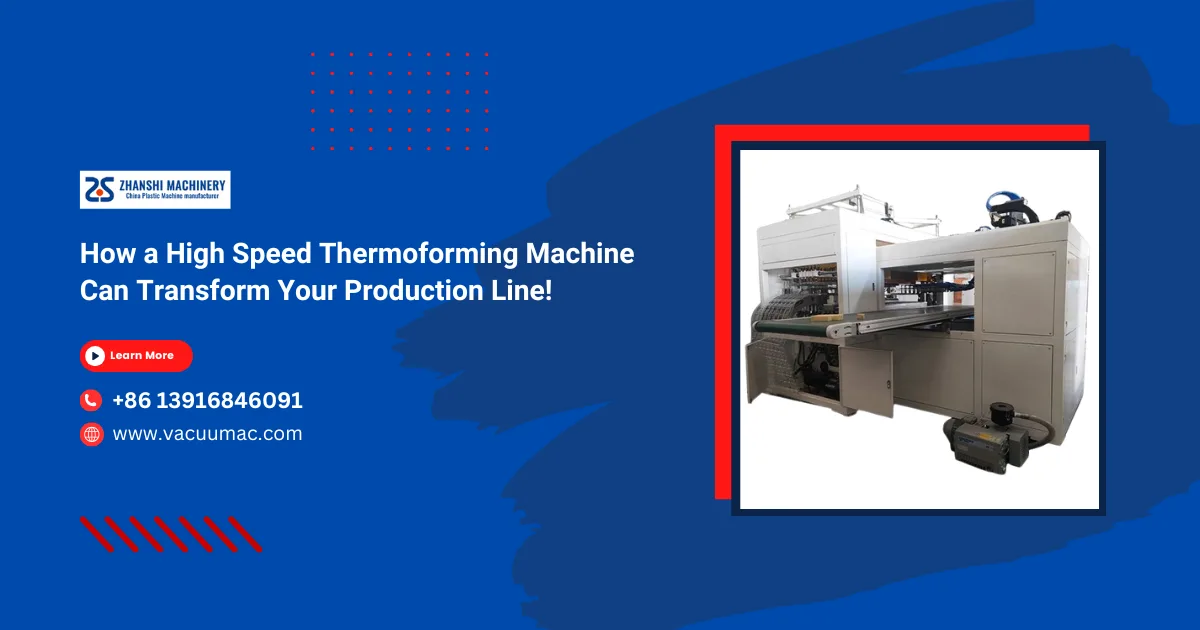
In today’s fast-paced manufacturing environment, companies across industries face ever-increasing demands for efficiency, precision, and scalability. As global markets expand and consumer preferences rapidly evolve, manufacturing operations can no longer afford lengthy downtimes or bottlenecks. Instead, the trend pivots toward automation, digital integration, and speed without compromising product quality.
Amid these changes, the high speed thermoforming machine stands out as a game-changer for factories striving to achieve more in less time. Modern thermoforming technologies, led by premium manufacturers such as Shanghai Zhanshi Mechanical Equipment Co., Ltd., offer unprecedented advantages ranging from increased output to cost reductions and improved product consistency.
Understanding High Speed Thermoforming: The Basics
To begin, let’s clarify what a high speed thermoforming machine is and how it stands apart from standard models available on the market.
Thermoforming is a plastic processing technique whereby a material sheet—typically plastic—is heated to a pliable temperature, formed over a mold, cooled, and trimmed to produce a finished part. This technology is widely used for packaging, medical trays, disposable cups, automotive inserts, electronics housings, and countless consumer products.
Now, high speed thermoforming machines are engineered to maximize throughput. They feature robust heating elements, precision-driven motion controls, optimized mold changes, and integrated automation. In short, these machines complete more forming cycles per minute, minimize downtime, and produce higher volumes, all while retaining strict tolerances and superior surface finishes.
But speed alone is not the only differentiator. The best machines—like those designed and built by Shanghai Zhanshi Mechanical Equipment Co., Ltd.—combine many complementary features to deliver a fully transformative experience for factory managers and business owners alike.
Key Advantages of a High Speed Thermoforming Machine
Let us delve into the primary advantages and see why companies around the world are switching from conventional to high speed thermoforming solutions.
1. Remarkable Increase in Output
The most obvious and impactful benefit is the dramatic boost in production output. Thanks to optimized heating, rapid mold movement, and minimal setup times, a high speed thermoforming machine can process substantially more units per hour than traditional equipment. In some cases, manufacturers have seen output grow by over 50-100%, enabling them to fill larger orders and take on more customers.
2. Consistent and Superior Product Quality
Speed does not mean you have to sacrifice quality. Advanced models come equipped with precise temperature controls, automated pressure regulation, and in-line quality inspection systems. As a result, every unit produced maintains tight dimensional tolerances and consistent material properties. For industries such as food packaging and medical products, this assurance is invaluable.
3. Improved Resource Efficiency
Modern machines, especially those from trusted brands like Shanghai Zhanshi Mechanical Equipment Co., Ltd., are designed to optimize energy consumption and material usage. Faster cycles do not translate into waste; instead, servo-driven mechanisms and smart controls tailor energy delivery, heating duration, and vacuum application to the job at hand. This results in lower per-unit utility costs, less scrap, and more sustainable operations.
4. Flexibility and Versatility
Today’s high speed thermoforming machine is anything but inflexible. Sophisticated servo systems, quick-change tools, and intuitive human-machine interfaces (HMIs) empower operators to switch between products—or even materials and thicknesses—in a matter of minutes. This is a far cry from older machines that required hours or days for such adjustments.
5. Lower Labor Costs
Because automation is built into every layer of control and movement, operator requirements decrease substantially. A smaller, better-trained staff can run more machines, maintain optimal productivity, and spend less time on manual adjustments, cleaning, or troubleshooting. Over time, labor cost savings become a significant contributor to a company’s bottom line.
Technical Innovations Fueling Transformation
High speed thermoforming machines have evolved well beyond their predecessors. Let’s examine some of the standout technologies and how they contribute to transforming a production line.
Servo-Driven Motion Control
Servo motors replace traditional hydraulic and pneumatic drives, ensuring precision and repeatability at high speeds. Operators benefit from smoother acceleration and deceleration, less wear on moving parts, and the ability to program intricate motion profiles.
Advanced Heat Management
Uniform and rapid heating is critical to fast cycle times. Innovations like infrared ceramic heaters, zone-based temperature controls, and feedback sensors prevent hot and cold spots, minimizing the risk of incomplete forming or material degradation.
Integrated Automation and Robotic Handling
Automation is not limited to forming. Integrated robotic arms or pick-and-place units can stack, count, inspect, and package finished products—sometimes at speeds that match or exceed the forming cycle. This end-to-end automation further enhances efficiency.
Touchscreen Interfaces and Intelligent Software
User-friendly touchscreens give operators real-time information about machine status, error alerts, recipe management, and maintenance schedules. Cloud connectivity means data can be logged, problems can be diagnosed remotely, and software upgrades can occur over the air.
In-Line Quality Assurance
Cameras, laser sensors, weight checks, and AI-driven defect detection systems can be built directly into the line. Automatic rejection systems ensure that only conforming products make it downstream, further reducing manual inspection needs.
Rapid-Change Tooling Systems
Quick-release mechanisms, automated locking, and preset programming make it possible to switch molds or tools in a fraction of the time. This supports production of small batch runs or frequent customization with minimal downtime.
Business Transformation: Beyond the Machine
The impact of a high speed thermoforming machine goes far beyond technical specifications. Let’s look at how such an upgrade transforms your production line and business at large.
Reduced Lead Times
Faster cycle times, quick changeovers, and fewer breakdowns mean orders can move from receipt to shipment at record speed. Businesses can respond faster to customer inquiries, meet tight delivery schedules, and flexibly scale production up or down as seasons or demand fluctuate.
Enhanced Competitive Positioning
By delivering more, faster, and with consistent quality, you’ll be positioned to win contracts and customers that legacy systems simply can’t service. This can open new markets and result in stronger relationships with existing clients who value reliability.
Lower Total Cost of Ownership
Though high speed thermoforming machines may require higher upfront investment, their total cost over time is offset by reduced energy bills, lower labor costs, decreased scrap, improved uptime, and minimized maintenance. Many Shanghai Zhanshi clients report payback periods far shorter than anticipated.
Sustainability and Green Manufacturing
Today’s market—particularly in food, medical, and consumer goods—demands eco-friendly products. Machines that reduce waste, use recycled materials, and run energy efficiently put your factory at the forefront of sustainability, enhancing your brand reputation and appeal.
Real-World Applications: Industries Leading the Charge
Different industries benefit in different ways. Here are a few sectors where high speed thermoforming has transformed what’s possible:
-Food Packaging
The food industry relies on rapid, high-volume production with the strictest requirements for hygiene and product integrity. High speed thermoforming machines allow for the creation of custom containers, lids, and trays—often with integrated printing or sealing processes—all at rates suitable for supermarket demand.
-Medical Devices and Pharmaceuticals
Sterility and precision are paramount. Shanghai Zhanshi’s high speed machines allow rapid production of blister packs, syringe trays, and diagnostic kit components, meeting both output and safety requirements while supporting frequent changes to design or format.
-Consumer Goods and Electronics
From clamshell packaging to device housings, the electronics sector values both output and flexibility. The advanced automation found in Shanghai Zhanshi models supports small-batch and mass production, enabling factories to serve both niche and mainstream markets.
-Automotive
Dashboards, protective covers, and functional trim components are now commonly made using thermoforming. The fast cycle times and ability to process complex, multi-material laminates make high speed machines ideal for automotive lines focusing on both cost and quality.
A Step-By-Step Example: Transforming a Production Line
Let’s walk through a hypothetical example to illustrate just how a high speed thermoforming machine can transform a typical production line:
Step 1: Upgrading Equipment
A packaging company replaces an aging, semi-automatic thermoformer with a Shanghai Zhanshi high speed model. Installation occurs over a weekend, with minimal downtime.
Step 2: Training and Automation
Operators receive on-site training on the new HMI and automation features. Tasks that previously involved three operators can now be handled by one, freeing up staff for other assignments.
Step 3: Production Runs
First runs reveal a 75% increase in trays per hour. Quality levels, inspected via inline camera systems, show a reduction in defect rates from 4% to 0.2%.
Step 4: Changeover and Batch Flexibility
Within the first month, the plant switches tray type five times with just 30 minutes for each changeover—compared to up to four hours with the old system.
Step 5: Bottom-Line Impact
Energy usage per unit drops by 10%. Labor costs decrease by 35%. The company is able to accept orders from two new customers, boosting annual revenue.
This example, inspired by real Shanghai Zhanshi customer outcomes, highlights the transformative potential of a high speed thermoforming machine.
Integration Best Practices: Ensuring a Seamless Transition
Investing in a high speed thermoforming machine is a major decision. However, with the right planning and support, integration can be smooth and disruption minimal. Consider these best practices:
- Assess production goals and calculate desired output per shift.
- Collaborate with your supplier (like Shanghai Zhanshi) for thorough site preparation and machine customization.
- Train operators and maintenance teams on both basic operations and advanced troubleshooting.
- Implement preventative maintenance schedules from day one; use digital logging for proactive care.
- Leverage automation and downstream solutions for stacking, labeling, or packaging to maximize efficiency gains.
- Monitor output and quality metrics post-installation and be ready to fine-tune process settings for evolving needs.
Shanghai Zhanshi Mechanical Equipment Co., Ltd. offers comprehensive support, from pre-installation surveys to ongoing technical consulting and rapid spare part supply.
The Shanghai Zhanshi Mechanical Equipment Co., Ltd. Advantage
Choosing a high speed thermoforming machine is about more than just hardware. It is about relying on a technology partner with a track record of innovation, reliability, and customer service.
At Shanghai Zhanshi, our engineers design and assemble every machine with the unique goals of each client in mind. With ongoing R&D, modular system options, and a global support network, we empower businesses to achieve new heights.
Transitioning to a high speed thermoforming machine is one of the most impactful upgrades a production line can make. Not only does it slash cycle times and amplify throughput, but it also brings transformative benefits in quality assurance, operational cost, versatility, and long-term sustainability.
Frequently Asked Questions
Q1: How fast can a high speed thermoforming machine actually run?
The answer depends on the size and type of product. Many can form up to 40-60 cycles per minute, with multiple cavities per cycle, leading to thousands of parts per hour.
Q2: Are these machines suitable for small batch runs?
Absolutely. The rapid changeover and programmable settings mean high speed machines can handle both large and small batches efficiently.
Q3: Does increased speed come at the expense of quality?
Not with modern designs. Advanced controls, sensors, and automation ensure product quality remains high, as evidenced in many Shanghai Zhanshi client installations.
Q4: Is operator training complex for these advanced systems?
While high speed machines use sophisticated tech, intuitive touchscreens and guided workflows make them accessible. Shanghai Zhanshi provides comprehensive training for seamless onboarding.
Q5: What support is available after installation?
Shanghai Zhanshi offers both remote and on-site support, spare parts logistics, and periodic maintenance to ensure maximum uptime and performance.
Q6: Can high speed thermoforming machines handle recycled or biodegradable materials?
Yes! Newer models can be tuned for various material characteristics, including recycled or bio-based plastics, supporting your sustainability initiatives.
Q7: How long does it take to see ROI from such an upgrade?
Many clients report full payback within one to two years based on labor, material, and energy savings combined with higher revenue from greater capacity.