
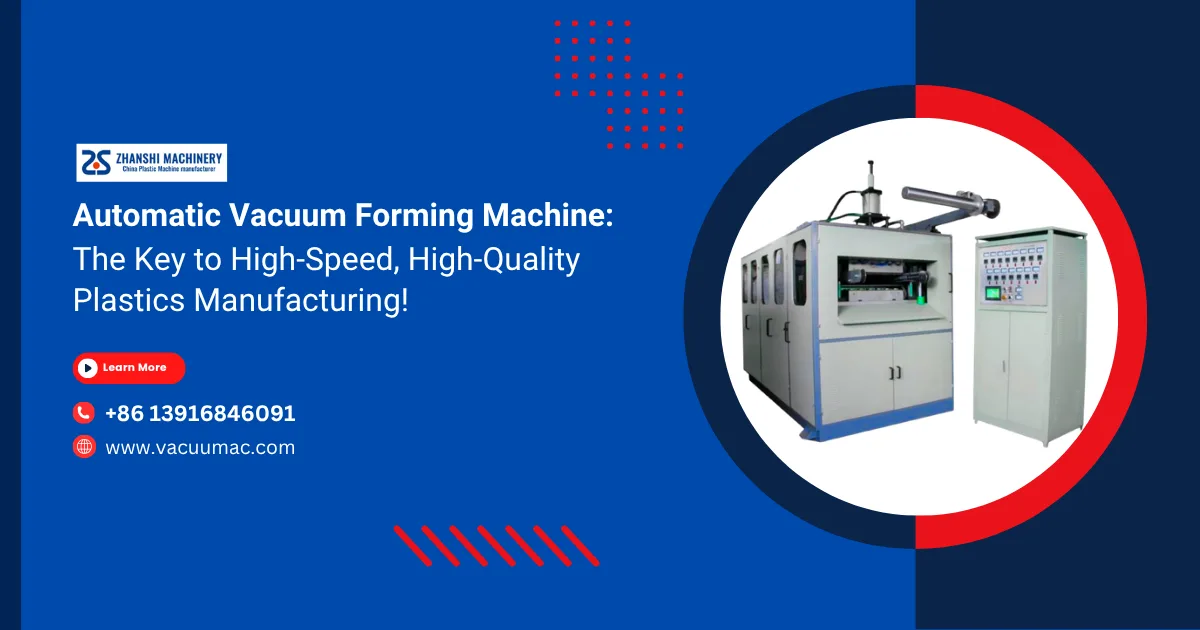
In today’s fast-paced manufacturing landscape, the demand for efficient, reliable, and high-quality plastic products is at an all-time high. From food packaging and automotive components to consumer goods and medical devices, plastics play a pivotal role in nearly every industry. As product designs become more complex and market competition intensifies, manufacturers are under increasing pressure to deliver superior products at faster rates and lower costs. This is where the automatic vacuum forming machine emerges as a game-changing solution.
At Shanghai Zhanshi Mechanical Equipment Co., Ltd., we understand that the backbone of successful plastics manufacturing lies in the ability to combine speed, precision, and consistency. The automatic vacuum forming machine is engineered to meet these exacting requirements, offering manufacturers a powerful tool to streamline production, reduce labor costs, and achieve exceptional product quality.
Understanding Automatic Vacuum Forming
What is an Automatic Vacuum Forming Machine?
An automatic vacuum forming machine is a highly advanced piece of equipment designed to shape plastic sheets into precise, three-dimensional forms using heat and vacuum pressure. Unlike manual or semi-automatic machines, automatic vacuum forming machines are equipped with automated feeding, heating, forming, cooling, and trimming systems. This automation enables continuous, high-speed production with minimal human intervention, ensuring consistent quality and maximizing throughput.
How Does Automatic Vacuum Forming Work?
The process of automatic vacuum forming involves several key steps:
- Sheet Feeding: Plastic sheets are automatically fed into the machine from a roll or stack.
- Heating: The sheet is heated to a pliable temperature using infrared or contact heaters.
- Forming: The heated sheet is positioned over a mold, and a vacuum is applied to draw the sheet tightly against the mold’s surface, creating the desired shape.
- Cooling: The formed part is cooled to retain its shape and ensure dimensional stability.
- Trimming: Excess material is automatically trimmed away, leaving a finished product ready for further processing or packaging.
- Ejection: The finished part is ejected from the mold, and the cycle repeats.
This fully automated process allows for rapid, repeatable production of complex plastic parts with high precision and minimal waste.
The Advantages of Automatic Vacuum Forming Machines
1. High-Speed Production
One of the most significant benefits of an automatic vacuum forming machine is its ability to operate at high speeds. Automated feeding, forming, and trimming systems enable continuous production, drastically reducing cycle times compared to manual or semi-automatic processes. This increased throughput is essential for meeting large-volume orders and tight delivery schedules.
2. Consistent Quality
Automation ensures that every part is formed under identical conditions, resulting in uniform thickness, shape, and surface finish. This consistency is critical for industries where product quality and repeatability are non-negotiable, such as food packaging, medical devices, and automotive components.
3. Reduced Labor Costs
By automating the entire forming process, manufacturers can significantly reduce the need for manual labor. Operators are freed from repetitive tasks and can focus on quality control, maintenance, and process optimization, leading to higher overall productivity.
4. Material Efficiency
Automatic vacuum forming machines are designed to minimize material waste. Precise control over sheet feeding and trimming ensures that only the necessary amount of plastic is used, reducing scrap and lowering material costs.
5. Versatility
These machines can process a wide range of thermoplastic materials, including ABS, PET, PVC, PS, PP, and more. They are also capable of producing parts in various sizes, shapes, and thicknesses, making them suitable for diverse applications.
6. Enhanced Safety
Automation reduces the risk of workplace injuries associated with manual handling of hot materials and moving parts. Modern machines are equipped with safety features such as emergency stops, interlocks, and protective guards.
7. Integration with Downstream Processes
Automatic vacuum forming machines can be seamlessly integrated with downstream equipment such as stacking, packing, and labeling systems, creating a fully automated production line.
Innovative Applications of Automatic Vacuum Forming Machines
The versatility and efficiency of automatic vacuum forming machines have led to their widespread adoption across numerous industries. Let’s explore some of the most innovative and impactful applications:
1. Food Packaging
a. Disposable Containers and Trays
Automatic vacuum forming machines are widely used to produce disposable food containers, trays, lids, and clamshell packaging. The high-speed production and consistent quality are essential for meeting the demands of the food service and retail sectors.
b. Blister Packs
Blister packaging for candies, snacks, and ready-to-eat meals is efficiently manufactured using automatic vacuum forming, ensuring product safety and shelf appeal.
2. Medical and Pharmaceutical
a. Medical Device Packaging
Sterile packaging for syringes, vials, and surgical instruments requires precise forming and sealing. Automatic vacuum forming machines deliver the accuracy and hygiene standards needed for these critical applications.
b. Diagnostic Trays and Components
Custom trays for diagnostic kits and laboratory equipment are produced with tight tolerances and smooth finishes, supporting the medical industry’s stringent requirements.
3. Automotive Industry
a. Interior and Exterior Components
From dashboard panels and door trims to wheel covers and protective liners, automatic vacuum forming machines enable the production of lightweight, durable, and aesthetically pleasing automotive parts.
b. Custom Prototyping
Automotive designers use vacuum forming for rapid prototyping of new components, allowing for quick design iterations and testing.
4. Consumer Goods
a. Appliance Housings
Vacuum forming is used to create housings and panels for household appliances such as refrigerators, air conditioners, and washing machines.
b. Toys and Sporting Goods
Complex shapes and vibrant colors are easily achieved, making vacuum forming ideal for producing toys, helmets, and sports equipment.
5. Electronics
a. Device Enclosures
Protective enclosures for electronic devices, including routers, control panels, and instrument cases, are efficiently manufactured with automatic vacuum forming machines.
b. Packaging Inserts
Custom inserts for electronics packaging ensure safe transport and attractive presentation.
6. Industrial and Commercial Applications
a. Machine Guards and Covers
Safety guards, covers, and panels for industrial machinery are produced with high precision and durability.
b. Point-of-Purchase Displays
Retailers use vacuum-formed displays and signage to attract customers and showcase products.
How Automatic Vacuum Forming Machines Are Transforming Manufacturing
-Speed to Market
With rapid prototyping and high-speed production capabilities, automatic vacuum forming machines enable manufacturers to bring new products to market faster than ever before. This agility is crucial in industries where trends and consumer preferences change rapidly.
-Customization and Flexibility
Manufacturers can quickly switch between different molds and materials, allowing for short production runs and customized products without significant downtime or retooling costs.
-Sustainability
Modern automatic vacuum forming machines are designed for energy efficiency and minimal waste. Many thermoplastics used in the process are recyclable, supporting circular economy initiatives and reducing environmental impact.
-Quality Assurance
Advanced control systems and real-time monitoring ensure that every part meets strict quality standards. Automated inspection and rejection systems further enhance product reliability.
The Role of Shanghai Zhanshi Mechanical Equipment Co., Ltd.
At Shanghai Zhanshi Mechanical Equipment Co., Ltd., we are dedicated to advancing the capabilities of plastics manufacturing through our innovative automatic vacuum forming machines. Our equipment is engineered for precision, reliability, and versatility, enabling our clients to achieve superior results across a wide range of applications.
Why Choose Our Automatic Vacuum Forming Machines?
- Cutting-Edge Technology: Our machines feature advanced heating, forming, and control systems for consistent, high-quality results.
- Customization: We offer tailored solutions to meet the unique needs of your production environment and product specifications.
- Comprehensive Support: From initial consultation to installation, training, and after-sales service, our team is committed to your success.
- Sustainability: Our machines are designed for energy efficiency and minimal material waste, supporting your sustainability goals.
The automatic vacuum forming machine is a cornerstone of modern plastics manufacturing, offering unparalleled speed, precision, and versatility. Its ability to produce high-quality parts at scale makes it an invaluable asset for industries ranging from food packaging and medical devices to automotive and consumer goods. As manufacturers continue to seek innovative solutions to meet the demands of today’s market, automatic vacuum forming stands out as a technology that delivers both performance and efficiency.
Frequently Asked Questions (FAQ)
1. What materials can be used with an automatic vacuum forming machine?
A wide range of thermoplastics can be used, including ABS, PET, PVC, PS, PP, and more. The choice of material depends on the desired properties of the final product, such as clarity, strength, or chemical resistance.
2. How fast can an automatic vacuum forming machine operate?
Cycle times vary depending on the part size and complexity, but modern machines can produce several hundred to thousands of parts per hour, making them ideal for high-volume production.
3. What are the main advantages of automatic vacuum forming over manual or semi-automatic processes?
Automatic machines offer higher speed, consistent quality, reduced labor costs, and the ability to integrate with other automated systems for a seamless production line.
4. Can automatic vacuum forming machines handle large parts?
Yes, machines are available in various sizes to accommodate both small and large parts. The maximum sheet size and forming area depend on the specific model.
5. Is automatic vacuum forming suitable for prototyping?
Absolutely. The process allows for rapid prototyping and short production runs, enabling quick design iterations and testing.
6. How precise is the automatic vacuum forming process?
Modern machines offer high precision in temperature control, forming pressure, and mold design, resulting in parts with tight tolerances and excellent repeatability.
7. What post-processing is required after vacuum forming?
After forming, parts are typically trimmed to remove excess material and may undergo additional finishing processes such as drilling, painting, or assembly.
8. Can recycled materials be used in automatic vacuum forming?
Yes, many thermoplastics used in the process are recyclable, and recycled materials can often be incorporated, supporting sustainability initiatives.
9. How do I choose the right automatic vacuum forming machine for my application?
Consider factors such as sheet size and thickness, material compatibility, production volume, and the complexity of the parts you need to produce. Consulting with an experienced supplier like Shanghai Zhanshi Mechanical Equipment Co., Ltd. can help you make the best choice.
10. What kind of maintenance do automatic vacuum forming machines require?
Regular maintenance includes cleaning heating elements, checking vacuum and pressure systems, lubricating moving parts, and inspecting electrical components to ensure optimal performance and longevity.