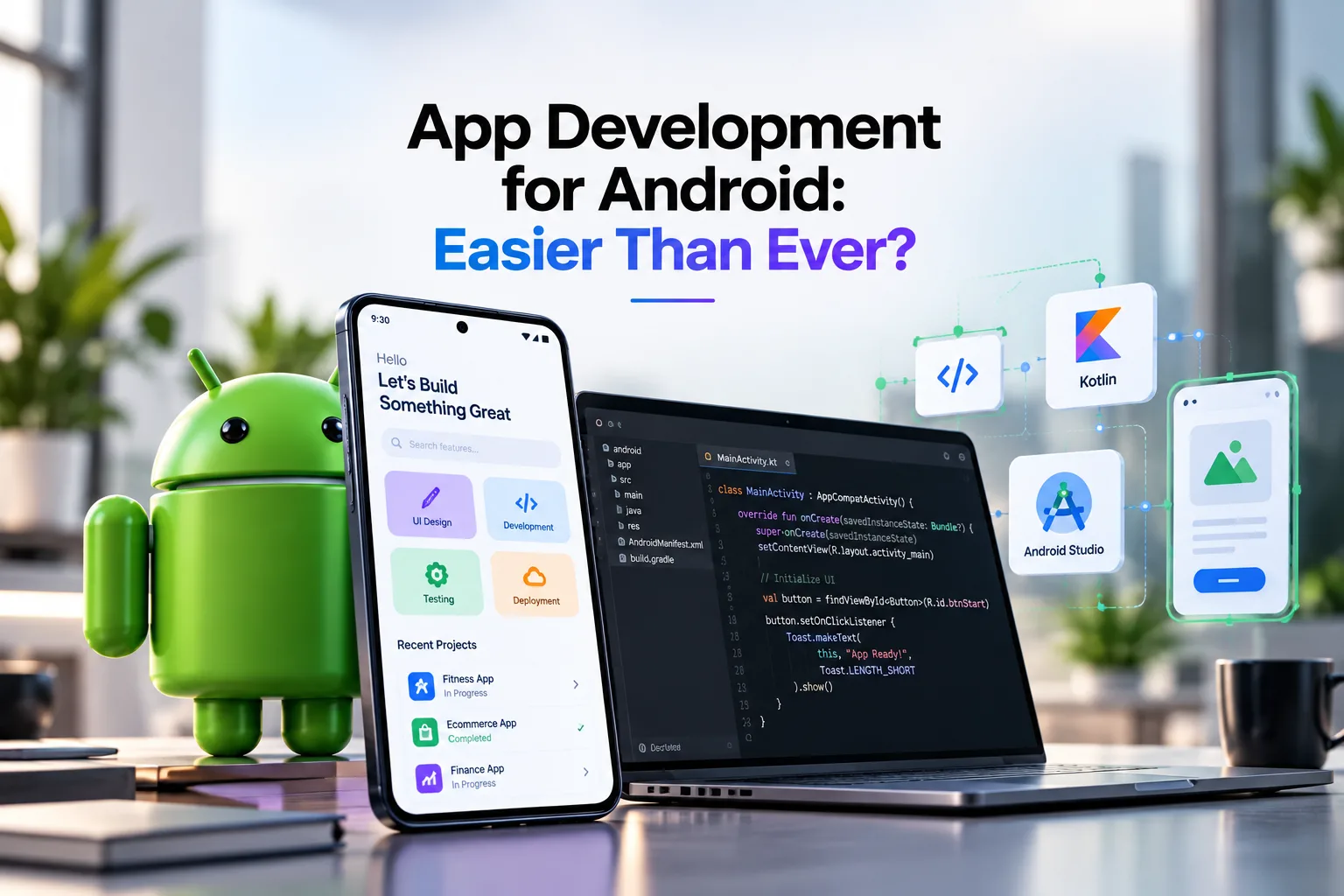
For years, building a mobile app required a clear technical plan, development know-how, time, and a budget. Even a simple idea could involve designing screens, writing code, testing features, and getting the app ready to ship. AI-powered coding tools are starting to change that process.
Today, you can describe an app idea to an AI in plain English, and it can generate a working version. This method, known as vibe coding, is making it easier for entrepreneurs, small businesses, and people who don’t know how to code well to build apps.
But easier app creation raises an important question: can anyone turn a prompt into an app that is reliable enough for real business use?
How AI Prompts Are Transforming Android App Development
In traditional development, business requirements are translated into technical specifications and then implemented in code. AI-assisted development makes the process more conversational. Users describe what they want, see what the tool generates, and refine it with additional prompts.
For example, a small business owner may want a booking app that includes a calendar, customer details, and booking confirmations. An AI tool can help create an initial interface and app code, allowing the owner to explore the idea before diving into a full development project.
Google has been expanding this approach through Google AI Studio. In May 2026, Google announced support for building native Android apps from prompts. In October 2026, Google Play introduced a feature that allows eligible users in certain markets, including the United States, to launch personal AI-built Android apps on their own devices without needing a developer account. These apps are not part of the public Play Store catalogue. Read Google’s official announcement.
This trend points to a larger shift: building an initial app is becoming less dependent on traditional coding skills.
Who Benefits From Easier App Building?
AI-assisted development can be especially valuable when you want to explore an idea, solve a narrow problem, or test a workflow before investing in a larger product.
Entrepreneurs and start-ups: Founders can build prototypes to test an idea, get early feedback, and determine which features are most important before spending significant money.
Small businesses: Teams can explore simple internal tools, such as task trackers, inventory interfaces, or appointment planners, that suit their particular operational requirements.
Non-technical innovators: Those with industry knowledge but little coding experience can test digital solutions and communicate their needs to developers more effectively.
Product teams: Experienced developers can use AI-generated code as a starting point for prototyping, repetitive tasks, and focused implementation efforts. They can then spend more time reviewing architecture, handling complex requirements, and improving the user experience.
What’s great here isn’t that you can now build any app instantly. It’s that businesses can test assumptions earlier and make better decisions before committing to development.
Why an AI-Generated App Isn't Business-Ready Out of the Box
A demo might look good, but a prototype might not work as expected when real users start using it. Writing reliable software involves more than just code generation.
Security and Data Protection
Business applications may include customer information, payment details, employee records, or proprietary business data. These requirements call for careful decisions about authentication, permissions, data storage, encryption, and secure communication.
Review AI-generated code for security vulnerabilities and inappropriate handling of sensitive information. Businesses should also review the data policies of the tools they’re using and refrain from sending sensitive information to services without proper authorisation.
Business Processes and Integrations
A standalone prototype is different from an app that connects to existing business systems. A production app may need to communicate with payment gateways, customer relationship management systems, inventory databases, or third-party APIs.
These integrations involve more than a working interface. They require permissions, error handling, data integrity, and clear decisions about how systems should respond when a connection is lost.
Testing in Real-Life Conditions
An app built using sample data may not perform the same way when people enter unexpected data, lose connectivity, or perform multiple actions at once.
Test cases should cover normal workflows, invalid inputs, device compatibility, performance, accessibility, and failure scenarios. Apps that support critical business operations also need appropriate data integrity and recovery checks.
Scalability and Maintenance
A quick prototype may be suitable for a small number of users but struggle as the user base grows. Businesses need to consider architecture, performance, infrastructure costs, monitoring, updates, and long-term maintenance.
AI tools can accelerate implementation, but someone still needs to determine whether the underlying design can accommodate the anticipated growth of the product.
A Real-Life Approach to Using AI in App Development
Instead of seeing AI as a complete replacement for the development process, companies can use it at different stages.
- Define the problem. Identify the target users, the problem the app needs to solve, and the outcome the business expects.
- Build a small prototype. Explore the interface and demonstrate the core workflow using AI-assisted tools.
- Test the idea. Have potential users try the prototype and identify confusing steps, missing features, and unnecessary complexity.
- Determine the technical requirements. Identify features that will need secure back-end services, integrations, user accounts, or specialised development.
- Test and refine. Verify that the app behaves correctly under realistic conditions before relying on it.
- Prepare for production. Consider security, performance, deployment, monitoring, and maintenance before making an app available to a wider audience.
This process enables businesses to benefit from faster experimentation without overlooking the work necessary to deliver a reliable product.
When Is It Right for a Business to Bring in Professional Developers?
Prototypes built with AI tools can be useful for exploring possibilities, but professional development becomes especially important when the app supports revenue, customer relationships, sensitive data, or essential business operations.
An experienced team can translate business goals into technical requirements, select the right architecture, evaluate security risks, integrate with existing systems, and establish a testing and ongoing maintenance process. If you are looking for a mobile app development company in the USA, you can assess teams based on their technical knowledge, development approach, security standards, and ability to support the product after launch.
Another important consideration is feature planning. Implementing every suggested feature can increase complexity, development effort, and maintenance costs. A better approach is to prioritise features based on user needs and business value. Artificial intelligence can help teams make better decisions through informed planning where necessary. Read more about how AI helps define mobile app features.
The Future: Easier to Build, Greater Demand for Sound Decisions
AI is lowering the barrier to experimenting with mobile app ideas. Individuals can build their own tools, start-ups can validate ideas faster, and existing companies can test ideas before committing to large-scale development.
But accessibility doesn't remove the need for technical judgement. The more important questions remain whether an app solves a genuine problem, protects its users, performs reliably, and can be maintained over time.
The best approach combines the speed of AI-assisted creation with clear requirements, meaningful user feedback, proper testing, and professional expertise where complexity demands it.
AI may make it easier to build the first version. Building an app that people and businesses can depend on still requires thoughtful decisions throughout the development process.