
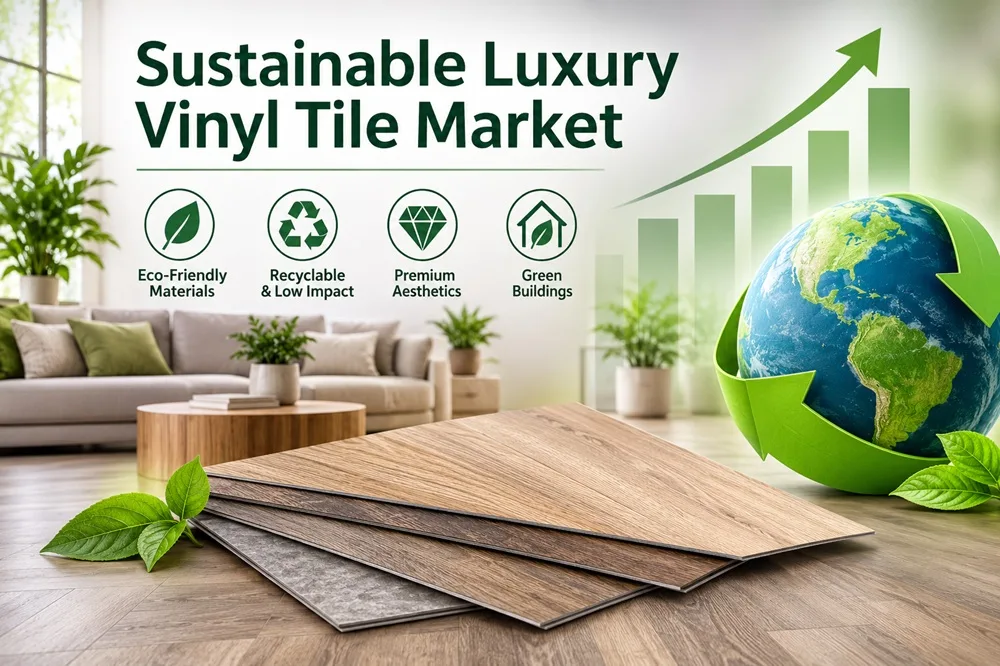
The Sustainable Luxury Vinyl Tile Market is gaining momentum as flooring manufacturers increasingly incorporate recycled materials and bio-attributed feedstocks into their products. Valued at $5,177.4 million in 2025, the market is projected to reach $11,407.8 million by 2035, growing at a CAGR of 7.95% from 2026 to 2035.
What are the Key Drivers of the Sustainable Luxury Vinyl Tile Market?
- Growing adoption of green building standards: Environmental certifications and sustainable procurement requirements are encouraging developers, architects, and building owners to select flooring products with verified recycled content and improved environmental performance.
- Increasing commercial renovation activities: Renovation and replacement projects across offices, retail spaces, healthcare facilities, and hospitality properties are generating demand for durable, water-resistant, and easy-to-maintain flooring solutions.
- Expansion of recycled PVC feedstock availability: Improvements in PVC collection, sorting, and recycling infrastructure are increasing the availability of recovered materials for sustainable flooring production.
- Rising demand for circular building materials: Growing awareness of resource efficiency and responsible material sourcing is encouraging manufacturers to reduce dependence on virgin raw materials and adopt circular production practices.
Which End Users are Driving Demand for Sustainable Luxury Vinyl Tile?
The residential sector represents the largest end-user segment, supported by housing construction, renovation, and flooring replacement activities. Homeowners increasingly prefer sustainable flooring that combines attractive wood- and stone-inspired designs with durability, moisture resistance, and easy maintenance. Commercial applications, including offices, retail stores, hospitality facilities, healthcare institutions, educational buildings, and public infrastructure, also contribute to market demand.
Download the ToC for Sustainable Luxury Vinyl Tile Market - Focus on Application, Product Construction, Primary Sustainability Pathway, and Region Analysis and Forecast, 2026-2035
What are the Key Trends Shaping the Sustainable Luxury Vinyl Tile Market?
- Increasing integration of recycled materials: Manufacturers are incorporating post-consumer and pre-consumer recycled PVC into flexible and rigid-core flooring products to reduce virgin material consumption.
- Growing adoption of bio-attributed PVC: The use of bio-based and bio-circular feedstocks through mass-balance approaches is creating alternative pathways for sustainable flooring production.
- Rising demand for rigid-core flooring: Stone polymer composite (SPC) and wood polymer composite (WPC) products are gaining popularity due to their dimensional stability, water resistance, durability, and installation convenience.
- Development of closed-loop recycling solutions: Flooring take-back programs, material recovery initiatives, and recycling partnerships are gaining importance as manufacturers work toward improving product circularity.
Which Regions are Leading the Sustainable Luxury Vinyl Tile Market?
North America dominated the global market in 2025, accounting for approximately 37.6% of revenue, equivalent to $1,946.7 million. Its leadership is supported by established flooring manufacturers, residential replacement demand, commercial renovation, and increasing adoption of recycled-content products. Europe also represents a significant market, while Asia-Pacific offers growth opportunities through expanding construction activities, manufacturing capabilities, and rising demand for sustainable flooring solutions.
What Challenges and Opportunities Exist in the Market?
The market faces challenges related to the cost competitiveness of sustainable products, inconsistent recycled PVC feedstock quality, and difficulties associated with collecting and processing used flooring materials. Chemical contamination and legacy additives in recovered PVC also create concerns regarding material safety, regulatory compliance, and product quality. Additionally, manufacturers must demonstrate the economic and environmental benefits of sustainable alternatives compared with conventional flooring products.
However, several opportunities are emerging through closed-loop recycling systems, flooring take-back services, and the development of advanced sustainable products for premium commercial applications. Innovations in alternative plasticizers, bio-attributed feedstocks, and recycled polymer formulations can further support product development. Country-specific green procurement programs and environmental certification requirements are also expected to create opportunities for manufacturers offering traceable materials and verified environmental performance.
Who are the Key Players in the Sustainable Luxury Vinyl Tile Market?
The competitive landscape includes established flooring manufacturers, resilient flooring specialists, and companies investing in recycled and bio-attributed material technologies. These players are focusing on product innovation, sustainable raw material sourcing, manufacturing efficiency, and circular flooring solutions.
The key companies operating in the market include:
- Mohawk Industries
- Tarkett
- Shaw Industries
- Gerflor
- NOX Corporation
- Interface
- Mannington Mills, Inc.
- Novalis Innovative Flooring
- Forbo Flooring Systems
- AHF Products/Armstrong Flooring
- Engineered Floors/J+J Flooring Group
- Karndean Designflooring
- Beaulieu International Group/Congoleum
- CFL Flooring
- James Halstead/Polyflor
Competition increasingly revolves around recycled PVC integration, bio-attributed materials, alternative plasticizers, product durability, low-emission performance, water resistance, and design flexibility. Strategic partnerships with recycling companies, raw material suppliers, distributors, and certification organizations are also helping manufacturers strengthen their market positions.
Conclusion
The Sustainable Luxury Vinyl Tile Market is expected to experience strong growth as the flooring industry transitions toward circular materials and environmentally responsible manufacturing. Increasing adoption of recycled PVC, bio-attributed feedstocks, and rigid-core flooring technologies will create new opportunities for manufacturers. Companies investing in material innovation, recycling infrastructure, and sustainable product development will be better positioned to address evolving construction requirements and environmental expectations.