Quick Summary: If your business deals with different languages, reviews calls, or needs searchable records, an AI softphone is the clear pick, it translates conversations live, writes them down in your language, and summarizes them. If none of that applies, a traditional softphone still does the core job well. And since AI features layer on top of reliable calling rather than replacing it, choosing AI means gaining capabilities without losing anything you already rely on.
If you're choosing a softphone for your business right now, you've probably noticed the options have split into two camps. There's the traditional softphone, the kind that's been around for years and does one job well: connect calls. And there's the newer AI-powered softphone, which does that and a whole lot more on top.
So which one should you actually pick? The honest answer is that it depends on what your business does with its calls, but the decision is easier to make once you understand what genuinely separates the two. Here's a straight look at how they compare and how to choose.
The quick definition of each
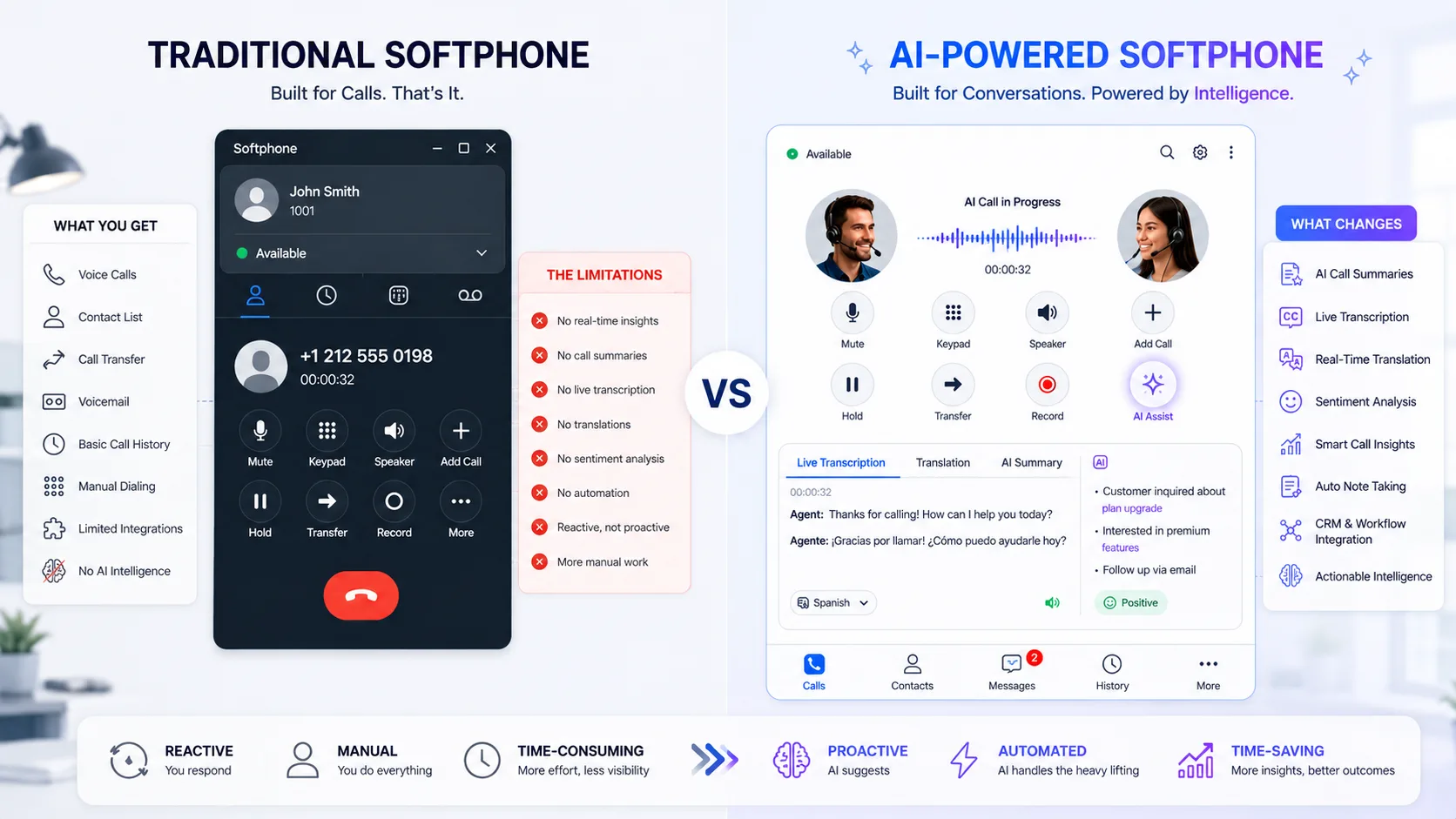
A traditional softphone is a calling app that connects calls over the internet. It handles the essentials well: clear audio, reliable connections, call history, contacts. It's the digital version of a desk phone, and for a lot of businesses it's been perfectly sufficient.
An AI-powered softphone does everything a traditional one does, then adds a layer of AI on top. It can translate a conversation live across languages, show a transcript in the reader's own language, summarize the call afterward, and turn conversations into searchable records. Where a traditional softphone carries the call, an AI one also works with what's said in it.
The key thing to understand before choosing
Here's the point that makes the decision clearer, and it's worth getting straight before anything else.
An AI softphone doesn't replace reliable calling, it builds on it. The AI features sit as a layer on top of the same dependable call quality a good traditional softphone gives you. So choosing an AI softphone isn't a trade-off where you risk the basics to get clever features. You keep everything a traditional softphone offers and gain the AI capabilities alongside it.
That reframes the whole decision. It's not "traditional's reliability versus AI's features." It's "reliability, or reliability plus a lot more." Which makes the real question simply whether your business would use the extra capabilities.
When an AI softphone is clearly the right choice
There are a few situations where the AI features stop being nice extras and become genuinely valuable.
If you talk to customers or partners who speak different languages, this is the big one. An AI softphone translates conversations live, in both directions, so your team and your customers each speak their own language and understand each other. A capable AI vs traditional softphone comparison usually shows this as the single biggest differentiator, and for good reason: it replaces expensive multilingual hiring or interpreters with a feature you switch on. Some platforms handle 70+ languages with automatic detection.
If your team reviews calls, the automatic summaries and searchable transcripts save real time. Instead of scrubbing through a recording to find what was said, you read a summary in seconds or search the transcript by keyword.
If you work in a regulated industry, having documented, searchable, compliance-ready records built in is a genuine advantage rather than something you bolt on later.
And if your team is spread across languages or locations, the live translation and translated transcripts keep everyone on the same page regardless of what language a given call happened in.
When a traditional softphone is still fine
Being straight about it: not every business needs the AI layer, and there's no shame in that.
If your team all speaks the same language, you rarely review calls, and you don't need searchable records, a solid traditional softphone will serve you well. The AI features solve specific problems, and if you don't have those problems, you won't miss the solutions.
That said, even here it's worth thinking a step ahead. Businesses grow, take on customers in new markets, and add compliance needs over time. Choosing a softphone that can grow into AI features, even if you don't use them on day one, can save a migration later.
The comparison at a glance
What you needTraditional softphoneAI-powered softphoneReliable callsYesYesTalk across languagesHire staff or interpretersLive AI translation, 70+ languagesReview calls quicklyListen to recordingsRead AI summariesFind what was saidScrub the audioSearch the transcriptMultilingual recordsSpoken language onlyTranscript in each reader's languageCompliance-ready recordsVariesBuilt around GDPR, HIPAA, SOC 2Best forSingle-language, simple needsMultilingual, call review, growth
How to make the decision
Strip it down to a few questions about your actual business.
Do you deal with more than one language, now or likely soon? Do you or your team ever need to go back and check what was said on a call? Do you have compliance or record-keeping requirements? Is your customer base or team spread across regions?
If you answered yes to any of those, an AI softphone is worth serious consideration, because it solves problems you actually have. If you answered no to all of them, a traditional softphone is a perfectly sensible choice, though it's worth picking one that leaves the door open to AI features as you grow.
The bottom line
Choosing between a traditional and an AI-powered softphone isn't really a fight between reliability and features, because the AI sits on top of reliable calling rather than replacing it. The genuine question is whether your business would use what the AI layer adds: live translation, searchable transcripts, automatic summaries, and records that keep working after the call ends.
For businesses where communication drives the work, and especially any that touch more than one language, the answer increasingly leans toward AI, not because it's new, but because it solves real, expensive problems that a traditional softphone simply can't. And because you gain all of it without giving up the dependable calling you already count on, it's an upgrade with very little downside.