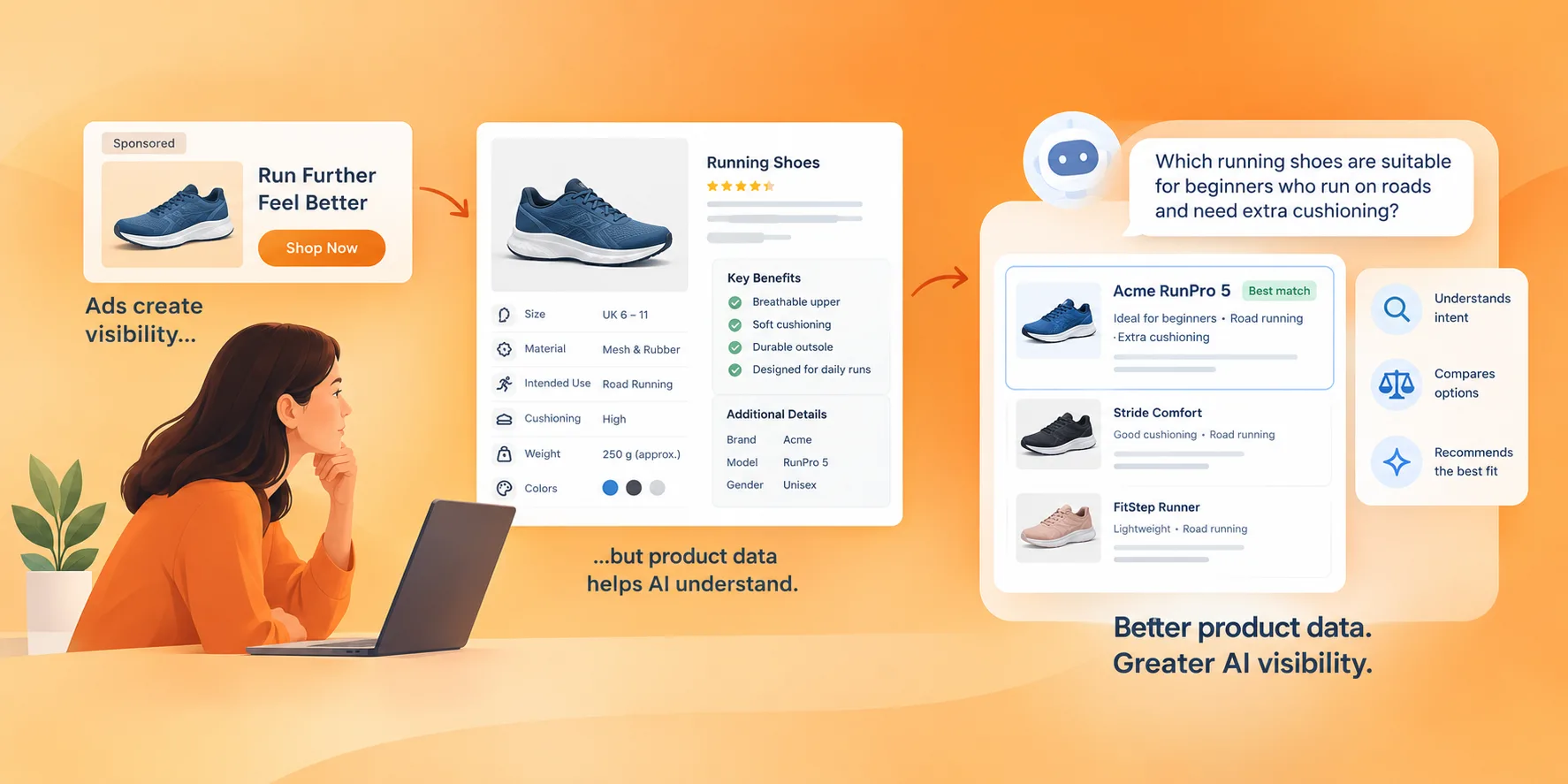
For years, ecommerce brands have invested heavily in advertising to get products in front of shoppers. The logic is simple: more visibility means more opportunities to be considered. But the way people discover products online is changing, and paid visibility is only one part of that buying journey.
AI-powered search and shopping tools can now help shoppers compare products, answer questions, summarize reviews, and narrow down choices. Instead of simply showing a list of links, these systems increasingly need to understand what a product actually is, who it is for, how it differs from alternatives, and whether it fits a shopper's needs.
That makes product data more important than it has traditionally been.
Ads Can Create Visibility. Data Helps Create Understanding.
An advertisement can tell a shopper that a product exists. Product data gives the systems behind search and shopping more information to work with.
Consider a shopper looking for a shampoo for an oily scalp with a specific ingredient preference. A brand may have a strong advertising campaign, but if its product page does not clearly communicate ingredients, hair type, usage, size, benefits, and other relevant attributes, an AI system may have limited information to work with.
This is where product content starts becoming part of the discovery process itself.
The issue is not simply whether the product page contains enough words. The information needs to be complete, accurate, consistent, and easy for machines to interpret.
AI Shopping Changes What Product Discoverability Means
Traditional ecommerce search often revolves around keywords, rankings, categories, and paid placements. AI-driven discovery introduces another layer: whether a system can understand the product well enough to include it in an answer or recommendation.
Imagine asking an AI shopping assistant:
“Which running shoes are suitable for beginners who run on roads and need extra cushioning?”
The system has to interpret the intent behind the question and match it with product attributes. Cushioning, running surface, shoe type, intended use, fit, materials, and other details can all influence that decision.
If those details are missing or buried in inconsistent marketing copy, the product becomes harder to evaluate.
This is why AI visibility is increasingly connected to product information quality.
What Brands Should Start Checking
Brands do not necessarily need to rebuild every product page. A better starting point is to examine their most important SKUs and ask a few practical questions.
1. Are the important attributes clearly available?
Look beyond the product description. Check whether information such as size, ingredients, compatibility, material, capacity, intended use, and specifications is clearly represented.
2. Can AI answer basic questions about the product?
Ask AI systems realistic pre-purchase questions about your products. Does the answer accurately describe your product? Are important details missing? Is a competitor being recommended instead?
These exercises can reveal content gaps that traditional SEO audits may not highlight.
3. Is the information consistent?
Product information often exists across websites, marketplaces, feeds, retailer listings, and other channels. Differences in specifications, naming, or attributes can make it harder for AI systems to establish a reliable understanding of the product.
4. Is your content written only for ranking?
SEO still matters. But product content increasingly has another job: helping machines understand the product well enough to answer shopper questions.
That means brands should think beyond keywords and consider information sufficiency and AI indexability as part of their product content strategy.
The Shift From Being Seen to Being Understood
Advertising will continue to play an important role in ecommerce. But when shoppers increasingly ask AI systems to research and compare products, simply getting attention may not be enough.
The bigger question becomes: Can your product information give AI enough context to explain why your product is relevant?
This is closely connected to the emerging discipline of Agentic Commerce Optimization (ACO), which focuses on making product information easier for AI shopping agents to understand and use during product discovery.
For brands, the practical takeaway is straightforward: start treating product data as a discoverability asset, not just catalog information. Tools such as Enaiblex can help brands assess product content for AI readiness, identify information gaps, and understand where their SKUs may be difficult for AI systems to interpret.
Because the next competitive advantage in ecommerce may not simply come from having a bigger advertising budget. It may come from having product information that AI can confidently understand, compare, and recommend.