A common mistake I see among people starting an IT career is trying to learn too many things at once.
One week, they decide to learn Python. The next week, they start watching videos about Artificial Intelligence. Then someone tells them that Data Science has a good future, so they download a course for that. A few days later, they hear about Cloud Computing, Cybersecurity, DevOps, React, Java, and Generative AI.
Before they know it, they have saved dozens of courses, followed hundreds of tutorials, and still don't know what they should actually learn.
If this sounds familiar, you're not alone.
The IT industry has a huge number of technologies, but you don't need to learn everything to start an IT career. You need to understand where you want to go, learn the right foundation, and spend enough time practising one path before moving to another.
The Internet Makes IT Look More Complicated Than It Is
Search for "IT skills" on the internet and you'll quickly find enormous lists.
Python. Java. JavaScript. React. Node.js. AWS. Docker. Kubernetes. Machine Learning. Data Science. Cybersecurity. Power BI. SQL. Generative AI. Cloud Computing.
All of these can be useful. The problem starts when a beginner thinks they need to learn all of them before applying for a job.
You don't.
A person learning web development doesn't need to become a cybersecurity specialist first. Someone interested in Data Analytics doesn't need to learn Kubernetes. And someone preparing for an AI career doesn't need to become an expert in every web framework.
Your first goal should be much smaller:
Become useful in one area.
Once you understand one area properly, learning the next skill becomes much easier.
Start With the Kind of Work You Enjoy
Before choosing a course, think about what you actually enjoy doing.
Do you like writing code and building things?
Do you enjoy working with numbers and finding patterns?
Are you curious about how websites and applications work?
Do servers, networks, and infrastructure interest you?
Are you interested in security?
Or do you enjoy understanding how businesses can use technology to solve problems?
There isn't one correct answer.
Your interest doesn't have to be perfect either. You simply need a starting direction.
If You Like Building Websites and Applications
You may enjoy Full Stack Development.
A beginner can start with:
HTML → CSS → JavaScript → React → Node.js → Database → APIs
You don't need to learn five frontend frameworks at the beginning.
Pick one stack, build a few applications, understand how the frontend communicates with the backend, learn how databases work, and practise deploying your projects.
For example, a student interested in JavaScript-based development can explore a MERN Stack Development course and gradually build projects using MongoDB, Express, React, and Node.js.
The important part isn't how many technologies appear on your resume. It's whether you can actually build something with them.
If You Like Python and Problem Solving, Look at AI
Artificial Intelligence attracts a lot of attention right now, but beginners sometimes make the mistake of jumping straight into advanced AI tools.
You don't need to start there.
A more sensible foundation is:
Python → Mathematics and Statistics → Data → Machine Learning → Deep Learning → Generative AI
Python is useful because it appears in several areas, including AI, Machine Learning, Data Analytics, automation, and backend development.
If you're serious about this direction, learn Python properly first. Understand functions, data structures, object-oriented programming, APIs, files, exceptions, and basic problem-solving.
After that, the more advanced concepts will make much more sense.
For learners interested in this path, an Artificial Intelligence and Machine Learning course can provide a structured starting point.
If You Like Numbers, Data Could Be Your Direction
Not everyone enjoys spending the whole day writing application code.
Some people naturally enjoy working with numbers, reports, business questions, and patterns.
That's where Data Analytics can be a good direction.
A beginner's path might look like:
Excel → SQL → Power BI → Python → Statistics
SQL deserves special attention here.
You may know Excel and create attractive dashboards, but real business data is often stored in databases. Understanding how to query, filter, combine, and analyse that data gives you a much stronger foundation.
You can then move into Python, Pandas, statistics, and more advanced analytical techniques.
A Data Analytics course is one possible structured route for someone who wants to develop these skills together.
If You Like Servers, Cloud, and Infrastructure
Maybe you don't find frontend development particularly interesting.
Perhaps you'd rather understand what happens behind the application.
In that case, Cloud Computing and DevOps may be worth exploring.
A beginner-friendly progression could be:
Linux → Networking → Cloud → Git → Docker → CI/CD → Kubernetes
You don't have to learn Kubernetes on day one.
First understand Linux, networking, servers, and how applications are deployed. Then containers, automation, monitoring, and orchestration start to have a real meaning.
This is also why simply memorising cloud services isn't enough. You should understand the problem you're trying to solve with each technology.
For someone moving toward this area, an AWS Certification course or a DevOps Engineering course can be considered depending on the career direction.
Cybersecurity Is Another Path, Not an Add-On to Everything
Cybersecurity is another field that attracts beginners because of the variety of roles available.
But cybersecurity also has foundations.
Start with:
Networking
Linux
Operating systems
Security fundamentals
Authentication and access control
Vulnerabilities
Security monitoring
Incident response
Then you can explore areas such as ethical hacking, penetration testing, SOC operations, digital forensics, application security, or cloud security.
You don't need to become an expert in all of these.
For example, someone interested in SOC operations can build knowledge around networking, Linux, logs, SIEM tools, threat detection, and incident response instead of trying to study every cybersecurity specialization at the same time.
The "Learn Everything" Approach Usually Creates a Problem
Imagine a student spends three months learning:
Basic Python
Basic Java
Basic JavaScript
Basic React
Basic SQL
Basic AWS
Basic Cybersecurity
Basic Machine Learning
It sounds impressive.
But what happens when an interviewer asks:
"Tell me about a project you built."
If the student has only followed tutorials, there may not be much to discuss.
Now consider another student who spent those three months learning JavaScript, React, Node.js, MongoDB, APIs, Git, and deployment.
They built a small e-commerce application.
They had bugs.
They changed the database structure.
They struggled with authentication.
They deployed the application and fixed problems along the way.
That person may know fewer technologies on paper, but they have something concrete to explain.
Depth gives you something to talk about.
Your First Course Doesn't Have to Decide Your Entire Career
Another concern I often hear from students is:
"What if I choose the wrong course?"
That's understandable.
But your first technology doesn't permanently lock you into one career.
A Python learner can later move toward AI, Data Science, Data Engineering, automation, or backend development.
A JavaScript developer can move from frontend into full stack development.
A Data Analyst can later learn Python and Machine Learning.
A Java developer can move into Spring Boot, microservices, cloud, and DevOps.
An IT professional working with infrastructure can move toward cloud security or DevSecOps.
Technology careers overlap more than they appear to from course brochures.
The foundation you build matters more than trying to predict your entire career at 18, 20, or 25.
Projects Will Tell You More Than Another Tutorial
Once you've selected a direction, start building.
Don't wait until you feel completely ready.
If you're learning Python, build something with Python.
If you're learning Data Analytics, find a dataset and answer real questions with it.
If you're learning Full Stack Development, build a working application.
If you're learning cybersecurity, practise in a legal lab environment and document what you learned.
Your first project doesn't need to be revolutionary.
It needs to be yours.
A good project gives you experience with decisions that tutorials don't always explain:
Why did you choose this technology?
Why did you structure the application this way?
What went wrong?
How did you debug it?
What would you change?
How did you deploy it?
What did you learn?
These are the kinds of questions that turn learning into practical experience.
What About Generative AI?
This is where many beginners get confused.
They see AI tools generating code, writing content, creating images, analysing data, and answering technical questions, and they assume they need to learn Generative AI before anything else.
Not necessarily.
AI tools can be extremely useful while you're learning, but you should still understand the fundamentals of the work you're asking AI to perform.
If you're learning web development, use AI to help understand an error, but learn why the error happened.
If you're learning Python, ask AI to explain a piece of code, then modify it yourself.
If you're learning Data Analytics, use AI to explore ideas, but understand the SQL query, calculation, or statistical method being used.
The goal isn't to avoid AI.
The goal is to learn with AI without becoming completely dependent on it.
What Should a Beginner Actually Do?
If I were helping someone start from zero, I wouldn't give them a list of 30 technologies.
I'd suggest something much simpler.
Step 1: Choose One Direction
Pick one:
AI and Machine Learning
Data Analytics
Full Stack Development
Backend Development
Cloud and DevOps
Cybersecurity
Step 2: Learn the Fundamentals
Don't rush through the basics because they seem boring.
Programming fundamentals, databases, networking, Git, operating systems, and problem solving become useful later.
Step 3: Pick Your Main Technology
For example:
AI: Python
Data: SQL + Excel
Full Stack: JavaScript
Java Backend: Java
Cloud/DevOps: Linux + cloud fundamentals
Cybersecurity: Networking + Linux
Step 4: Build Projects
Start small.
Then make the projects more realistic as your skills improve.
Step 5: Add Skills Based on Your Goals
Once your foundation is strong, add another layer.
For example:
Python → Machine Learning → Generative AI
or
JavaScript → React → Node.js → Next.js
or
Linux → AWS → Docker → Kubernetes
Now you're building a skill combination rather than collecting random technologies.
Learning IT Skills in Agra: What Should You Look For?
If you're looking for an IT training institute in Agra, don't judge a course only by the number of technologies listed in its syllabus.
Ask practical questions.
Will you work on projects?
Will someone review your code or assignments?
Can you ask questions when you're stuck?
Will you learn how to use Git and work with real development workflows?
Does the course match the career direction you actually want?
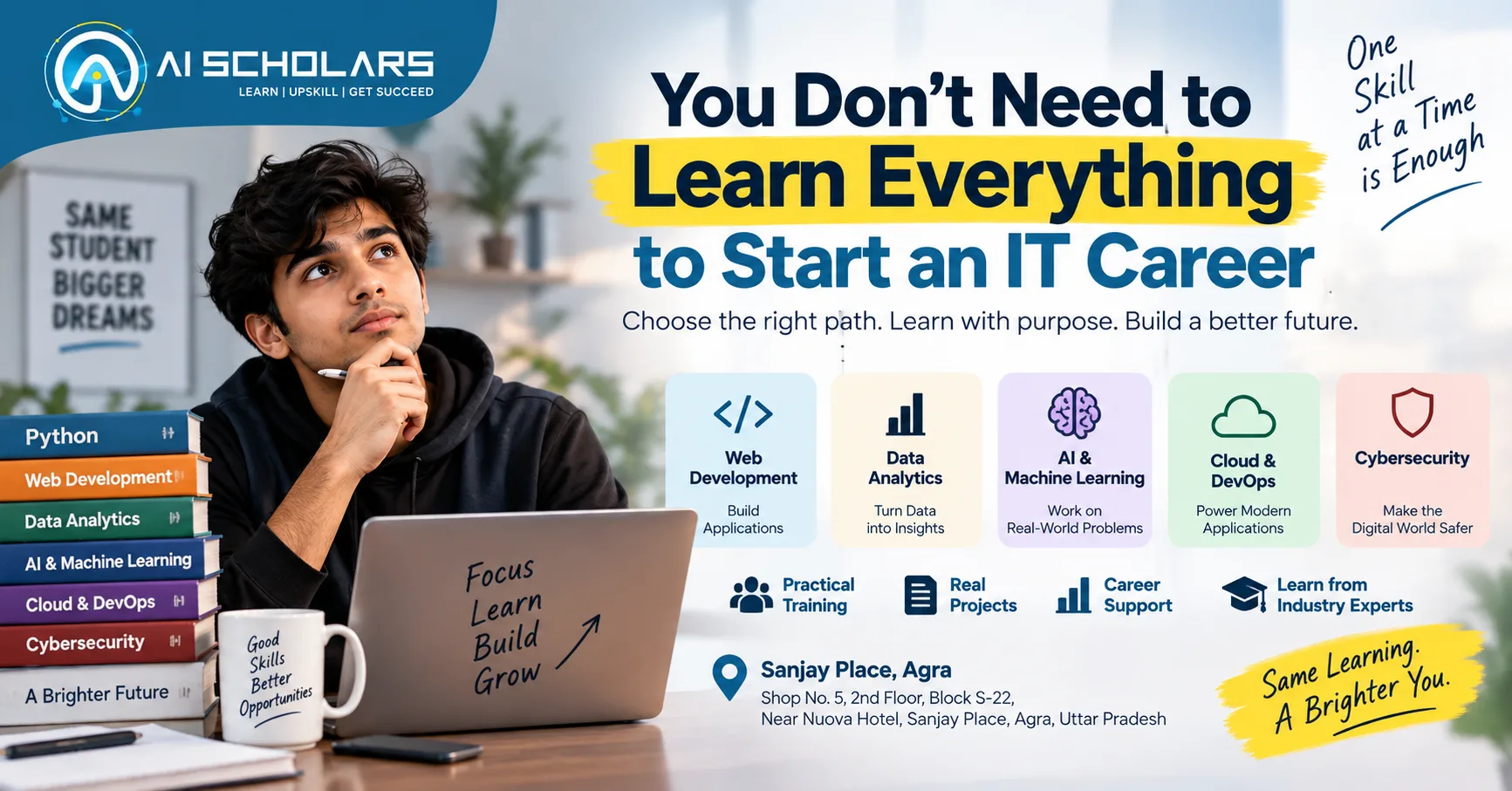
At AI Scholars, located at Shop No. 5, 2nd Floor, Block S-22, Near Nuova Hotel, Sanjay Place, Agra, learners can explore different technology-focused programs, including AI & Machine Learning, Data Analytics, Data Science, Data Engineering, Full Stack Development, Python, Java, AWS, DevOps, and Cybersecurity.
The idea should still be the same: choose the learning path that fits your goal instead of choosing every course available.
Your Career Doesn't Need Twenty Technologies on Day One
There's nothing wrong with being curious about technology.
Learn about new tools. Try different things. Follow industry developments.
But when it comes to building a career, curiosity needs some direction.
You don't need to know Python, Java, JavaScript, AWS, Kubernetes, React, Machine Learning, Cybersecurity, Data Science, and every new AI tool before you can call yourself an IT professional.
Choose one area.
Learn the fundamentals.
Build something.
Make mistakes.
Fix them.
Then add the next skill when you have a reason to do so.
That's a much more manageable way to start an IT career, and it gives you something far more valuable than a long list of technologies: the ability to actually use what you've learned.
AI Scholars
Agra, Uttar Pradesh