Enterprise AI conversations have changed quickly. A year or two ago, many organizations were focused on experimentation: testing copilots, launching internal chatbots, exploring generative AI use cases, and running proofs of concept.
Now the conversation is shifting toward deployment.
Business leaders want AI embedded into customer service, finance, operations, sales, supply chains, and employee workflows. But as organizations move from pilots to production, many are discovering that the biggest obstacle is not necessarily the AI model.
It is the technology environment surrounding it.
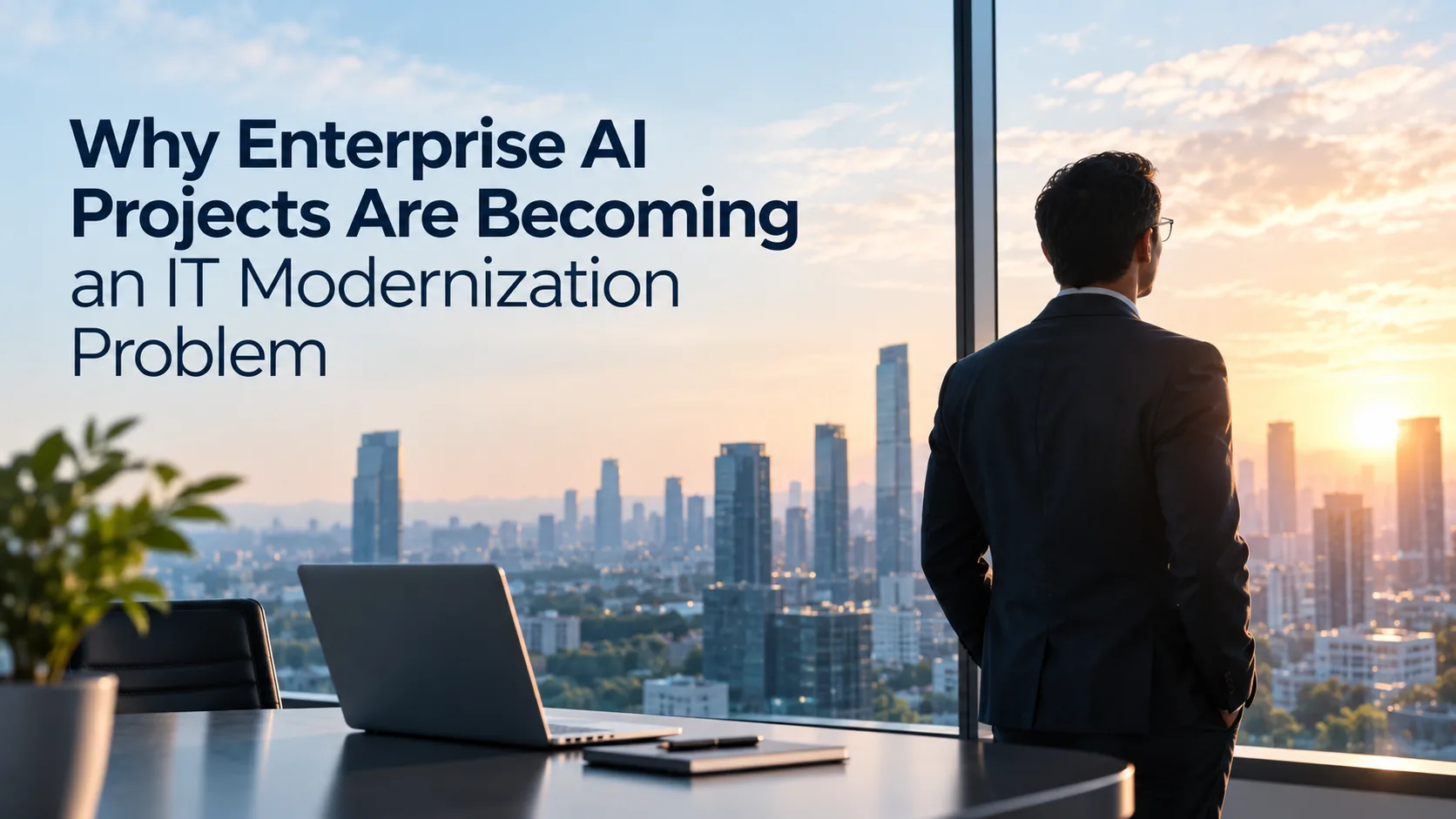
Legacy applications, fragmented data, inconsistent integrations, cloud complexity, security requirements, and weak governance can make enterprise AI significantly harder to scale. As a result, AI strategy is increasingly becoming inseparable from IT modernization strategy.
The AI Readiness Gap Is Becoming More Visible
An enterprise may have access to sophisticated AI platforms and still struggle to generate meaningful business value from them.
Consider an organization operating dozens of business applications across multiple cloud platforms, data environments, SaaS products, and legacy systems. An AI assistant may technically be capable of answering complex questions or automating workflows, but its usefulness depends heavily on the information and systems it can securely access.
If customer information exists in several applications, operational data is inconsistent, APIs are limited, or business processes still rely heavily on manual handoffs, AI inherits those limitations.
This creates what could be called an AI readiness gap: the difference between having access to AI technology and having an enterprise technology environment capable of supporting it at scale.
Five IT Problems That Can Quietly Limit Enterprise AI
Several technology challenges repeatedly surface when organizations attempt to move AI initiatives into production.
IT challengeWhy it matters for AILegacy applicationsOlder architectures may lack the APIs and integration capabilities required for AI-driven workflows.Fragmented enterprise dataAI applications need reliable access to consistent, governed information.Cloud complexityMultiple cloud and SaaS environments increase integration, governance, cost, and security challenges.Weak identity and security controlsAI can introduce new access paths to sensitive enterprise information.Disconnected business processesAutomation becomes difficult when workflows span applications that do not communicate effectively.None of these problems are new. What is changing is their importance.
Technical debt that organizations could previously tolerate may become a direct constraint on AI adoption.
Legacy Modernization Is Taking on a New Purpose
Application modernization was traditionally justified through familiar benefits such as reducing maintenance costs, improving performance, strengthening security, or moving workloads to the cloud.
AI adds another reason.
Modern applications are generally easier to expose through APIs, integrate with enterprise data platforms, connect to automation tools, and incorporate into AI-powered workflows.
This does not mean every legacy application needs to be replaced.
Organizations increasingly need to determine which applications should be retained, replatformed, refactored, replaced, or retired based partly on their importance to future AI-enabled business processes.
That makes application portfolio decisions much more strategic than a straightforward cloud migration exercise.
Enterprise Data May Be the Bigger Challenge
Generative AI has made enterprise data architecture visible to business executives in a way traditional IT projects often did not.
An executive might ask an AI assistant:
“Which customers are most likely to experience delivery delays this month, and what should we do about it?”
Producing a useful answer could require information from CRM, ERP, logistics platforms, customer-service systems, inventory databases, and external sources.
If those systems contain conflicting definitions, incomplete records, inaccessible data, or outdated information, even an advanced AI system can produce an incomplete response.
For this reason, data governance, integration, master data management, and modern analytics platforms are becoming foundational components of enterprise AI programs rather than separate IT initiatives.
AI Also Changes the Managed Services Conversation
The rise of enterprise AI is also changing what organizations should expect from managed IT service providers.
Traditional managed services have often concentrated on infrastructure availability, service desks, cloud operations, application support, cybersecurity, and SLA performance.
Those capabilities remain important, but enterprises increasingly need partners capable of connecting multiple disciplines.
An AI-enabled environment may require cloud engineering, application modernization, data engineering, cybersecurity, automation, enterprise application expertise, and ongoing operations to work together.
This is where the distinction between simply managing technology and continuously improving the technology experience and business outcome becomes increasingly relevant.
One example is Synoptek's Managed Experience Provider (MxP) approach, which combines consulting, technology transformation, and managed services rather than treating them as isolated engagements.
For enterprises pursuing AI adoption, this type of integrated model can be valuable because AI initiatives rarely remain confined to a single technology stack.
CIOs Should Start With the Business Workflow
One mistake organizations can make is beginning with the AI technology and then searching for places to deploy it.
A more sustainable approach starts with the workflow.
For example, instead of asking:
“Where can we deploy generative AI?”
leadership teams can ask:
“Which business processes create the most friction, cost, delay, or poor customer experience - and what prevents us from improving them?”
That question frequently reveals dependencies across applications, infrastructure, data, integrations, security, and operating processes.
AI may ultimately be part of the solution, but modernization creates the foundation that allows the solution to work reliably.
A Practical Enterprise AI Readiness Checklist
Before scaling AI initiatives, technology leaders should be able to answer several fundamental questions:
- Can critical enterprise data be securely accessed across systems?
- Are legacy applications capable of supporting modern integrations?
- Are data definitions consistent enough for AI-driven decisions?
- Are identity and access controls prepared for AI agents and assistants?
- Can AI workloads operate efficiently across the organization's cloud architecture?
- Are governance policies defined for enterprise AI usage?
- Can AI applications be monitored after deployment?
Who owns the underlying systems when an AI-enabled workflow fails?
Organizations unable to answer several of these questions may benefit more from strengthening their technology foundation before rapidly expanding AI deployment.
The Next Phase of AI Will Be About Integration
The first wave of enterprise generative AI demonstrated what the technology could do.
The next phase will determine whether organizations can operationalize it.
That will require much more than selecting models or deploying copilots. Enterprises will need applications, data, cloud infrastructure, cybersecurity, integrations, and operating models capable of supporting AI continuously.
In that sense, the enterprise AI race may ultimately be won not by the organization experimenting with the largest number of AI tools, but by the organization with the strongest technology foundation for turning AI into repeatable business outcomes.
For technology leaders, that changes the question from “Are we using AI?” to something more important:
“Is our enterprise actually ready to run on it?”