Artificial intelligence may be the most visible part of an AI-powered product, but its success depends heavily on the quality, accessibility, and reliability of the data behind it. Even the most advanced AI model cannot consistently deliver valuable results when the underlying data is incomplete, outdated, fragmented, or poorly managed.
For businesses building intelligent digital solutions, working with an AI Digital Product Engineering Consultant in USA can involve much more than selecting AI models. A successful AI product requires a strong data foundation that connects enterprise information, prepares it for AI systems, maintains data quality, and supports scalability, security, and real-time processing.
This is where data engineering becomes the foundation of successful AI products. From predictive analytics and recommendation engines to generative AI, RAG applications, and AI agents, modern AI systems depend on well-designed data pipelines that continuously provide accurate, secure, and usable information.
In this article, we’ll explore why data engineering is essential for AI product development, how it affects AI performance, what a strong AI data architecture looks like, and how businesses can build a reliable data foundation for production-ready AI solutions.
What Is Data Engineering in AI Product Development?
Data engineering is the process of designing, building, integrating, transforming, storing, and managing data so that it can be reliably used by applications, analytics platforms, machine learning systems, and AI models.
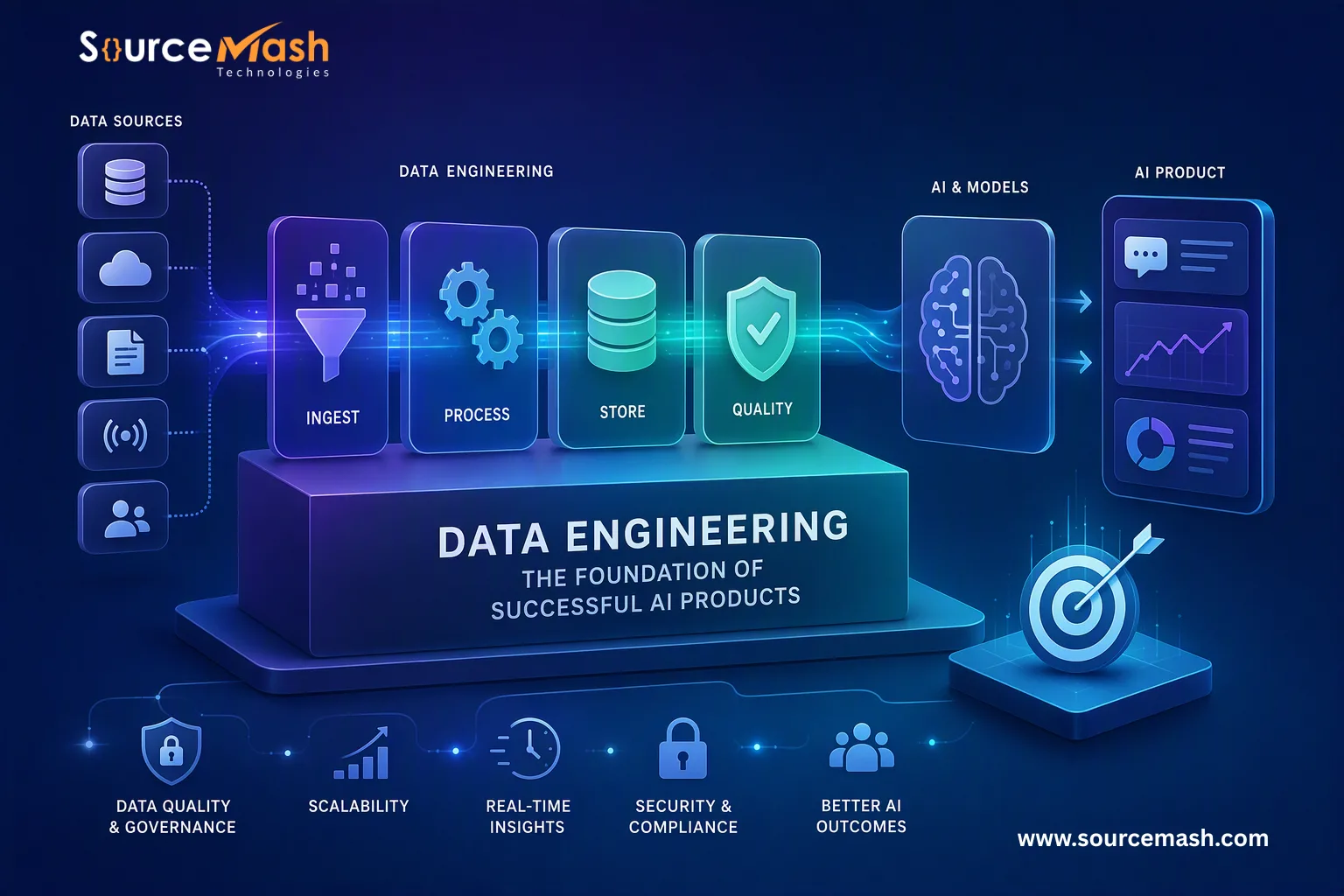
In an AI product, data engineering typically connects multiple stages:
Data Sources → Data Ingestion → Storage → Processing → Data Quality → AI/ML Systems → Product Experience
Data may originate from:
- Enterprise databases
- CRM and ERP platforms
- Websites and applications
- APIs
- Customer interactions
- SaaS platforms
- IoT devices
- Transactional systems
- Documents and knowledge bases
- Event streams
- Third-party data sources
Raw data from these systems is rarely ready for AI immediately.
Data engineers build pipelines that collect the data, validate it, clean it, transform it, store it appropriately, and make it available to downstream AI systems.
Therefore, data engineering acts as the bridge between business data and AI capabilities.
Why Is Data Engineering So Important for AI?
The performance of an AI product is constrained by the quality and availability of its data.
Consider a customer-support AI assistant.
The underlying language model might be capable of understanding a customer's question. However, the application may still provide a poor answer if it receives:
- Old product documentation
- Duplicate information
- Incomplete customer records
- Conflicting policies
- Incorrect metadata
- Poorly organized documents
Improving the model alone does not solve these problems.
The organization must improve the data infrastructure feeding the AI system.
Strong data engineering helps AI systems receive the right information, in the right format, at the right time.
1. Data Quality Directly Affects AI Quality
One of the most important principles in AI development is simple:
Poor-quality data leads to poor-quality AI outcomes.
AI models learn patterns or retrieve context from the information available to them. Problems inside that data can negatively affect predictions, recommendations, classifications, search results, and generated responses.
Common data-quality problems include:
- Missing values
- Duplicate records
- Incorrect labels
- Inconsistent formats
- Outdated information
- Corrupted records
- Conflicting data
- Invalid values
A robust data engineering process can introduce automated validation, normalization, deduplication, monitoring, and anomaly detection before information reaches downstream systems.
Example
Imagine an AI-powered sales platform where one customer appears under three slightly different company names.
Without reliable data integration and entity resolution, the system could treat those records as separate customers.
This can distort:
- Lead scoring
- Customer segmentation
- Revenue analysis
- Recommendations
- Sales forecasts
The issue is not necessarily the AI model. It begins with the data.
2. AI Products Need Reliable Data Pipelines
AI products rarely operate on a static dataset forever.
Data continuously enters an organization from customer interactions, transactions, applications, APIs, devices, documents, and internal business systems.
A data pipeline automates the movement and transformation of that information.
A simplified AI data pipeline may look like:
Business Systems → Data Ingestion → Data Lake/Warehouse → Processing → Feature or Retrieval Layer → AI Model → Application
Reliable pipelines help organizations:
- Automate data collection
- Integrate multiple sources
- Standardize formats
- Validate incoming information
- Make fresh data available to AI systems
- Reduce manual data preparation
- Monitor pipeline failures
Without this infrastructure, AI teams can spend significant effort repeatedly preparing information instead of improving the actual product.
3. Data Engineering Makes AI Products Scalable
A proof of concept might work with thousands of records.
A production application may eventually need to process millions of events, documents, transactions, requests, or customer interactions.
That creates engineering challenges around:
- Data volume
- Processing speed
- Storage
- Availability
- Query performance
- Reliability
- Cost
- Real-time processing
Data engineering addresses these challenges by designing infrastructure for the expected workload rather than treating data management as an afterthought.
For example, architectures may combine:
- Data warehouses
- Data lakes
- Lakehouses
- Distributed processing
- Streaming systems
- Cloud storage
- Caching
- Specialized databases
The correct architecture depends on the product rather than a single technology being appropriate for every AI project.
4. Real-Time AI Depends on Real-Time Data
Some AI products can work with information updated every few hours or days.
Others cannot.
AI applications supporting areas such as fraud monitoring, supply-chain operations, recommendations, cybersecurity, or operational decision-making may require much fresher information.
This introduces streaming data engineering.
Instead of waiting for large scheduled batches, events can be processed as they are generated.
For example:
User Action → Event Stream → Real-Time Processing → AI System → Product Response
This architecture can help AI products react to changing conditions more quickly.
The key lesson is that real-time AI is not created simply by using a fast AI model. The data architecture also needs to deliver sufficiently fresh information.
5. Data Engineering Powers Generative AI and RAG Applications
Generative AI has made data engineering even more important.
Many enterprise AI applications need access to proprietary information such as:
- Product documentation
- Internal policies
- Knowledge bases
- Technical manuals
- Customer information
- Support records
- Research documents
A common architecture for connecting generative AI with enterprise information is Retrieval-Augmented Generation (RAG).
A simplified RAG workflow looks like:
Enterprise Data → Processing → Chunking → Embeddings → Vector Storage → Retrieval → LLM → Response
Data engineering plays a role throughout this pipeline.
Teams must determine:
- Which documents should be ingested?
- How frequently should they be updated?
- How should duplicate documents be handled?
- Which metadata should be retained?
- How should documents be divided into useful chunks?
- Who should be allowed to retrieve certain information?
- What happens when source information changes?
Poor ingestion and retrieval architecture can undermine a RAG application even when the underlying large language model is highly capable.
6. AI Agents Need Strong Data Foundations
AI products are also evolving from systems that simply respond to prompts toward applications capable of completing multi-step workflows.
AI agents may interact with:
- APIs
- Databases
- Business applications
- Search systems
- Knowledge repositories
- Enterprise workflows
This increases the importance of reliable data infrastructure.
For example, an AI agent helping a sales team could potentially need information from a CRM, pricing database, product catalog, support history, and account activity.
If those systems contain conflicting or outdated data, the agent may make decisions using an incomplete picture.
Therefore:
Better-connected data → Better AI context → More reliable actions
Agentic AI makes data integration a core part of product architecture rather than a secondary technical concern.
7. Data Governance Makes Enterprise AI Safer and More Manageable
Providing AI with more data is not automatically better.
Organizations also need control over which data is available and how it is used.
Data governance establishes policies around areas such as:
- Data ownership
- Access permissions
- Data classification
- Privacy
- Lineage
- Retention
- Security
- Data quality
- Auditability
This becomes particularly important when AI applications interact with sensitive enterprise information.
Teams should know:
- Where did this information come from?
- Who owns it?
- Who is permitted to access it?
- When was it last updated?
- How is it transformed?
- Which AI systems are using it?
Governance should therefore be designed into the data architecture rather than added after the AI product is deployed.
8. Data Engineering Helps Reduce AI Bias and Data Blind Spots
AI systems can inherit problems that exist within historical or collected data.
Engineering alone cannot eliminate every source of algorithmic bias. However, good data practices make it easier to identify potential problems.
Teams can monitor:
- Dataset composition
- Missing information
- Source distribution
- Label quality
- Data drift
- Unusual patterns
- Changes in input distributions
This allows data scientists, product teams, and domain experts to investigate issues before they become invisible parts of an AI workflow.
Responsible AI therefore requires both technical controls and human oversight.
9. Data Engineering Supports MLOps and Continuous AI Improvement
An AI product does not stop evolving once it goes live.
Customer behavior changes. Business processes change. New information arrives. Data distributions shift.
Production AI therefore needs ongoing monitoring.
This is where data engineering and MLOps work closely together.
A typical lifecycle may involve:
Collect → Validate → Transform → Train/Retrieve → Evaluate → Deploy → Monitor → Improve
Teams may need to monitor:
- Data freshness
- Pipeline health
- Model performance
- Data drift
- Retrieval quality
- Latency
- Errors
- Infrastructure usage
Without operational data infrastructure, maintaining AI applications becomes difficult as they grow.
10. Strong Data Engineering Can Improve AI Development Efficiency
Poor data foundations create recurring engineering work.
Teams may repeatedly need to locate datasets, resolve inconsistent schemas, manually clean information, repair broken pipelines, or investigate unreliable outputs.
A reusable data platform can reduce that friction.
Well-designed systems can provide:
- Reusable pipelines
- Standardized datasets
- Automated quality checks
- Central governance
- Shared metadata
- Monitoring
- Documented data contracts
Instead of preparing similar information separately for every AI initiative, organizations can create reusable data assets that support multiple products.
That makes data infrastructure a long-term investment rather than merely a requirement for one AI deployment.
What Does a Strong Data Architecture for AI Look Like?
There is no universal architecture, but a mature environment often contains several layers.
1. Data Source Layer
Business databases, SaaS platforms, applications, APIs, documents, devices, and event streams.
2. Data Ingestion Layer
Processes responsible for collecting batch and streaming data.
3. Storage Layer
Data warehouses, lakes, lakehouses, operational databases, or specialized storage systems.
4. Processing Layer
Data is cleaned, standardized, enriched, validated, and transformed.
5. Governance Layer
Security, metadata, lineage, quality controls, and permissions are applied.
6. AI Data Layer
The information is prepared for machine learning features, analytics, search, embeddings, vector retrieval, or other AI workloads.
7. AI/ML Layer
Models perform prediction, classification, recommendation, retrieval, generation, or reasoning.
8. Product Layer
AI becomes part of the actual user experience through applications, dashboards, assistants, APIs, or automated workflows.
9. Monitoring Layer
Teams observe pipeline reliability, model behavior, data quality, performance, cost, and product outcomes.
The result is not simply an AI model. It is a complete data-to-product system.
Data Engineering vs. Data Science vs. Machine Learning Engineering
These areas are closely related but solve different problems.
FunctionMain ResponsibilityData EngineeringBuilds pipelines, storage systems, integrations, and reliable datasetsData ScienceAnalyzes data and develops statistical or predictive approachesML EngineeringTurns machine learning models into reliable production systemsAI Product EngineeringIntegrates AI capabilities into usable, scalable digital products
Successful AI products often require collaboration across all four areas.
Common Data Engineering Mistakes That Hurt AI Products
Businesses can avoid many AI implementation problems by addressing several common mistakes early.
Building the Model Before Understanding the Data
Teams sometimes select an AI model before evaluating what information is available.
Better approach: begin with the business problem and perform a data readiness assessment.
Creating Separate Data Pipelines for Every Experiment
This creates duplicated work and inconsistent datasets.
Better approach: design reusable data components where practical.
Ignoring Data Quality Until Production
A prototype may hide problems that become serious at scale.
Better approach: automate validation and quality monitoring throughout the pipeline.
Treating Security as an Afterthought
AI can expose information in unexpected contexts if permissions are poorly designed.
Better approach: integrate identity, authorization, governance, and access controls from the architecture stage.
Focusing Only on Model Accuracy
An accurate model is not useful if its data is stale or its predictions arrive too late.
Better approach: measure the complete system, including data quality, latency, availability, product performance, usability, and business outcomes.
How to Build a Data Foundation for an AI Product
Organizations can approach the process systematically.
Step 1: Define the Business Problem
Start with the outcome rather than the technology.
Ask:
- What should the AI product accomplish?
- Who will use it?
- What decisions or workflows will it support?
- How will success be measured?
Step 2: Identify Required Data
Map the data needed to achieve the desired outcome.
Document its source, format, ownership, sensitivity, quality, and update frequency.
Step 3: Assess Data Readiness
Evaluate gaps such as:
- Missing data
- Duplicates
- Inconsistent schemas
- Poor labeling
- Limited historical data
- Access restrictions
- Integration problems
Step 4: Design the Architecture
Determine how information will move from its original sources to the AI system.
Choose batch, streaming, or hybrid processing based on the actual product requirements.
Step 5: Build Quality Controls
Introduce validation, deduplication, schema checks, monitoring, and anomaly detection.
Step 6: Establish Governance and Security
Define data ownership, access levels, privacy requirements, retention rules, and lineage.
Step 7: Connect the Data Layer With AI
Prepare the information for machine learning, RAG, generative AI, analytics, AI agents, or other required workloads.
Step 8: Monitor the Entire System
Continue monitoring both data and AI performance after deployment.
This approach helps businesses move from an attractive AI prototype toward a dependable production product.
When Should a Business Work With an AI Product Engineering Consultant?
Organizations do not always need external expertise. However, consulting support can be valuable when an AI initiative requires multiple disciplines at the same time, including:
- Data engineering
- Cloud architecture
- Generative AI
- Machine learning
- Application engineering
- API integration
- DevOps and MLOps
- Security
- Product strategy
For organizations looking for an AI Digital Product Engineering Consultant in USA, evaluating data engineering capability should be part of the selection process.
Instead of asking only “Which AI models can you develop?”, businesses should also ask:
- How will you assess our existing data?
- How will enterprise systems be integrated?
- How will you maintain data quality?
- Can the architecture scale with the product?
- How will sensitive data be protected?
- How will RAG data be refreshed?
- How will pipeline and model performance be monitored?
- How will cloud and AI infrastructure costs be managed?
An AI engineering partner should be able to connect data architecture, AI capabilities, software engineering, and business objectives into one production-ready solution.
Frequently Asked Questions
Can an AI product work without data engineering?
Small experiments can sometimes operate using manually prepared datasets. Production AI products usually require reliable processes for ingesting, transforming, validating, securing, and delivering data.
Is data engineering only required for machine learning?
No. It also supports analytics, business intelligence, generative AI, RAG applications, AI agents, recommendation systems, real-time applications, and enterprise automation.
Why do AI projects fail because of data?
Common causes include insufficient data, poor quality, inconsistent formats, limited access, outdated information, weak governance, and unreliable pipelines.
Does generative AI still require structured data engineering?
Yes. Generative AI frequently relies on both structured and unstructured information. Documents still need ingestion, processing, metadata management, permissions, updating, indexing, and monitoring.
What is the relationship between RAG and data engineering?
RAG retrieves relevant external information before an AI model generates a response. Data engineering helps ensure that the information being indexed and retrieved is clean, current, appropriately segmented, searchable, and properly governed.
Why is data engineering important for AI agents?
Agents require accurate context to make decisions and interact with external systems. Reliable data connections and permission controls help ensure those actions are based on valid information.
Should data engineering come before AI model development?
In most business projects, data readiness should be evaluated early. Model selection, architecture, and data engineering can then evolve together around the actual product requirement.
Final Thoughts
The success of an AI product is determined by far more than the intelligence of its model.
A dependable AI application requires an equally dependable foundation underneath it.
Data engineering provides that foundation by turning fragmented organizational information into accurate, accessible, governed, scalable, and AI-ready data.
As AI products evolve toward RAG systems, intelligent automation, AI agents, real-time decision systems, and personalized digital experiences, the connection between data engineering and AI product engineering will become increasingly important.
Businesses that invest in the data foundation early are better positioned to build AI systems that can move beyond demonstrations and become reliable digital products used in real business environments.