
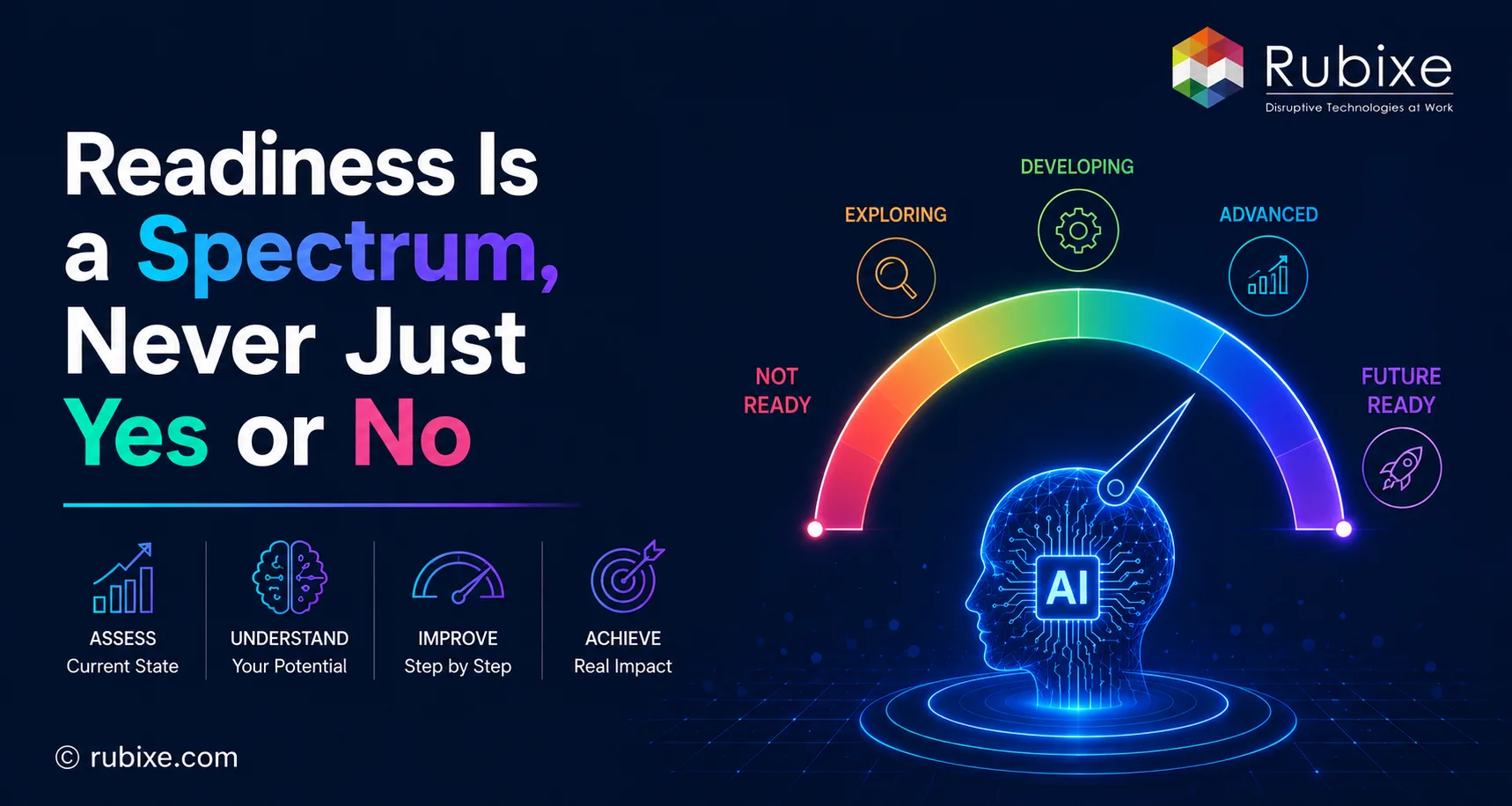
Two companies can launch the same AI pilot with the same budget and walk away with completely different outcomes. The difference rarely comes down to the technology itself.
It comes down to AI Readiness, the often-overlooked groundwork that decides whether a pilot becomes a lasting capability or a forgotten experiment.
What AI Readiness Actually Means
AI Readiness refers to how well a company's data, technical infrastructure, team skills, and leadership support are prepared to adopt and sustain AI initiatives successfully. A business can have plenty of enthusiasm for AI and still be far from ready, since readiness depends on concrete factors like data quality and organizational structure instead of ambition alone.
Quick Answer: Why Does Readiness Matter More Than Enthusiasm?
AI Readiness matters more than enthusiasm because even a well-funded, well-intentioned AI project fails if the underlying data is messy, the technical infrastructure cannot support the tool, or staff lack the skills to use it effectively.
Companies that assess readiness honestly before starting tend to see far stronger long-term results than those who jump straight into a build.
Why So Many AI Projects Struggle From the Start
Excitement Often Outpaces Preparation
Leadership teams get excited about AI's potential and greenlight projects before checking whether the foundation actually supports them, leading to pilots that look promising in early demos and then stall once they hit production complexity.
Data Problems Surface Late and Expensively
Companies frequently discover data quality issues only after a model has already been built, at which point fixing the underlying problem costs significantly more than it would have if addressed during initial planning.
Culture and Skills Get Overlooked
Technical readiness gets most of the attention, while the human side, whether staff trust the tool and know how to use it, often gets treated as an afterthought that surfaces as resistance only after launch.
The Core Components of AI Readiness
Data Quality and Accessibility
Clean, structured, accessible data forms the foundation everything else depends on. A company with scattered, inconsistent, or siloed data will struggle regardless of how sophisticated the chosen AI tool happens to be.
Technical Infrastructure That Can Support the Work
Systems need enough computing capacity, proper integration capability, and secure data pipelines to support AI tools reliably. Infrastructure gaps discovered mid-project often cause the most significant delays.
Team Skills and Organizational Culture
Staff need enough understanding to trust and effectively use new AI tools, and a culture open to adjusting existing workflows makes adoption considerably smoother than one resistant to change.
Leadership Alignment and Sustained Support
AI initiatives that lose leadership attention after the initial announcement tend to stall quickly. Sustained support through budget, prioritization, and patience during the learning curve makes the difference between a pilot that scales and one that quietly disappears.
A Clear, Well-Defined Use Case
Readiness also depends on knowing exactly which problem a project is meant to solve. Vague goals like general efficiency rarely translate into a successful project, while a specific, well-defined target gives a team something concrete to build toward.
Testing Readiness With a Small, Low-Risk Pilot
Instead of committing fully before confirming readiness, some companies benefit from a small pilot in a lower-stakes area first. AI implementation services applied to this kind of limited test reveal readiness gaps in a controlled setting, at a fraction of the cost a full rollout would carry if the same gaps surfaced later.
Ready Companies vs Partially Ready Companies vs Unprepared Companies
FactorReady CompaniesPartially Ready CompaniesUnprepared CompaniesData qualityClean, structured, accessibleInconsistent, needs workScattered, largely unusableTechnical infrastructureSolid, scalableSome gaps presentSignificant gapsStaff skills and buy-inStrong, engagedMixed, developingLimited, resistantLeadership supportSustained through the projectPresent initially, fadesMinimal from the startTypical project outcomeScales successfullyStalls or requires reworkFails earlyReadiness Assessed Before a Single Line of Code
A manufacturing client approached Rubixe eager to launch a predictive maintenance system across its entire production floor immediately. Instead of starting the technical build right away, the team conducted a focused AI Readiness Audit first, uncovering significant gaps in how sensor data was structured across different equipment types.
Addressing these gaps before building anything saved the project from a costly mid-build discovery that would have delayed everything by months. The pilot that eventually launched hit its throughput improvement target within six weeks, a result the client later attributed directly to the time spent assessing readiness upfront instead of rushing straight to deployment.
Why Readiness Deserves Ongoing Attention
Readiness is never a box a company checks once and forgets. Data quality can degrade, teams change, and infrastructure needs shift as a business grows, meaning the same factors that determined readiness for a first project need periodic reassessment before each new initiative. Companies that treat readiness as an ongoing discipline instead of a one-time hurdle tend to sustain AI success across multiple projects instead of seeing results plateau after an initial win.
Common Mistakes When Assessing Readiness
- Assuming enthusiasm and budget alone signal readiness for a project
- Skipping a formal data quality assessment before committing to a build
- Underestimating how much staff training a successful rollout actually requires
- Choosing a use case that is too broad or vague to measure meaningfully
- Failing to secure sustained leadership support beyond the initial kickoff
Building Readiness Before Committing to a Project
Start With an Honest Assessment
A thorough readiness evaluation looks at data, infrastructure, skills, and leadership support honestly, even when the findings are less encouraging than a company hoped to hear.
Bring in Outside Perspective When Needed
AI Consulting support during this stage helps companies see gaps that internal teams sometimes miss simply because they are too close to daily operations to notice them clearly.
Address Gaps Before Building Anything
Fixing data quality or infrastructure issues before a technical build begins costs far less than discovering and fixing the same problems mid-project.
Consider Specialized Support for the Skills Gap
AI Staffing can fill specific expertise gaps during a project's early phases without requiring a company to commit to permanent headcount before readiness is fully established.
Frequently Asked Questions
How can a company tell if it is ready for AI adoption?
A formal readiness assessment covering data quality, infrastructure, staff skills, and leadership support gives the clearest overall picture.
What is the most commonly overlooked readiness factor?
Data quality is often assumed to be fine until a project surfaces just how inconsistent or siloed it actually is across systems.
Does a small business need the same level of readiness as a large enterprise?
The scale differs, but the core factors, data quality, infrastructure, and leadership support, matter regardless of company size or industry.
How long does a readiness assessment typically take?
Most focused assessments take two to four weeks depending on the complexity of existing systems and data sources involved.
Can a company become AI ready gradually instead of all at once?
Yes, many companies build readiness incrementally, addressing the most critical gaps first before expanding further into additional use cases.
Long-term AI success depends far more on preparation than on enthusiasm or budget alone. AI Readiness determines whether a project becomes a lasting capability or a forgotten pilot.
Rubixe helps companies assess and build this readiness before committing to a full build. Talk to Rubixe about where your organization currently stands.