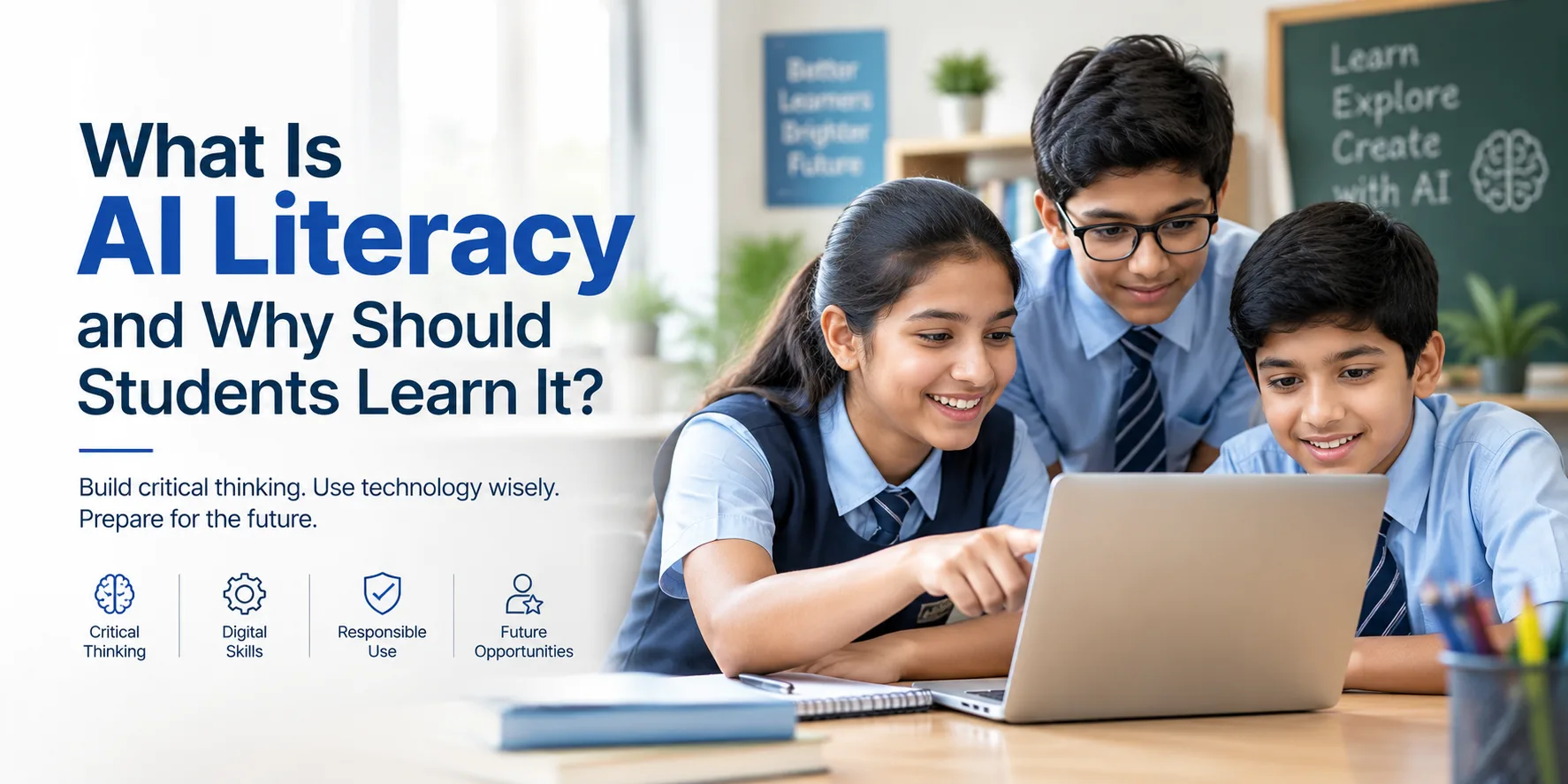
A student does not need to become an AI engineer to understand artificial intelligence. But they should know what AI can do, where it can go wrong, and when they should question its output. That is the basic idea behind AI literacy for students. It means giving young learners enough knowledge and practical understanding to use AI thoughtfully rather than simply accepting whatever a tool produces.
For Indian students, this is becoming increasingly relevant. AI is already appearing in search tools, learning platforms, smartphones, recommendation systems, translation apps and creative software. Schools therefore have a practical reason to help students understand the technology they are likely to encounter both inside and outside the classroom.
What Is AI Literacy?
AI literacy is the ability to understand, use and question artificial intelligence responsibly.
It is broader than knowing how to write a prompt or use a chatbot. A student with basic AI literacy should understand that AI systems work with data, recognise patterns and generate outputs based on the way they have been designed and trained.
They should also know that an AI-generated answer is not automatically correct.
UNESCO describes AI literacy in terms of foundational knowledge, skills, values and ethical principles that help learners engage with AI effectively and responsibly. Its student competency framework covers four areas: a human-centred mindset, AI ethics, AI techniques and applications, and AI system design.
For a school student, this might simply mean being able to answer questions such as:
- How does an AI tool produce an answer?
- Where does the information come from?
- Can the result contain mistakes or bias?
- What information should I avoid sharing?
- When should I use AI, and when should I think or research for myself?
- How can I check whether an AI-generated answer is reliable?
These are useful questions even for students who never plan to study computer science.
Why Is AI Literacy Important for Students?
The importance of AI literacy is not only about future careers. It is also about making better decisions today.
Students are increasingly likely to encounter AI while studying, searching for information, creating content or solving problems. Without a basic understanding of how these systems work, it is easy to treat AI output as fact.
AI literacy gives students a habit that matters far beyond technology: questioning information before accepting it.
This can strengthen several areas of learning:
- Critical thinking
- Digital awareness
- Problem-solving
- Information evaluation
- Creativity
- Ethical decision-making
- Responsible technology use
The goal is not to make students dependent on AI. It is almost the opposite. They should become confident enough to use AI when it is useful and confident enough to reject or verify it when necessary.
AI Literacy Is More Than Learning to Use Chatbots
One common mistake is to treat AI literacy as prompt writing.
Prompting can be useful, but it is only one small part of the picture.
A student might know how to ask an AI tool to write an answer but still have no idea whether the answer is accurate. Another student may understand how AI can generate text or images but may not realise that biased data can influence the results.
Good AI education for students should therefore cover both practical use and critical thinking.
Students can gradually learn:
- What artificial intelligence is
- Where AI is used in everyday life
- How AI systems use data and patterns
- How to evaluate AI-generated information
- Basic ideas about bias and fairness
- Privacy and responsible data use
- Appropriate and inappropriate uses of AI
- How humans remain responsible for important decisions
UNESCO's framework similarly moves beyond simple tool use and includes understanding, application and creation as progressive levels of competency.
What AI Skills Should Students Learn?
The AI skills for students will naturally depend on their age.
A primary school student does not need the same technical knowledge as a Class 12 student. The foundation should develop gradually.
1. Understanding Everyday AI
Students can begin by identifying AI around them.
Voice assistants, recommendation systems, image recognition, translation tools and some educational applications provide simple examples.
The point is to help children realise that AI is not some distant technology. It is already part of many ordinary digital experiences.
2. Asking Better Questions
Students should learn to question an AI response instead of accepting it immediately.
For example:
“Where can I verify this?”
“Could this answer be wrong?”
“What information is missing?”
These questions encourage independent thinking.
3. Understanding Data
Data is central to AI.
Students do not need advanced statistics at an early age, but they can learn that AI systems depend on examples and information. They can also explore why incomplete or unbalanced data can affect results.
Simple classroom activities can make this easier to understand.
4. Learning About AI Ethics
AI raises questions about privacy, fairness, ownership and responsibility.
Students should understand that using technology responsibly matters just as much as knowing how to operate it.
5. Creating With AI
At an appropriate age, students can use AI as part of projects, coding activities, research or creative work.
The teacher's role is important here. Instead of asking students to let AI complete the entire task, activities can require them to explain, test, edit and improve the AI output.
That keeps the learning with the student.
How Can AI Literacy Be Taught in Schools?
AI literacy in schools does not necessarily require a separate subject for every age group.
It can be introduced through existing subjects and project-based activities.
For example:
Science: Students can explore how machines recognise patterns.
Mathematics: They can discuss data, probability and simple classification.
Computer Science: Students can experiment with basic algorithms or AI models.
English: Students can compare a student-written paragraph with an AI-generated version and identify differences in accuracy, tone and reasoning.
Social Science: Students can discuss how automated decisions may affect people.
This interdisciplinary approach is consistent with UNESCO's recommendation that AI-related learning can be integrated across subjects rather than treated only as a technical topic.
For Indian schools, this direction is also becoming more visible in curriculum planning. CBSE currently lists a Curriculum Framework for Computational Thinking and Artificial Intelligence for Classes III–VIII, while its 2026–27 secondary curriculum includes CT & AI modules.
What Should Teaching AI to Students Look Like?
Good teaching AI to students should involve more than demonstrations.
Students learn better when they have a chance to test an idea and see what happens.
A simple classroom activity could work like this:
Step 1: Give students a question.
Step 2: Ask them to write their own answer first.
Step 3: Let them compare it with an AI-generated response.
Step 4: Ask them to identify errors, missing information or questionable claims.
Step 5: Have them improve the final answer using reliable sources.
This approach changes AI from an answer machine into something students can investigate.
The teacher does not need to know every AI tool available. What matters more is creating activities where students practise reasoning, verification and responsible use.
What Are the Benefits of AI Education?
The benefits of AI education become clearer when students use the technology as a learning aid rather than a replacement for learning.
Better critical thinking
Students practise checking information and questioning outputs.
Stronger digital awareness
They begin to understand how technology influences what they see, read and receive online.
Greater problem-solving ability
AI-related projects can give students opportunities to break problems into smaller steps and test possible solutions.
Better understanding of technology
Students become familiar with basic AI concepts instead of seeing AI as something mysterious or inaccessible.
Responsible technology habits
Early guidance can help students think about privacy, fairness, attribution and appropriate use.
Preparation for further study
Students who later choose computer science, engineering, data science or other technology-related fields have a useful foundation to build on.
AI Literacy Does Not Mean Every Student Needs to Become a Programmer
This distinction is important.
Some students may eventually study machine learning, robotics or software engineering. Others may become doctors, designers, teachers, lawyers, entrepreneurs or researchers.
They can all benefit from understanding AI.
Just as basic financial literacy is useful even for someone who does not become an accountant, AI literacy can be useful even for someone who never becomes an AI specialist.
The objective is not to put every child on the same technical path. It is to give them enough understanding to make informed choices about technology.
What Role Do Teachers Play?
Teachers remain central to effective AI skills in education.
A tool can generate an answer in seconds, but it cannot replace the teacher's understanding of the student's age, learning needs, classroom context and misconceptions.
Teachers can help students ask better questions, verify information and understand when AI is appropriate.
This is especially important because AI tools can produce convincing answers that contain errors. Students need guidance on how to check those answers rather than simply being told to use or avoid AI.
CBSE's current curriculum and AI initiatives also include teacher capacity-building and school-level implementation around AI and computational thinking.
How Parents Can Support AI Literacy at Home
Parents do not need technical expertise to help.
A useful approach is to talk with children about how they use technology.
Instead of only asking, “Did you use AI?”, parents can ask:
- What did the AI tool tell you?
- How do you know the answer is correct?
- Did you check another source?
- What information did you provide?
- Could there be another way to solve the problem?
These conversations help children develop judgement rather than fear or dependence.
What Does AI Literacy Look Like at Different Ages?
AI learning should be age-appropriate.
Primary school
Focus on recognising AI in everyday tools, simple patterns, logical thinking and responsible technology habits.
Middle school
Students can explore data, algorithms, AI applications, bias, privacy and simple AI projects.
Secondary school
Students can go deeper into AI concepts, coding, data, model limitations, ethics and real-world applications.
The emphasis should gradually move from “What is AI?” to “How does it work?”, then to “How should we use it?” and eventually “What can we create or solve with it?”
That progression gives students a more balanced understanding.
The Real Goal of AI Literacy
AI literacy is not about teaching students to use the newest tool.
Tools will change. The ability to question information, understand limitations, protect personal data and make responsible decisions will remain useful.
UNESCO's student framework takes a similar approach by focusing on human agency, ethics, AI knowledge and system design rather than tying learning to one particular technology.
For Indian schools, this makes AI literacy a practical part of broader technology education. The focus should be simple: help students understand what AI is, use it carefully, question its output and retain responsibility for their own thinking.
Final Takeaway
Students do not need to know everything about artificial intelligence. They need the right foundation.
AI literacy for students means understanding how AI is used, recognising its limitations, evaluating its output and making responsible choices about when and how to use it.
Schools that introduce these ideas through practical activities can make AI less mysterious and more understandable. The strongest learning happens when students are encouraged to experiment, question, verify and create — not simply ask a tool for an answer.
For Indian students, that foundation can become an important part of learning how to work with technology while keeping human judgement at the centre.
FAQs
1. What is AI literacy for students?AI literacy for students means understanding how artificial intelligence works at a basic level and knowing how to use AI tools safely, critically and responsibly. It includes understanding AI applications, evaluating outputs, recognising limitations and considering ethical issues.
2. Why should students learn AI literacy?Students should learn AI literacy because they increasingly encounter AI in education, online services and everyday technology. It helps them evaluate AI-generated information, use technology responsibly and develop critical thinking skills.
3. What AI skills should students learn?Students should learn basic AI concepts, data awareness, critical thinking, responsible AI use, privacy, ethics and how to evaluate AI-generated information. Older students can also explore coding, algorithms, machine learning and AI system design.
4. How can schools teach AI literacy?Schools can teach AI literacy through computer science, science, mathematics, language activities and project-based learning. Students can examine AI outputs, identify errors, explore data and build simple AI-related projects appropriate to their age.
5. At what age should students start learning about AI?Students can begin learning age-appropriate AI concepts from the primary years. Younger children can learn about patterns and everyday AI applications, while older students can study data, algorithms, ethics, coding and AI systems in greater depth.
6. Is AI literacy the same as learning to code?No. Coding is one possible part of AI learning, but AI literacy is broader. It also includes understanding AI applications, evaluating outputs, recognising limitations, considering ethics and using AI responsibly. A student can develop AI literacy without becoming a programmer.