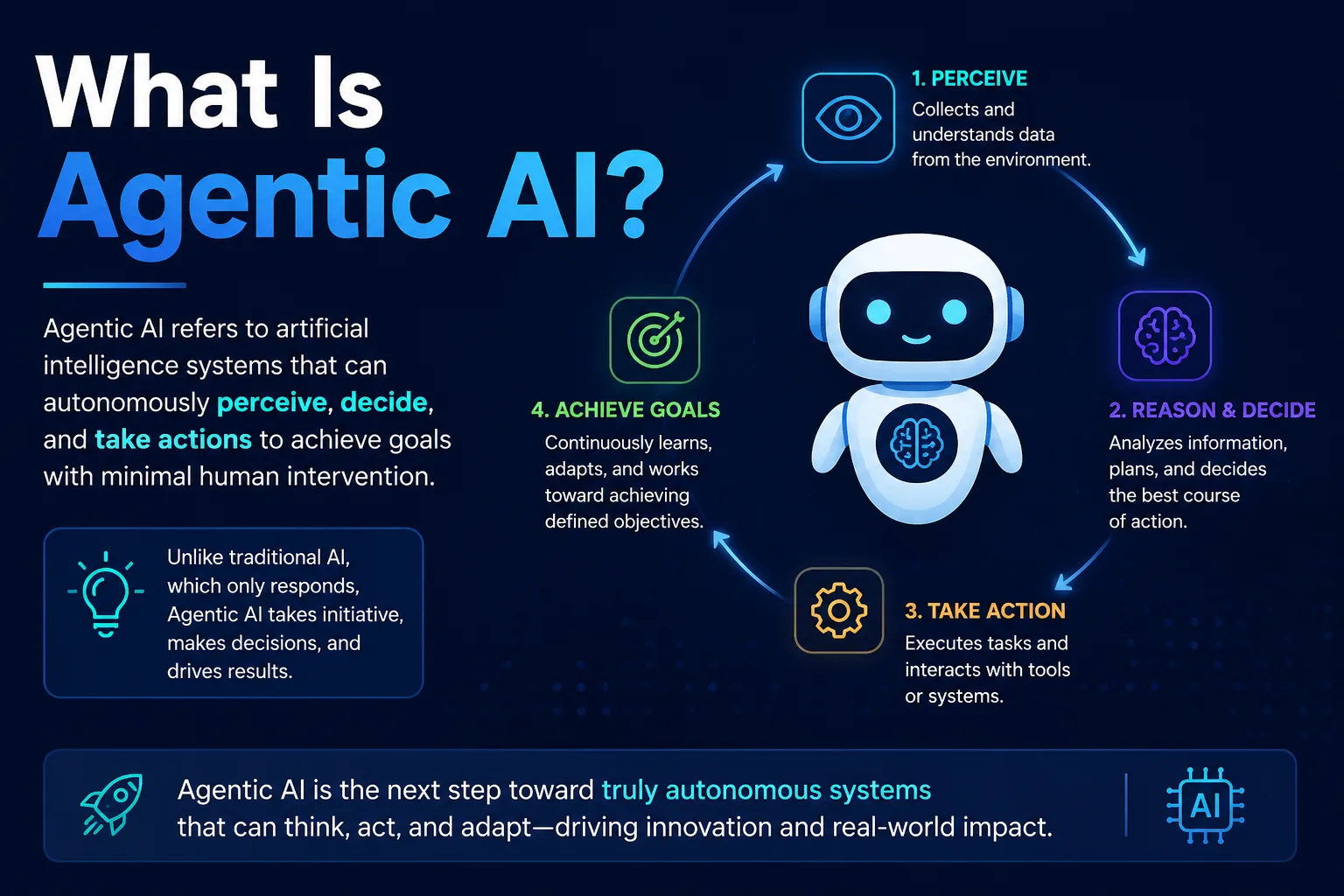
Artificial intelligence is moving beyond systems that simply answer questions or generate content. A newer approach, known as Agentic AI, enables AI systems to work toward defined goals by planning tasks, using tools, evaluating results, and taking actions with limited human intervention.
This technology is attracting attention across software development, customer service, research, finance, marketing, and business operations. However, understanding Agentic AI requires looking beyond the idea of an “autonomous AI.” Its capabilities, limitations, security requirements, and level of human oversight all depend on how the system is designed.
Agentic AI does not necessarily operate without humans. Human approval can be built into the workflow, especially when an agent handles sensitive information or performs actions that could have significant consequences.
How Does Agentic AI Work?
Agentic AI combines several capabilities to complete multi-step tasks.
1. Goal Interpretation
The system first interprets the objective provided by a user or organization. A clear goal gives the agent a basis for deciding which actions are relevant.
For example, “Prepare a competitor analysis” is a broader objective than “Summarize this document.” The first task may require research, comparison, analysis, and report generation.
2. Task Planning
After understanding the goal, the agent can divide it into smaller tasks. These may include collecting information, analyzing data, checking results, and preparing an output.
3. Tool Use
An important feature of Agentic AI is its ability to interact with external tools. Depending on its permissions, an agent may access databases, APIs, search systems, code environments, business applications, or other software.
This capability allows the AI to do more than generate information from a model. It can interact with systems that provide current data or enable specific actions.
4. Memory and Context
Agentic systems may use memory mechanisms to retain relevant information during a workflow. Short-term context can help an agent track the current task, while external memory or retrieval systems can provide additional information when needed.
Applications of Agentic AI
Agentic AI can support a wide range of practical workflows.
Customer Service
AI agents can retrieve approved information, answer customer questions, classify requests, and escalate complex issues to human representatives.
Software Development
Agents can assist developers by analyzing requirements, generating code, running tests, identifying errors, and suggesting changes. Human review remains important before code is deployed to production.
Research and Analysis
An agent can gather information from approved sources, compare documents, organize findings, and prepare a research summary. Source verification remains necessary because AI-generated outputs can contain errors.
How to Learn Agentic AI
A structured learning path can help beginners and professionals develop practical knowledge. Start with AI fundamentals and understand machine learning, natural language processing, and large language models. Next, learn prompt engineering and explore how instructions, context, and structured outputs influence AI behavior.
After that, study APIs, tool calling, retrieval systems, memory, planning, and workflow orchestration. Building small projects can then help learners understand how agents operate in real environments.
Finally, study AI security, privacy, evaluation, responsible AI, and human oversight. These areas are essential for building reliable systems rather than simply creating demonstrations.
Building a Career Around AI
Agentic AI is creating opportunities across technical and business roles. Developers can work on AI applications and integrations, while product managers, consultants, analysts, and business professionals can focus on AI-powered workflows and adoption strategies.
Professionals who want to strengthen their broader technology knowledge can also explore Tech Certifications as part of their professional development. These certifications can complement practical AI experience by helping learners build structured knowledge across relevant technology areas.
For professionals working on the commercial side of AI, Marketing and Business Certifications can support skills in marketing, business strategy, management, consulting, and digital transformation. Combining these areas with practical AI knowledge can help professionals understand both the technology and its business applications.
The Future of Agentic AI
Agentic AI is likely to become increasingly integrated into business software, productivity platforms, research systems, and enterprise workflows.
Future systems may become better at planning tasks, using multiple tools, understanding context, and coordinating complex workflows. However, technical progress alone will not determine successful adoption.
Human oversight will remain particularly important when AI agents are given access to sensitive information or systems that can affect people or business operations.
Frequently Asked Questions
1. What is Agentic AI?
Agentic AI refers to AI systems that can pursue defined objectives by planning tasks, using tools, taking actions, and evaluating results.
2. Can Agentic AI work without human intervention?
Some systems can perform tasks with limited intervention, but the appropriate level of autonomy depends on the application. High-risk workflows should include human oversight.
3. What is an AI Agent?
An AI agent is an intelligent system designed to work toward a specific objective with limited human intervention. Instead of simply responding to a prompt, it can understand the situation, determine what needs to be done, select suitable actions, and adjust its approach based on the results. AI agents can also interact with software, databases, APIs, and other digital tools to complete tasks more efficiently.
4. What skills are needed to learn Agentic AI?
Useful skills include AI fundamentals, prompt engineering, large language models, programming, APIs, tool integration, workflow automation, evaluation, security, and responsible AI.
5. Is Agentic AI reliable?
Its reliability depends on the model, data, tools, architecture, testing, and safeguards. AI agents should be evaluated and monitored before being trusted with important tasks.
6. Where is Agentic AI used?
It can support customer service, software development, research, marketing, cybersecurity, business operations, data analysis, and other multi-step digital workflows.
7. Is Agentic AI the same as autonomous AI?
The terms are related, but Agentic AI does not necessarily mean complete autonomy. Agents can operate within strict permissions and require human approval at specific stages.
8. Can Agentic AI replace jobs?
Agentic AI can automate certain tasks and workflows, but its impact varies by role and industry. It can also create demand for professionals who design, manage, evaluate, and govern AI systems.
9. How should beginners start learning Agentic AI?
Beginners should start with AI and LLM fundamentals, then learn prompting, APIs, tool use, retrieval, planning, agent architecture, evaluation, and responsible AI before building practical projects.
Conclusion
Agentic AI represents an important development in artificial intelligence because it moves beyond generating individual responses toward completing multi-step objectives. By combining AI models with planning, tools, memory, evaluation, and guardrails, agents can support increasingly complex digital workflows.
The technology offers significant opportunities, but successful implementation requires more than automation. Organizations must establish appropriate permissions, test systems carefully, protect data, monitor performance, and maintain human oversight where necessary.
For professionals, learning Agentic AI alongside broader technical and business skills can provide a strong foundation for participating in the next generation of AI-powered work.