
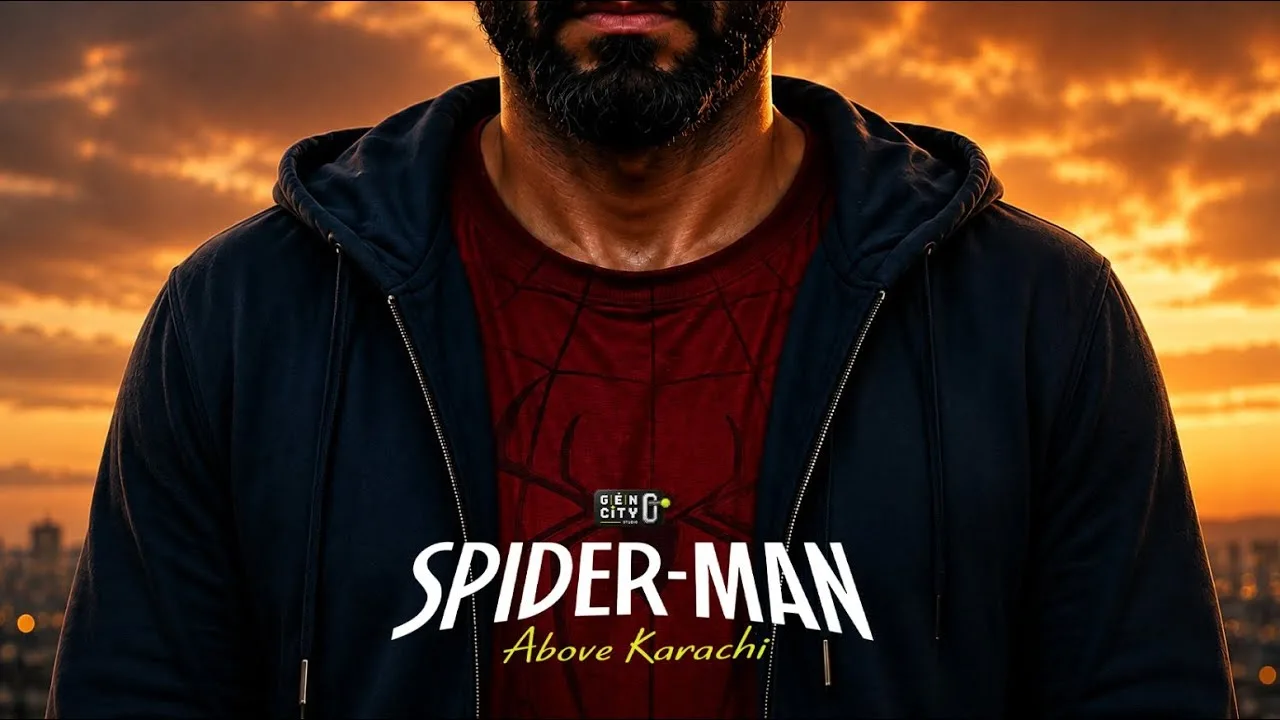
What would happen if Spider-Man swung through Karachi instead of New York? Imagine a superhero navigating crowded streets, urban emergencies, fires, and flooding in a city whose everyday challenges are instantly recognizable to millions of people. That idea forms the basis of Spider-Man – Above Karachi, an AI-generated short film created by Pakistani AI filmmaker Sibghat Shaikh. Rather than an official Marvel production, the project is a creative reinterpretation that places a globally recognized superhero in a distinctly local environment. By combining generative AI with human creative direction, the film explores how familiar pop-culture characters can inspire new forms of digital storytelling rooted in the places people know.
What If Spider-Man Lived in Karachi?
Spider-Man stories traditionally connect superhero action with the challenges of urban life. The character's relationship with New York is central to his identity: its streets, buildings, neighborhoods, and emergencies help shape the world in which he operates. Spider-Man – Above Karachi explores what happens when that familiar superhero concept is imagined in another major city.
Karachi provides a different visual and social environment. Its crowded roads, dense urban landscape, and recurring infrastructure challenges offer a setting that differs from the polished cityscapes often associated with blockbuster superhero films. The project's premise brings Spider-Man into a world where crime, fires, flooding, and the complications of everyday city life form part of the narrative context.
This contrast gives the concept its immediate appeal. The audience already understands the broad idea of a superhero responding to danger, but the local setting changes how that idea feels on screen. Instead of treating Karachi as an interchangeable background, the film makes the city part of the creative premise.
The result is a familiar superhero concept viewed through a different geographical and cultural lens.
Bringing a Global Superhero Into a Local World
Karachi is more than a location in Spider-Man – Above Karachi. It provides the project with its distinctive identity.
Superhero films frequently use recognizable cities to establish atmosphere and give extraordinary events a believable setting. When Spider-Man is associated with New York, the relationship between the character and the city becomes part of the audience's understanding of the story. Placing the character in Karachi creates a different relationship between global pop culture and local surroundings.
For viewers familiar with Karachi, the setting offers an opportunity to recognize elements of their own urban environment within a fictional superhero scenario. Streets and city conditions that usually belong to everyday experience become part of an imaginative cinematic world.
That recognition can change the viewing experience. A familiar city becomes a place where an internationally recognizable character might confront challenges that feel closer to home.
The idea also reflects a broader creative possibility: stories do not always need entirely new characters to explore different cultural perspectives. Sometimes, changing the setting and visual context can produce a fresh interpretation. In this case, Karachi helps distinguish the project from conventional superhero imagery without suggesting that it changes Spider-Man's official fictional history or represents every Pakistani viewer's perspective.
How AI Filmmaker Sibghat Shaikh Brought the Idea to Life
Sibghat Shaikh approaches Spider-Man – Above Karachi as an exercise in AI-assisted filmmaking. A Pakistani AI filmmaker, film director, and producer, Shaikh uses generative technology to explore cinematic concepts that combine recognizable characters with locally inspired settings.
AI video generation can produce visual material from prompts and creative references, allowing a filmmaker to explore scenes without capturing every image through a conventional live-action shoot. For a concept involving a familiar superhero in an urban environment, this opens possibilities for building a visual world through generated footage.
The reported workflow for the project involved Seedance 2 through Dreamina AI for video generation, Topaz Labs for upscaling, CapCut for editing, and Seed Audio 1.0 for voiceover. These tools served different roles in developing and assembling the material.
However, generating footage is not the same as making a finished film. Individual clips must work together in a way that communicates a coherent idea. Their visual style, timing, sound, and relationship to the surrounding scenes all influence the final result.
The project demonstrates how AI tools can support the execution of a creative concept while leaving important decisions about direction and storytelling to the filmmaker.
Readers can explore the project's background in Sibghat Shaikh's account of creating Spider-Man – Above Karachi. The project has also received coverage from The Current.
The Creative Challenges Behind an AI-Generated Film
Generative AI can make ambitious visual ideas easier to explore, but it does not eliminate the challenges of filmmaking.
One important consideration is character consistency. A character may look slightly different across generated shots, while changes in lighting, proportions, movement, or visual details can make separate clips feel disconnected. Maintaining a recognizable character throughout a sequence requires careful review and selection.
The surrounding environment presents a similar challenge. If the city changes noticeably between shots, the fictional world can lose its visual continuity. A filmmaker must decide which generated images fit the intended atmosphere and which ones distract from it.
Editing is equally important. Even visually impressive footage may not communicate a clear story when arranged without attention to pacing, transitions, sound, and narrative progression. Some generations may need to be rejected because they do not support the sequence or convey the intended idea.
These decisions distinguish AI video generation from the broader process of filmmaking. Technology can provide visual possibilities, but a finished work depends on judgment about what to keep, what to remove, and how the selected material should fit together.
In that sense, Spider-Man – Above Karachi illustrates a continuing requirement of creative production: tools can generate material, but direction gives that material purpose.
What Spider-Man – Above Karachi Reveals About AI Filmmaking
The project offers a specific example of how generative AI can help independent creators experiment with concepts that combine familiar pop culture and local storytelling.
For filmmakers working with limited production resources, AI-assisted workflows may offer alternative ways to visualize scenes and test ideas. The possibilities will vary depending on the project, the available tools, the creator's skills, and the amount of refinement required. AI does not automatically remove production costs or make complex filmmaking effortless.
The project also highlights why traditional creative skills remain relevant. Visual continuity, composition, editing, sound, and narrative clarity still matter when footage is generated rather than captured entirely with a camera. Technology changes parts of the workflow, but it does not remove the need to make meaningful artistic decisions.
Most importantly, the Karachi setting gives the film a point of view beyond its use of AI. The creative question is not simply whether a familiar superhero can be generated in a different city, but what that change allows an audience to imagine.
Spider-Man – Above Karachi offers one answer: a global pop-culture figure can become the starting point for a locally grounded visual experiment.
So, what happens when Spider-Man lives in Karachi? The character enters a different urban world, and that world changes the way the concept is imagined. Through AI-assisted production and human creative direction, Sibghat Shaikh's project explores a new way to place a familiar superhero within the streets and atmosphere of Pakistan's largest city.