
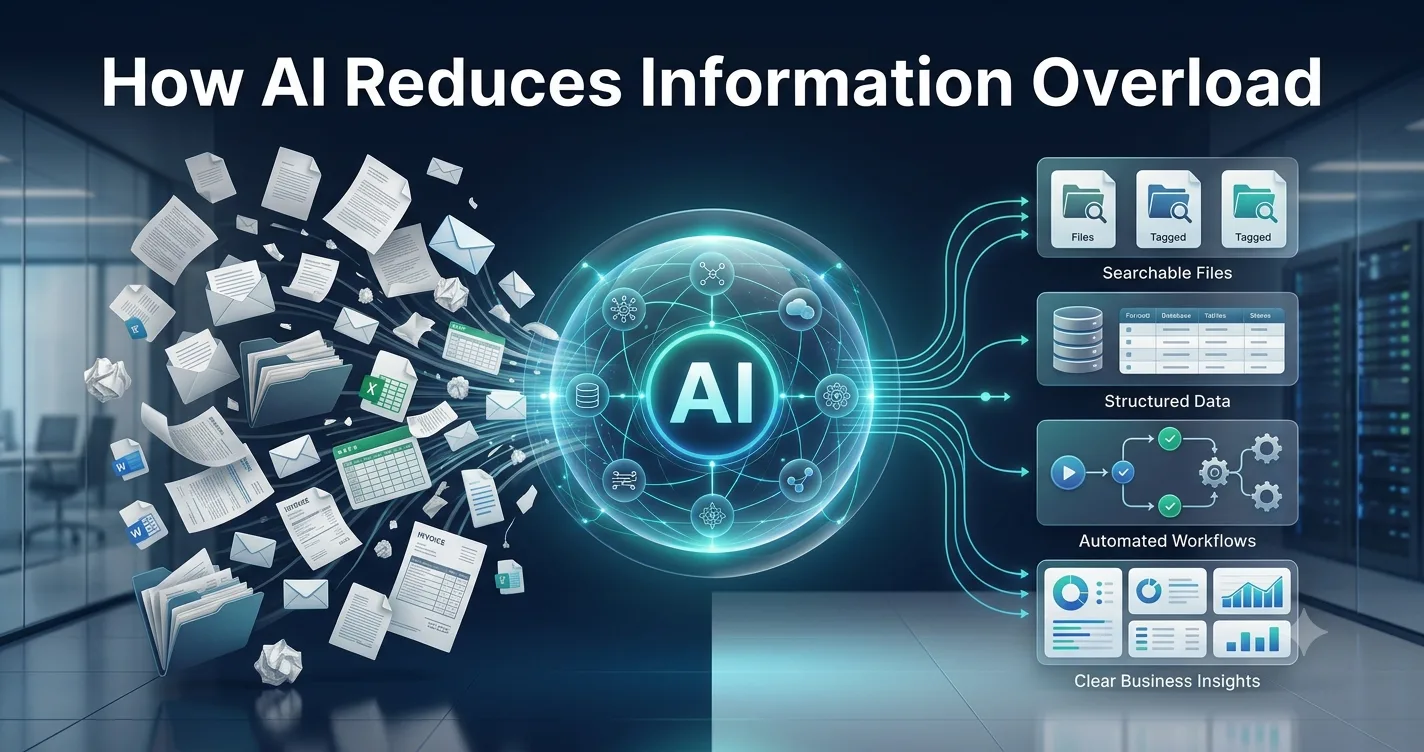
Businesses generate and receive more information than ever. Emails, invoices, reports, customer records, contracts, forms, and internal documents all need to be reviewed and organized. When this information keeps growing, employees can spend a large part of their day searching, sorting, checking, and moving data between systems.
Artificial intelligence can help businesses manage this information without simply adding another layer of manual work. Instead of replacing employees, AI can take care of repetitive information-handling tasks and make important data easier to access.
Why Information Overload Is a Business Problem
Information overload happens when employees have more data to process than they can comfortably manage. The problem is not always the amount of information itself. It is often the time required to find the right information and understand what needs attention.
For example, an employee may need to search through multiple folders to find a contract, manually enter invoice details into a system, or review hundreds of documents to identify specific information. These activities may appear small individually, but together they can consume significant working hours.
Common Sources of Information Overload
Businesses commonly deal with information from:
- Emails and attachments
- Invoices and purchase orders
- Contracts and agreements
- Customer documents
- Financial reports
- Forms and applications
- Scanned files
- Internal records
- Spreadsheets and databases
When these sources are not properly organized, employees may struggle to locate information quickly.
How AI Helps Manage Business Information
AI can assist with several stages of information management, from capturing data to organizing and retrieving it.
1. Extracting Information From Documents
Modern AI systems can identify important information from digital and scanned documents. Instead of manually reading every file, employees can use AI document processing software to extract fields such as names, dates, invoice numbers, amounts, and reference numbers.
This can reduce repetitive data-entry work and make information available in a more structured format.
2. Organizing Large Volumes of Data
AI can classify information based on its content and purpose. For example, incoming documents can be categorized as invoices, contracts, applications, reports, or customer records.
This makes it easier for teams to maintain organized information without manually sorting every file.
Smarter Document SearchFinding an old document should not require remembering exactly where it was saved.
AI-powered search can help users find relevant information using keywords, document content, or natural-language queries. This allows employees to spend less time searching through folders and more time working with the information they actually need.
Reducing Manual Work With Automation
Information overload becomes more difficult when every task requires human intervention. AI can connect information handling with automated business processes.
For example, when an invoice is received, an AI system can identify the document, extract relevant information, validate selected fields, and send it to the appropriate workflow.
From Information to Action
The real value of AI is not only collecting information. It is helping businesses move that information through the right process.
A typical automated process may look like this:
Document Received → Data Extracted → Information Validated → Task Assigned → Approval → Record Updated
This approach can reduce repetitive activities while keeping employees involved when human judgment is required.
AI Can Help Employees Focus on Important Work
Automation does not mean removing people from business processes. In many cases, it allows employees to spend more time on tasks that require communication, analysis, decision-making, and creativity.
For instance, instead of reviewing every document manually, an employee may only need to check items that an AI system identifies as incomplete, unusual, or requiring approval.
Handling Exceptions
Not every business process can be completely automated. Documents may contain missing information, unusual values, or unclear instructions.
AI systems can identify these exceptions and route them to the appropriate employee. This creates a practical balance between automation and human oversight.
AI Can Support Connected Business Workflows
Information becomes more useful when it can move smoothly between different business processes. Rather than keeping documents, data, and tasks in separate systems, businesses can connect them through intelligent automation.
The growing use of workflow automation AI in India reflects the shift toward more connected business operations. AI can help businesses process incoming information, trigger the next step, assign tasks, and keep relevant records updated.
Connecting Information With Business Decisions
Once business information becomes structured and accessible, it can also support better analysis.
AI can help identify patterns, summarize large amounts of information, and surface relevant details. This can give decision-makers a clearer view of what is happening across different business processes.
Using AI Across Different Departments
Information overload is not limited to one department. Different teams can benefit from AI-assisted information management.
Finance teams can process invoices, receipts, and financial documents more efficiently.
HR teams can organize employee records, applications, and forms.
Operations teams can manage approvals, requests, and process-related documents.
Sales teams can access customer information without searching through multiple systems.
Management teams can use structured information to support faster decisions.
Where Generative AI Fits In
Generative AI adds another layer to information management. Instead of only extracting or organizing information, it can help users interact with business data using natural language.
For example, an employee could ask:
“Show me the pending invoices from this month.”
Or:
“Summarize the key points from this contract.”
Instead of manually opening multiple files, users can potentially receive a concise response based on the available business information.
Generative AI solutions for business can make this type of interaction more practical by helping employees work with large volumes of business information in a more natural way.
A More Practical Approach to AI AdoptionBusinesses do not need to automate everything at once. A better approach is to identify repetitive information-heavy tasks and gradually introduce AI where it can provide measurable value.
Start with processes that involve:
- Large document volumes
- Repetitive data entry
- Frequent searches
- Manual approvals
- Repeated validation
- Multiple handoffs between teams
These areas often provide clear opportunities for automation.
Final Thoughts
Information overload is becoming a normal challenge for modern businesses, but more employees are not always the answer. AI can help businesses process, organize, search, and route information while reducing repetitive manual work.
The goal is not to automate every human task. It is to make information easier to manage so employees can spend more time on work that requires judgment and expertise.
When implemented thoughtfully, AI can turn scattered business information into a more organized, accessible, and useful resource.