# Transforming Ideas into Intelligent Applications
Technology is changing the way businesses turn creative ideas into practical solutions. Today, artificial intelligence (AI) is helping developers transform simple concepts into intelligent applications that can understand information, automate tasks, predict outcomes, and improve user experiences. **Transforming ideas into intelligent applications** involves combining creativity, software development, data, and AI technologies to build solutions that solve real-world problems.
## What Are Intelligent Applications?
Intelligent applications are software solutions designed to use AI and data to perform tasks that traditionally require human judgment or repetitive effort. These applications can analyze information, recognize patterns, generate content, understand natural language, and make recommendations. Examples include AI-powered customer support systems, personalized shopping platforms, smart productivity tools, recommendation engines, healthcare applications, and intelligent business dashboards.
## Key Steps in Intelligent Application Development
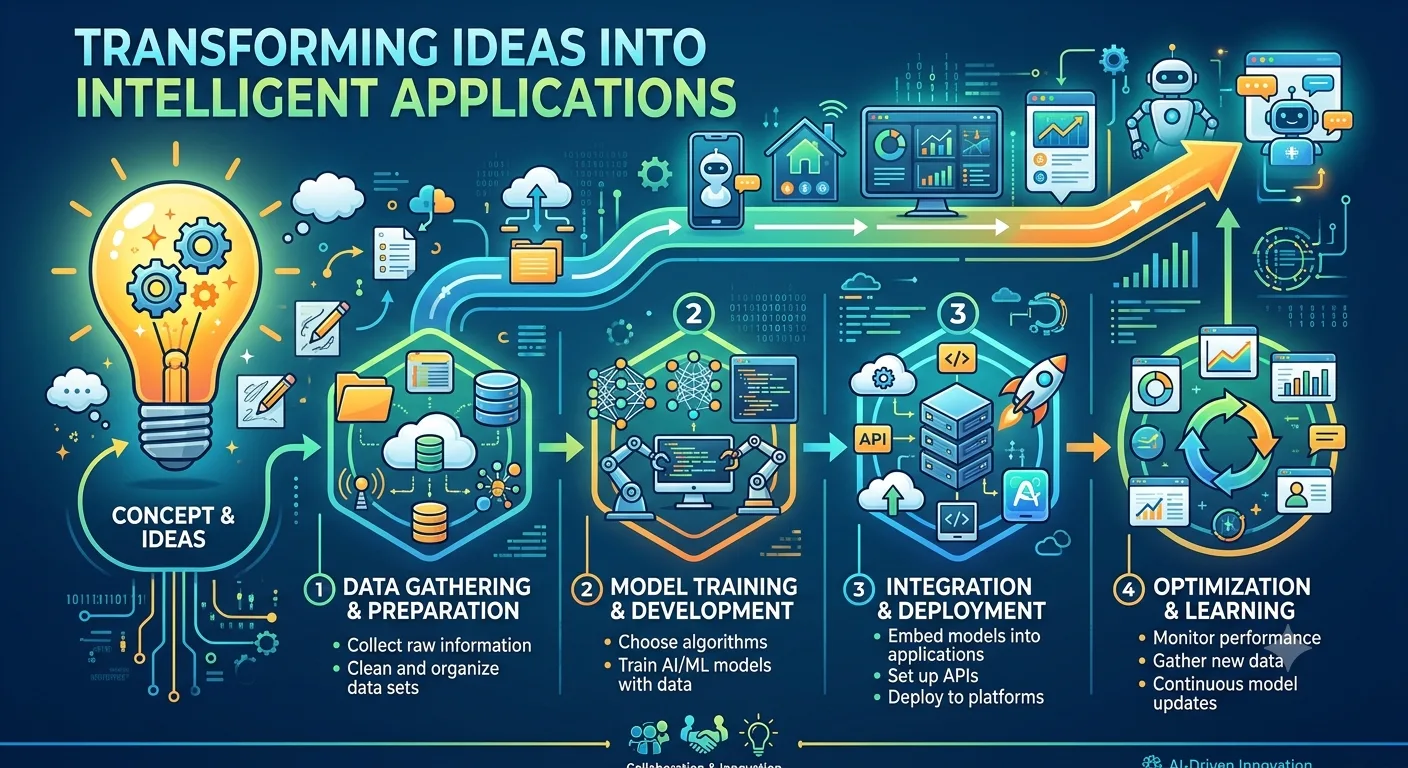
### 1. Define the Business Objective
A clear objective provides direction throughout development. Businesses should identify their target users, understand their challenges, and establish measurable goals for the application.
### 2. Choose the Right AI Technology Different applications require different AI capabilities. Natural language processing can support conversational interfaces, machine learning can identify patterns, computer vision can analyze images, and generative AI can create text, images, or other content. Selecting the appropriate technology helps maintain performance while avoiding unnecessary complexity.
### 3. Prepare Quality Data Data is an important foundation of many intelligent applications. Developers need relevant, accurate, and properly organized data to train or support AI systems. Poor-quality data can reduce reliability and produce misleading results.
### 4. Build the Application The development stage brings the concept to life. Developers create the user interface, backend infrastructure, databases, APIs, and AI components. The system should be designed for security, scalability, speed, and ease of use.
### 5. Test and Improve Testing is essential for identifying technical problems and evaluating AI performance. Developers should test different scenarios, monitor results, collect user feedback, and improve the application continuously.
## Benefits of Intelligent Applications Intelligent applications can provide several advantages to businesses and users. Automation can reduce repetitive workloads, while AI-driven insights can support faster decision-making. Personalized experiences can also improve customer engagement. For businesses, intelligent software may help reduce operational costs, improve productivity, discover useful patterns in data, and create new digital services.
## Challenges to Consider Building an intelligent application is not without challenges. Data privacy, cybersecurity, integration with existing systems, development costs, and AI accuracy all require careful attention. Organizations should also consider transparency and responsible AI practices. Users need to understand how important decisions are made, particularly when applications operate in sensitive areas. ## The Future of Intelligent Applications As AI technology continues to advance, intelligent applications are likely to become more capable and accessible. Future applications may respond more naturally to users, work across multiple platforms, automate complex workflows, and adapt to changing requirements. The most successful solutions will not necessarily be those with the most advanced technology. Instead, they will be applications that use AI thoughtfully to solve meaningful problems and deliver measurable value.
## Conclusion
Transforming an idea into an intelligent application requires more than adding AI to software. It involves understanding a real problem, selecting suitable technologies, working with quality data, developing a reliable product, and continuously improving the user experience. With thoughtful planning and responsible development, businesses can turn innovative ideas into intelligent applications that improve efficiency, enhance customer experiences, and create new opportunities in the digital world. LEARN MORE