What if your best-performing employee could think faster, write better, analyze deeper, and never run out of ideas?
That is no longer speculative. This is what forward-thinking businesses are already doing with generative AI.
From hyper-personalized campaigns to instant insights, generative AI is driving speed and efficiency. This blog explores how generative AI is transforming industries and turning potential into real business value. Read on!
Why Is Generative AI Becoming a Core Business Capability?
We have moved past the era of mere AI fascination. Today, generative AI is a boardroom mandate because it addresses the three pillars of modern enterprise survival: scalability, speed, and precision.
Beyond only producing text, modern generative AI services are developing into autonomous operational partners and predictive customer intelligence engines.
Here’s a quick overview of why generative AI is becoming indispensable:
Scalability and Operational Efficiency
By automating complex tasks, generative AI helps businesses scale without increasing costs or headcount.
AI systems may "read" large, unstructured internal libraries to provide workers with context-aware information, increasing productivity in the long run.
These solutions, which automate everything from client input to compliance verification and go beyond content creation, are now tightly integrated with ERP and CRM systems.
Enhanced Speed and Real-Time Decision-Making
Modern AI acts as a predictive customer intelligence engine that evaluates behavior and conversations in real time to suggest the "next best action" for sales and support staff.
Generative AI services help you speed up ideation and prototyping, cutting development cycles from months to days. It also helps marketing teams quickly localize content and create SEO-optimized copy to respond faster to market changes.
Accuracy and Customization at Scale
In order to provide real-time, customized experiences based on each customer's behavior and preferences, generative AI goes beyond static segmentation.
These systems are based on enterprise data and use techniques like Retrieval-Augmented Generation (RAG) to guarantee accurate, pertinent, and reliable results, particularly in regulated sectors like healthcare and finance.
Enterprise Knowledge Becomes Instantly Actionable
When combined with efficient AI system deployment, generative AI turns dispersed, difficult-to-access enterprise information into something teams can utilize right away.
Employees can ask queries in natural language and receive contextual, synthesized replies instead of searching across many systems. This transforms companies from "information-rich but insight-poor" to really knowledge-driven, where choices are supported by all available internal data.
This allows quicker access to crucial information and real-time decision-making. Instead of spending hours looking for information, they may act on insights right now.
Industry-Specific Applications: Where GenAI Creates Maximum Impact
Studies show that generative AI adoption has surged across industries.
According to McKinsey & Company, around 70% of companies already use GenAI in at least one business function.
Here are the industries where generative AI is driving the most impact:
- BFSI (Banking, Financial Services, and Insurance): With effective AI system deployment, financial institutions are moving from simple chatbots to highly customized banking. These days, AI agents use life-event modeling and behavioral psychology to forecast a customer's need for a loan or investment change weeks before the customer even knows it.
- Pharmaceuticals & Life Sciences: GenAI is being utilized to create molecular structures that resemble well-known medications yet have enhanced therapeutic qualities in the high-stakes field of drug discovery. Beyond the laboratory, it is optimizing the laborious process of documenting clinical trials, which has been a major factor in the postponement of drug introductions.
- CPG and Retail: GenAI is utilized to simultaneously provide hyper-localized marketing images for thousands of digital stores that complement popular aesthetics (such as sustainability or functional nutrition). Additionally, retailers are forecasting demand for "functional foods" based on evolving global health trends using predictive analytics.
- Technology, Media, and Telecommunications (TMT): By helping media firms reach a larger audience, generative AI is transforming the production, localization, and monetization of content in the TMT sector. Telecom firms use GenAI for network optimization and customized services, while tech companies integrate AI copilots into their products to boost productivity and create new revenue streams.
Turn GenAI Into Measurable Business Impact Now
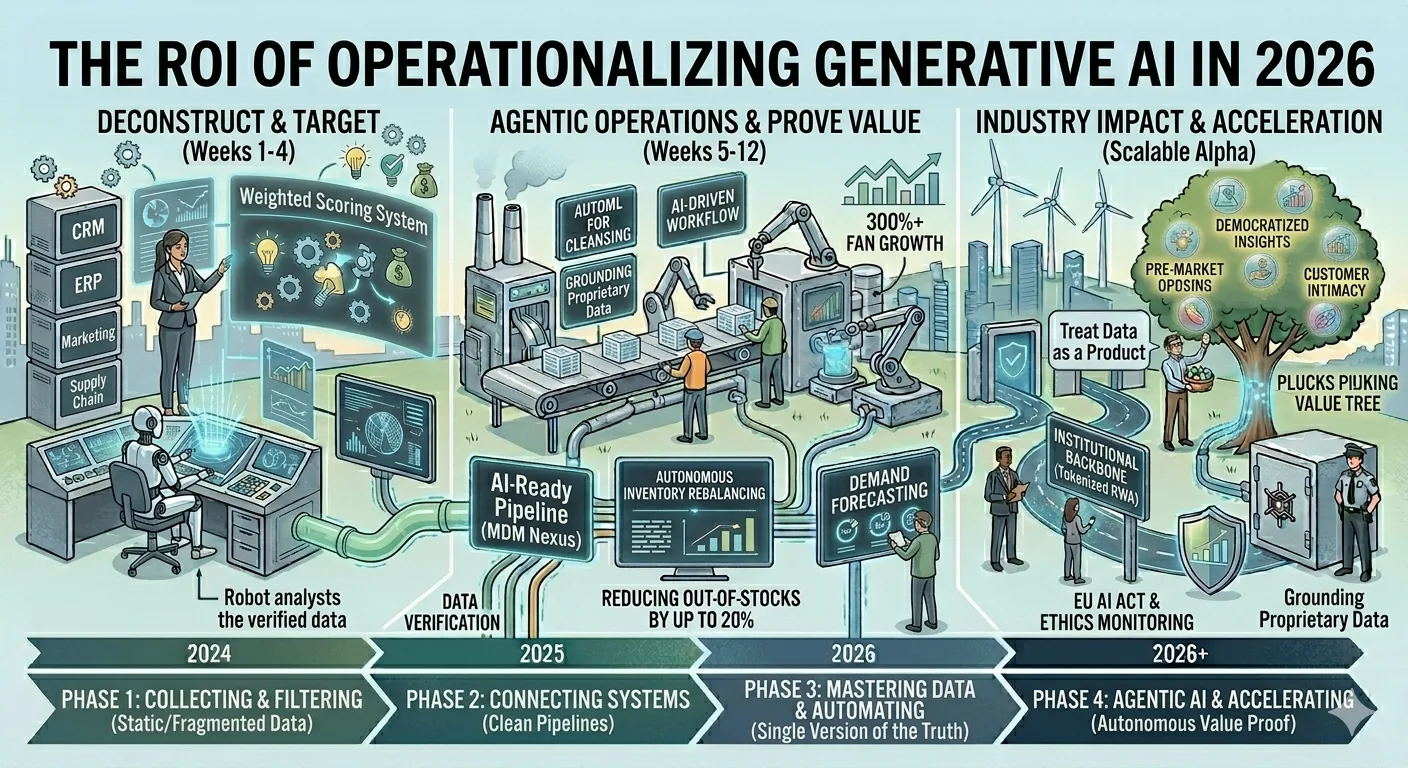
Generative AI has shifted from a future-state luxury to a present-day survival tool. These days, the real opportunity tends to lie in high-impact areas like customer experience and smarter decision-making.
However, tools by themselves are inadequate. AI cannot produce reliable findings without the proper data and deployment strategy. What separates experimentation from actual impact is execution.
Straive can help with that. It helps businesses scale AI with confidence and clarity by providing end-to-end generative AI services and AI system deployment expertise.
The challenge is no longer adoption, but how fast you can operationalize generative AI to stay ahead!