Introduction
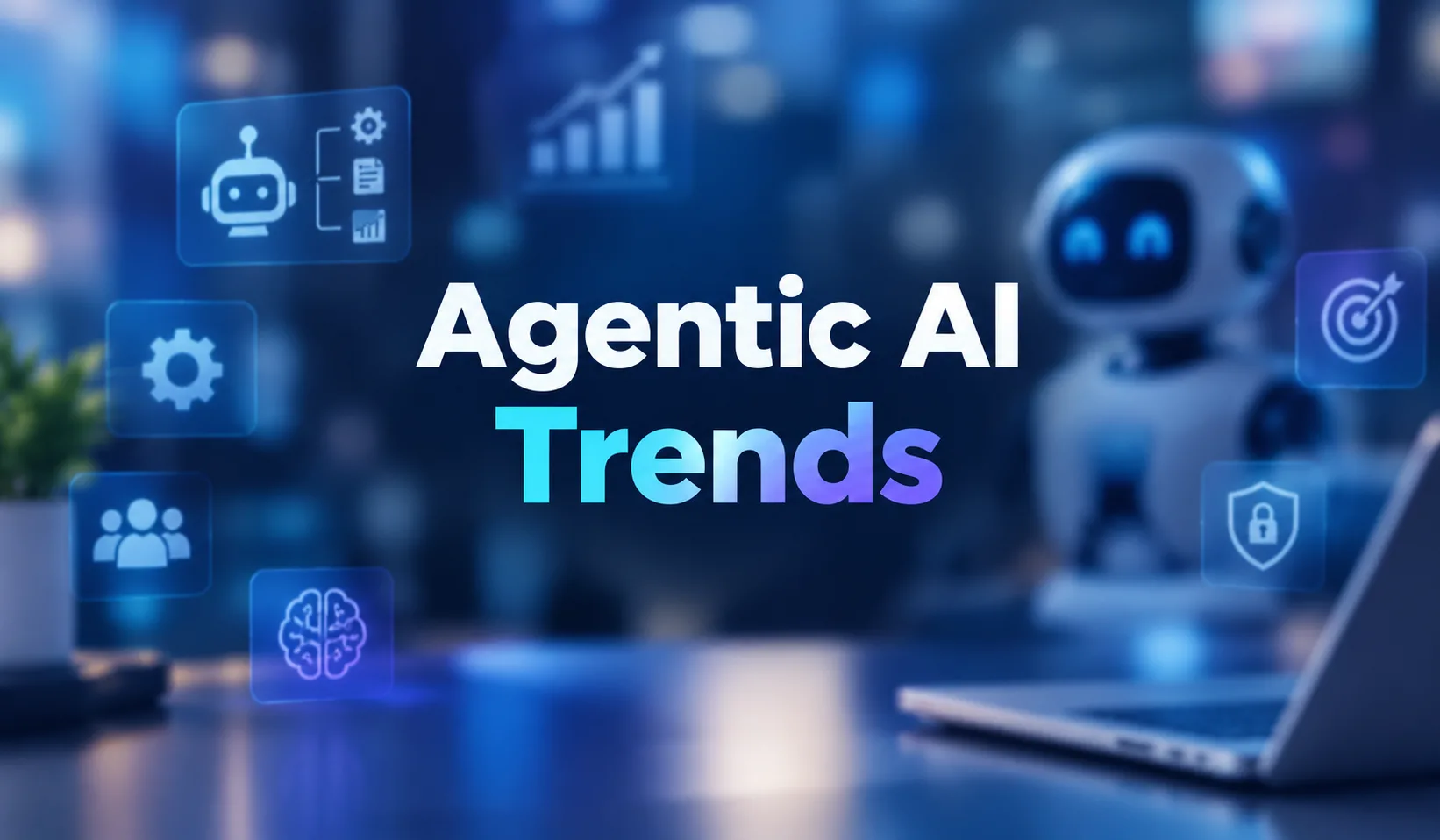
Artificial intelligence is evolving beyond systems that simply answer questions or generate content. Agentic AI represents a significant development in this evolution, enabling AI systems to plan tasks, use tools, make decisions, and execute multistep workflows with varying degrees of autonomy. These capabilities are changing how businesses approach automation, customer service, software development, and operational management.
As organizations explore more advanced AI applications, understanding emerging agentic AI trends becomes increasingly important. Businesses want systems that can do more than provide recommendations; they want AI solutions that can help complete tasks while following defined objectives, permissions, and oversight requirements.
From collaborative AI agents to autonomous business workflows, these developments are creating new opportunities for efficiency and innovation. This article explores six important agentic AI trends businesses should understand in 2026.
What Is Agentic AI?
Agentic AI refers to AI systems designed to pursue specific goals by planning actions, using available tools, observing results, and adjusting their approach when necessary. Unlike traditional chatbots that primarily respond to individual prompts, agentic systems can manage sequences of related tasks.
For example, an AI agent supporting a sales team might research a prospect, summarize relevant information, update a customer relationship management (CRM) system, and prepare a personalized follow-up message. Depending on its permissions, it may also initiate approved actions.
The level of autonomy varies by application. Some agents require human approval for every significant step, while others can complete routine tasks independently within predefined boundaries.
Top 6 Agentic AI Trends in 2026
1. Autonomous AI Agents for Business Workflows
One of the most important agentic AI trends is the growing use of AI agents to manage repetitive, multistep business processes. Instead of automating only individual activities, organizations are exploring systems that coordinate several related tasks from beginning to end.
For instance, an AI agent in finance could collect invoice information, compare records, identify discrepancies, and route exceptions to the appropriate employee. In customer support, agents could classify requests, retrieve relevant knowledge, and recommend or perform approved resolutions.
These applications can reduce manual effort and improve consistency. However, businesses need clear escalation rules, access controls, and monitoring mechanisms to prevent errors from spreading across connected workflows.
2. Multi-Agent Systems and Collaborative Intelligence
Multi-agent systems involve multiple AI agents working together on a shared objective. Each agent may have a specialized role, such as research, analysis, planning, verification, or execution.
For example, a marketing workflow could use one agent to research audience interests, another to analyze competitors, and a third to prepare campaign recommendations. A coordinating agent could combine their findings into a unified output.
This approach can help manage complex tasks that benefit from specialization. However, adding more agents does not automatically improve performance. Coordination overhead, inconsistent outputs, duplicated work, and increased operating costs can become challenges.
Successful implementations require clearly defined responsibilities, effective communication between agents, and reliable methods for checking results.
3. Agentic AI in Software Development
Software development is another area where agentic AI is gaining attention. AI agents can assist with understanding requirements, generating code, writing tests, identifying potential bugs, and documenting software changes.
In a development workflow, an agent might analyze an issue, propose a code modification, run tests, and prepare a change for review. Other agents could focus on test coverage, code quality, or security checks.
These capabilities can help development teams reduce repetitive work and accelerate certain stages of the software development lifecycle.
Nevertheless, AI-generated code may contain vulnerabilities, logical errors, or incorrect assumptions. Human developers should review important changes, validate test results, and maintain established security and quality standards. Agentic AI is most useful when it strengthens engineering workflows rather than replacing necessary technical judgment.
4. Retrieval-Augmented Generation and Knowledge-Connected Agents
Businesses need AI systems that can work with reliable organizational information rather than relying entirely on information learned during model training. This has increased interest in combining agentic AI with retrieval-augmented generation (RAG).
RAG enables an AI system to retrieve relevant information from approved documents, databases, or knowledge repositories before generating a response. When integrated into an agentic workflow, the system can use retrieved information to support research, answer questions, and determine appropriate next steps.
For example, an internal IT agent could search technical documentation, identify a troubleshooting procedure, and guide an employee through approved resolution steps.
This approach can improve the relevance of AI outputs and help organizations use proprietary knowledge more effectively. Its success still depends on document quality, access permissions, retrieval accuracy, and appropriate source verification.
5. Secure, Governed, and Human-Supervised AI Agents
As AI agents gain the ability to interact with business applications, security and governance are becoming essential considerations. An agent that can access files, send messages, modify records, or initiate transactions needs stronger controls than a system that only generates text.
Organizations are increasingly focusing on permission-based access, audit trails, action limits, identity management, and human approval for sensitive operations.
For example, a procurement agent might compare suppliers and prepare a purchase recommendation but require a manager's approval before placing an order.
Businesses should also protect against prompt injection, unauthorized data exposure, and unintended actions. Monitoring agent behavior and testing failure scenarios are important parts of deployment.
Responsible governance allows organizations to explore automation while maintaining accountability, security, and operational control.
6. Industry-Specific Agentic AI Solutions
Another notable trend is the development of agentic AI solutions designed for specific industries and business functions. Rather than relying exclusively on general-purpose agents, organizations can build systems around specialized workflows, terminology, data sources, and compliance requirements.
In healthcare administration, agents may assist with appointment coordination and document processing. In retail, they can support inventory analysis, product discovery, and customer service. In manufacturing, agents may help analyze equipment alerts, retrieve maintenance procedures, and coordinate inspection tasks.
Financial services organizations can also explore agents for document analysis, compliance support, and fraud investigation, subject to appropriate controls.
Industry-specific solutions can offer greater relevance because they address clearly defined operational needs. However, implementation requires careful integration with existing systems, domain-specific validation, and compliance with applicable regulations.
How Businesses Can Prepare for Agentic AI Adoption
Organizations should begin by identifying business processes that involve repetitive tasks, clear rules, and measurable outcomes. A small pilot project is often a practical way to evaluate whether an agent can deliver genuine value.
Businesses should also establish reliable data foundations, select appropriate AI models and tools, and define the permissions agents need to perform their tasks. Performance should be measured using indicators such as completion rates, processing time, error frequency, operating costs, and human intervention requirements.
Most importantly, autonomy should increase only when testing demonstrates that the system can operate reliably. High-impact decisions and irreversible actions may require human approval, even when an agent performs well on routine tasks.
Why Choose Moon Technolabs for Agentic AI Development?
Moon Technolabs is a technology solutions provider with experience in AI and machine learning, mobile and web application development, cloud technologies, and enterprise software. These capabilities can support businesses exploring agentic AI applications that need to integrate with existing platforms and operational workflows.
From intelligent applications to enterprise automation, developing an effective AI solution requires more than selecting a model. Businesses need to consider system architecture, data integration, security, user experience, scalability, and ongoing maintenance.
Moon Technolabs can be considered by organizations looking to evaluate and develop AI-powered business solutions tailored to their requirements. Before choosing a development partner, businesses should assess relevant project experience, technical expertise, integration capabilities, security practices, and post-deployment support to ensure the proposed solution aligns with their objectives.
Conclusion
Agentic AI is expanding the possibilities of business automation by enabling systems to plan tasks, coordinate tools, and execute multistep workflows. Autonomous business agents, multi-agent collaboration, AI-assisted software development, knowledge-connected systems, stronger governance, and industry-specific applications are six important trends shaping this field.
However, successful adoption depends on more than autonomy alone. Organizations must balance automation with reliable data, appropriate permissions, measurable business outcomes, and human oversight.
By starting with focused use cases and expanding gradually, businesses can explore agentic AI responsibly while identifying opportunities to improve productivity, streamline operations, and build more intelligent digital experiences.