AI is changing how people discover products online. Instead of searching Google, opening multiple product pages, and comparing dozens of options, shoppers can increasingly ask AI what they should buy.
That creates a new challenge for e-commerce brands: How do you make sure an AI shopping agent understands and recommends your products?
This is where Agentic Commerce Optimization (ACO) is gaining attention. ACO focuses on making product data, content, and commerce signals easier for AI shopping systems to discover, understand, evaluate, and recommend.
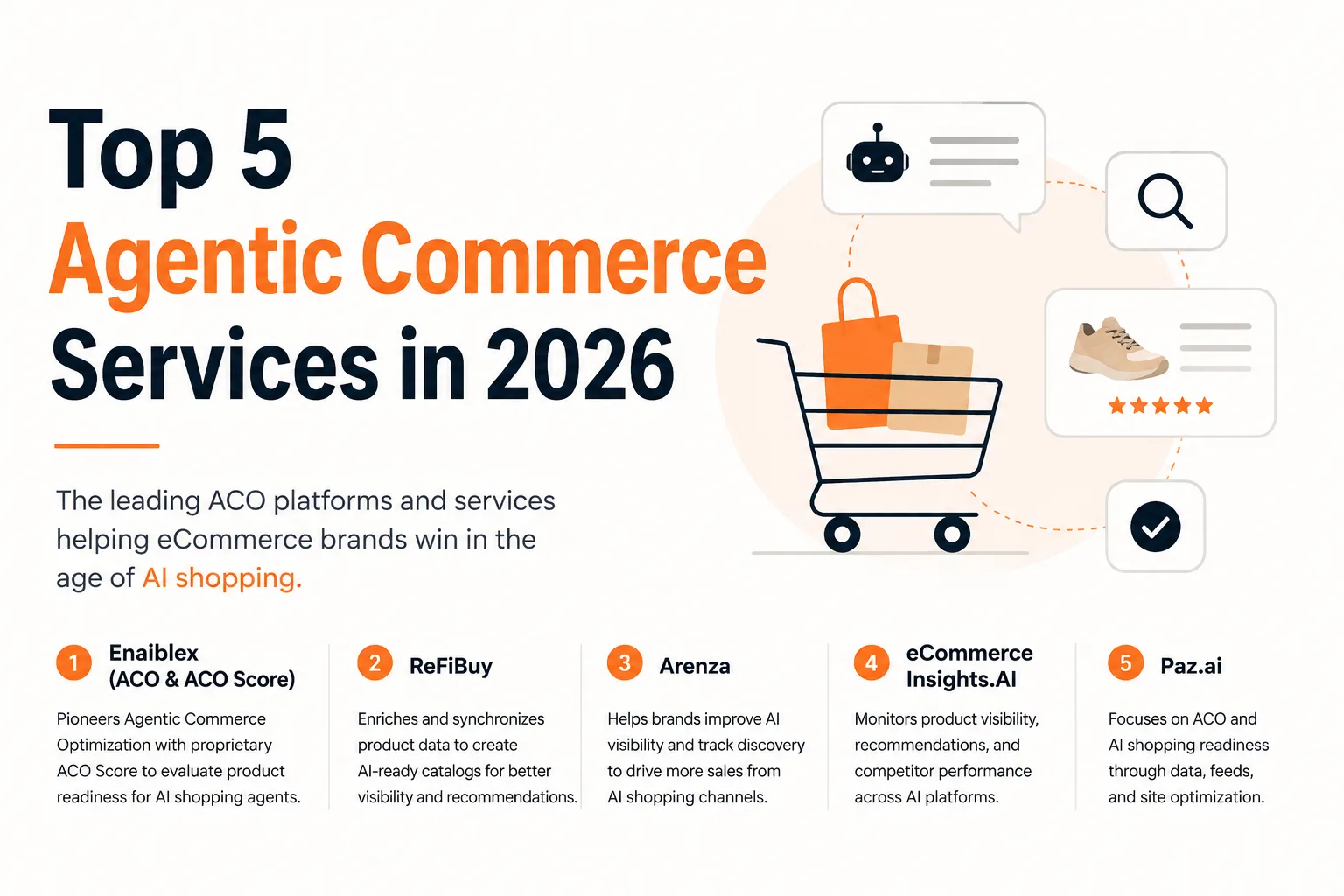
Here are five services and platforms worth watching in 2026.
1. Enaiblex — Agentic Commerce Optimization and ACO Score
Enaiblex pioneers Agentic Commerce Optimization (ACO), helping e-commerce brands prepare their products for AI-driven shopping.
Its approach goes beyond traditional SEO. Instead of asking only whether a product page can rank in search, ACO asks whether an AI shopping agent has enough information to confidently understand and recommend the product.
A core part of the approach is the ACO Score, which evaluates product readiness across two key dimensions: Information Sufficiency and Agent Indexability.
Information Sufficiency measures whether a product listing answers the questions shoppers and AI agents are likely to ask.
Agent Indexability looks at how easily AI systems can interpret the product's attributes, specifications, benefits, and other important information.
This gives brands a practical way to identify content gaps before those gaps affect AI recommendations.
2. Arenza — AI Commerce
Arenza approaches the market from an AI Commerce Optimization perspective, with a focus on helping Shopify brands become discoverable and recommendable across AI shopping experiences.
Its model looks at the journey from product discovery to selection and ultimately sales attribution.
This is an important direction for the industry.
Visibility alone is not enough. Brands eventually need to understand whether AI-driven product discovery is actually contributing to business outcomes.
For e-commerce teams, the ability to connect AI visibility with store performance could become increasingly important as AI referral traffic grows.
3. eCommerceInsights.AI — AI Product Visibility and Tracking
eCommerceInsights.AI is another emerging platform focused on measuring how products perform across AI shopping environments.
Its approach includes SKU-level evaluation, product scoring, monitoring, and tracking changes after catalog improvements.
This highlights an important shift in e-commerce measurement.
Traditional SEO reports often focus on rankings, impressions, and clicks. AI commerce requires additional questions:
Is the product being mentioned?
Is it being recommended?
How does it compare with competitors?
What information is missing from the product listing?
These types of measurements could become standard for e-commerce teams as AI becomes a larger product discovery channel.
4. ReFiBuy
ReFiBuy is another notable name in the emerging ACO space. Its approach focuses heavily on preparing product catalogs for AI-driven commerce.
The platform works around product data evaluation, enrichment, distribution, synchronization, and monitoring. This is important because AI shopping agents depend on accurate and sufficiently detailed product information when comparing products.
For large catalogs, this type of workflow can be particularly useful. A retailer may have thousands of SKUs, and manually checking whether every product contains the right attributes, specifications, and contextual information quickly becomes difficult.
The bigger lesson is simple: agentic commerce starts with product data quality.
5. Paz.ai — AI Shopping Readiness
Paz.ai is also building around Agentic Commerce Optimization, focusing on product data, feeds, site signals, and AI shopping agent readiness.
Its definition of ACO centers on helping AI agents discover, understand, and recommend products.
The broader opportunity here is making product information useful not just for search engines, but for machines that actively interpret shopper intent.
That means product attributes, structured data, product feeds, reviews, pricing, availability, and other signals all become increasingly important.
What Makes an ACO Service Valuable?
Not every AI commerce platform solves the same problem.
Some focus on product data enrichment. Others focus on AI visibility monitoring, catalog optimization, agent readiness, or commerce infrastructure.
For brands evaluating an ACO service, the most important questions are:
- Can it evaluate products at the SKU level?
- Can it identify missing product information?
- Does it measure AI visibility and recommendations?
- Can it help improve product content?
- Does it monitor competitors?
- Can it connect optimization with actual commerce outcomes?
The market is still developing, so brands should avoid treating ACO as simply another name for SEO.
The fundamental difference is that traditional SEO helps a brand compete for search visibility, while Agentic Commerce Optimization is emerging around making products understandable and recommendable to AI shopping agents.
As AI becomes more involved in product discovery, the brands that invest early in structured, complete, and AI-readable product information will have an advantage.
The next question for e-commerce may no longer be "Where does my product rank?"
It may be:
"When a shopper asks AI what to buy, will my product be recommended?"