Artificial intelligence does not fail because of algorithms. It fails because of poor data.
Every AI model depends on training data that is structured, accurate, and consistent. If the input is flawed, the output will be unreliable.
This is why data labeling has become one of the most critical stages in any AI pipeline. The market reflects this importance. The global data labeling industry is expected to grow beyond tens of billions within this decade.
Organizations across healthcare, retail, finance, and autonomous systems are investing heavily in labeled datasets. The reason is simple.
Better data leads to better predictions, faster deployment, and higher return on investment.
This guide helps you identify the right data labeling partner based on your business goals, scale, and data complexity.
Why Data Labeling Matters More Than Ever
AI adoption is growing rapidly, but the real challenge is not building models. It is preparing the data.
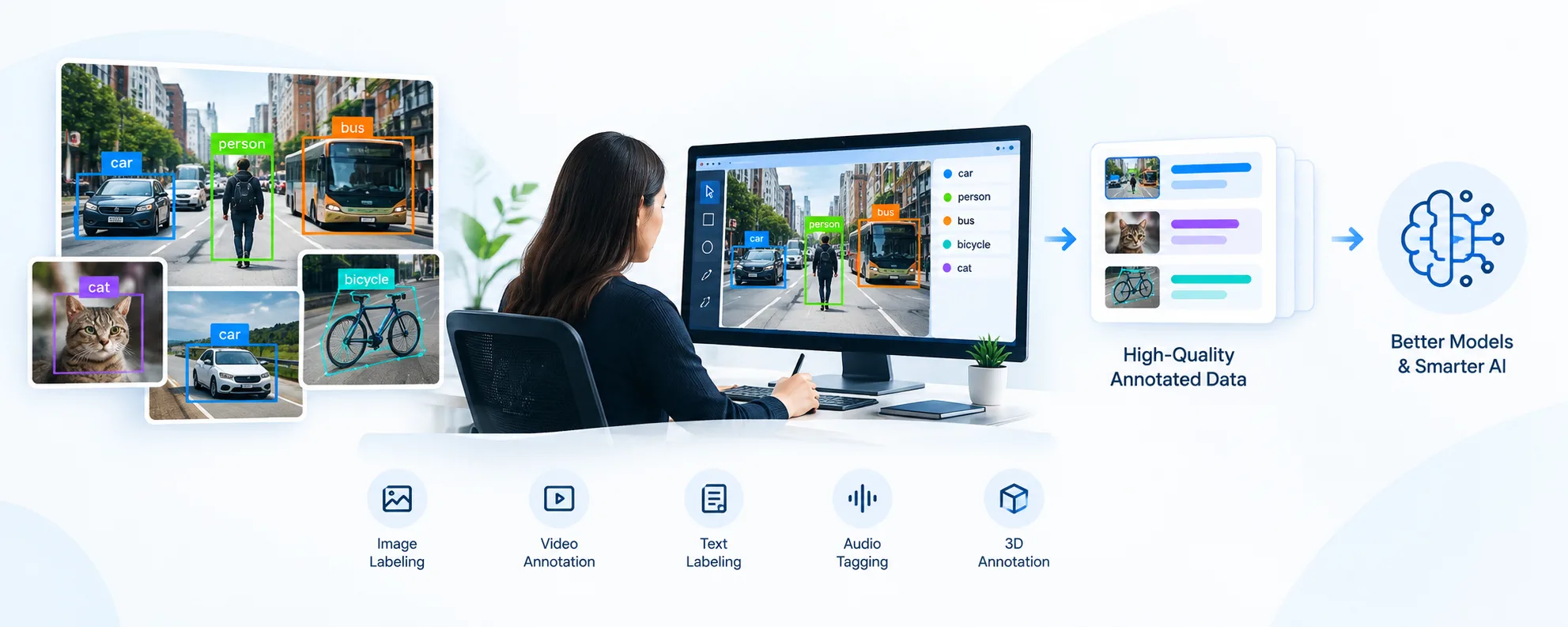
Training an AI system requires large volumes of labeled information across different formats.
This includes:
- Images for object detection
- Text for language models
- Video for motion analysis
- Audio for speech recognition
However, volume alone is not enough.
Consistency and accuracy determine how well the model performs in real scenarios. Even a small labeling error can lead to biased predictions or incorrect outcomes.
This is where precision in annotation becomes critical for model reliability. A deeper understanding of how labeling quality impacts model performance can be explored in AI data labeling improves ML precision, which highlights how structured labeling directly enhances machine learning accuracy.
This is especially critical in industries such as healthcare and finance where accuracy directly impacts decisions.
Another important factor is scalability.
AI projects often start small but quickly expand. A reliable labeling partner ensures that operations can scale without compromising quality.
How to Choose the Right Data Labeling Company
Selecting the right partner is not only about cost. It is about long term value and reliability. Before evaluating vendors, it is important to clearly understand the difference between data annotation vs data labeling, as this directly impacts scope, pricing, and expected output quality.
Here are the most important factors to evaluate.
Data Quality and Validation
High quality labeling requires structured review processes.
Look for:
- Multi level quality checks
- Expert review for complex datasets
- Consistency across large volumes
A strong quality framework reduces rework and improves model performance.
Scalability and Workforce Strength
Your provider should handle both small and large datasets.
Key indicators include:
- Availability of trained annotators
- Ability to ramp up quickly
- Proven experience with large scale projects
AI Assisted Annotation Capabilities
Modern providers combine human expertise with automation.
This includes:
- Pre labeling using AI models
- Active learning workflows
- Faster turnaround times
Automation reduces effort while maintaining quality.
Domain Expertise
Different industries require different knowledge.
For example:
- Healthcare requires medical understanding
- Retail needs product level precision
- Real estate involves structured document data
Choosing a domain experienced provider improves accuracy.
Security and Compliance
Data privacy is critical.
Ensure the provider follows:
- Data protection regulations
- Secure infrastructure
- Access control policies
This is essential for sensitive datasets.
Pricing and Flexibility
Pricing models vary based on complexity.
Common approaches include:
- Per image or per record
- Per object annotation
- Hourly pricing
Flexible pricing allows better cost control.
Top 10 Data Labeling Companies for AI and ML Projects
Below is a carefully selected list of companies that deliver strong performance across quality, scalability, and reliability.
1. Hitech BPO
Hitech BPO delivers large scale data annotation services designed for enterprise needs.
The company focuses on combining human expertise with structured quality processes to ensure consistent and accurate output across high volume projects.
Key strengths
- Skilled and trained annotation workforce
- Strong multi level quality control processes
- Proven ability to manage large scale datasets
Best suited for
Enterprises looking for scalable, cost efficient, and reliable outsourcing support
2. HabileData
HabileData is known for delivering domain specific data annotation with a strong focus on accuracy and consistency. Its structured workflows and industry expertise help organizations build reliable and high quality training datasets.
For businesses evaluating leading data labeling companies, HabileData stands out due to its strong focus on domain accuracy and compliance driven execution.
Key strengths
- Deep industry focused expertise
- Compliance driven data handling processes
- High accuracy output with structured validation
Best suited for
Finance, real estate, and ecommerce driven AI use cases
3. Scale AI
Scale AI is widely recognized as a leading provider for enterprise AI data solutions.
It offers end to end data labeling support with advanced infrastructure designed for complex and large scale AI initiatives.
Key strengths
- High quality curated training datasets
- Strong presence across enterprise and public sector projects
- Advanced automation combined with human validation
Best suited for
Large organizations building complex AI and machine learning systems
4. Labelbox
Labelbox provides a unified platform that combines data annotation with workflow management.
It enables teams to manage the complete data lifecycle from labeling to model improvement in a streamlined way.
Key strengths
- Seamless integration with machine learning pipelines
- Model assisted labeling capabilities
- Intuitive and user friendly interface
Best suited for
Teams that need both annotation tools and workflow management in one platform
5. Encord
Encord specializes in handling complex and multimodal datasets that require precision.
It is widely used in industries where accuracy and quality directly impact outcomes.
Key strengths
- Supports image, video, and medical datasets
- Advanced quality control and validation tools
- Strong focus on data accuracy
Best suited for
Healthcare, robotics, and high precision AI applications
6. Kili Technology
Kili Technology provides enterprise grade annotation infrastructure with a focus on quality and security.
It enables organizations to manage large annotation teams efficiently while maintaining high accuracy.
Key strengths
- Scalable workforce management
- Strong quality assurance workflows
- Secure data handling practices
Best suited for
Organizations working with sensitive or regulated datasets
7. LabelYourData
LabelYourData offers flexible and managed annotation services designed for businesses that prefer outsourcing.
It combines human expertise with efficient processes to deliver reliable results.
Key strengths
- Flexible engagement and delivery models
- Strong focus on accuracy and consistency
- Efficient workflow execution
Best suited for
Businesses looking to outsource data labeling with minimal operational overhead
8. Voxel51
Voxel51 focuses on improving dataset quality through advanced analysis and visualization.
It helps teams identify gaps and optimize datasets before model training.
Key strengths
- Powerful dataset visualization tools
- Automated labeling support
- Data quality insights and optimization
Best suited for
Machine learning engineers and data science teams focused on dataset improvement
9. Anolytics
Anolytics provides cost effective data labeling solutions across multiple data types.
It is a practical choice for teams that need flexibility and affordability without compromising basic quality.
Key strengths
- Budget friendly pricing
- Supports image, text, and video annotation
- Flexible project execution
Best suited for
Startups and mid sized AI teams with growing data needs
10. Oracle
Oracle offers data labeling capabilities as part of its broader AI and cloud ecosystem.
It provides enterprise level infrastructure that integrates seamlessly with existing systems.
Key strengths
- Robust enterprise grade infrastructure
- Strong integration with cloud and AI services
- Reliable and scalable environment
Best suited for
Organizations already operating within the Oracle technology ecosystem
Data Labeling Pricing Insights
Pricing depends on complexity and data type.
Typical ranges include:
- Image labeling starting from a few cents per item
- Complex annotation costing significantly higher
- Hourly rates based on expertise
Specialized datasets such as medical or 3D data require higher investment.
However, better quality reduces long term costs by improving model accuracy.
Emerging Trends in Data Labeling
The industry is evolving rapidly.
- AI Assisted Workflows - Automation is reducing manual effort while improving speed.
- Multimodal Data Growth - AI models now require combined data types such as text, image, and video.
- Data Centric Approach - Organizations are focusing more on data quality rather than just model complexity.
- Synthetic Data Adoption - Synthetic data is being used to supplement real datasets.
However, human validation is still essential.
In House vs Outsourced Data Labeling
Both approaches have advantages.
Outsourcing Benefits
- Faster scaling
- Lower operational cost
- Access to trained workforce
In House Benefits
- Greater control
- Better data security
- Custom workflows
Recommended Approach
Most organizations prefer a hybrid model. They keep sensitive tasks in house and outsource large scale labeling.
How to Choose the Right Partner
Before finalizing a vendor, follow this checklist.
- Start with a pilot project
- Evaluate quality and consistency
- Check scalability and turnaround time
- Review security standards
- Understand pricing structure
A good partner should align with your long term AI strategy.
Conclusion
Data labeling is no longer a background task. It is a core driver of AI success.
Choosing the right partner helps you:
- Improve model accuracy
- Reduce operational cost
- Accelerate time to market
The companies listed in this guide offer strong capabilities across different use cases. Your final choice should depend on your data complexity, scale, and business goals.
FAQs
Which is the best data labeling company?
The best company depends on your requirements. Scale AI and Labelbox are strong for enterprise needs, while Hitech BPO and HabileData are ideal for scalable outsourcing.
How much does data labeling cost?
Costs vary based on complexity. Simple tasks cost less, while specialized annotation requires higher investment.
Is data labeling still manual?
Yes. Automation supports the process, but human validation remains essential for accuracy.
Which industries use data labeling the most?
Healthcare, finance, retail, automotive, and real estate rely heavily on labeled data.