A procurement manager receives a new supplier specification in German.
A compliance team is waiting on a French regulatory document. The finance department has a Spanish market report sitting in a shared folder. A product manager has a Japanese technical manual that contains the answer to a question nobody can confidently verify.
None of these files looks urgent enough to stop the business.
So they wait.
That is where multilingual document problems become expensive.
The obvious cost is translation. The less obvious cost is everything that happens while people are waiting to understand the document.
Translation Backlogs Become Decision Backlogs
Most companies do not maintain a neat queue labelled “documents waiting for translation.”
The backlog is usually hidden inside ordinary work.
A manager postpones approving a supplier because the specifications need to be checked. A researcher ignores a potentially useful paper because reading it will take too long. A support team asks the regional office for clarification instead of opening the original manual.
Each delay seems small.
Together, they create a form of operational friction that is difficult to measure because it does not appear as a single line item.
The problem becomes larger as companies work with more international customers, suppliers, employees and research sources.
Language is not blocking access to the file. The PDF is already on the screen.
It is blocking confidence.
Why PDFs Make the Problem Worse
A short email can be copied into almost any translation tool.
PDFs are different because their meaning often depends on structure.
A supplier document may contain:
- specifications in tables;
- warnings beside diagrams;
- numbered clauses;
- footnotes;
- product codes;
- measurements;
- scanned pages;
- multiple columns.
Extracting the words without preserving those relationships can create a new problem.
The translation may be readable, but the reviewer now has to work out which value belongs to which heading, whether a warning still applies to the right procedure, or whether text from two columns was combined in the wrong order.
For that reason, document translation is increasingly becoming a document-processing problem rather than simply a language problem.
The First Useful Translation Does Not Need to Be Perfect
Companies often approach translation as an all-or-nothing task.
Either a document receives a complete, polished translation or someone struggles through the source language manually.
There is a more useful middle ground.
For many internal decisions, the first goal is not publication-quality language. It is enough understanding to decide what deserves attention.
Imagine a 120-page supplier report.
Before investing time in reviewing every page, a team may only need answers to five questions:
- Has the product specification changed?
- Are there new minimum order quantities?
- Did the warranty conditions change?
- Are there new compliance requirements?
- Which pages need review by engineering or legal staff?
That changes the role of translation.
Instead of being the final stage of document production, it becomes an early-stage tool for document discovery.
AI Moves Translation Earlier in the Workflow
This is where current document AI tools become more interesting.
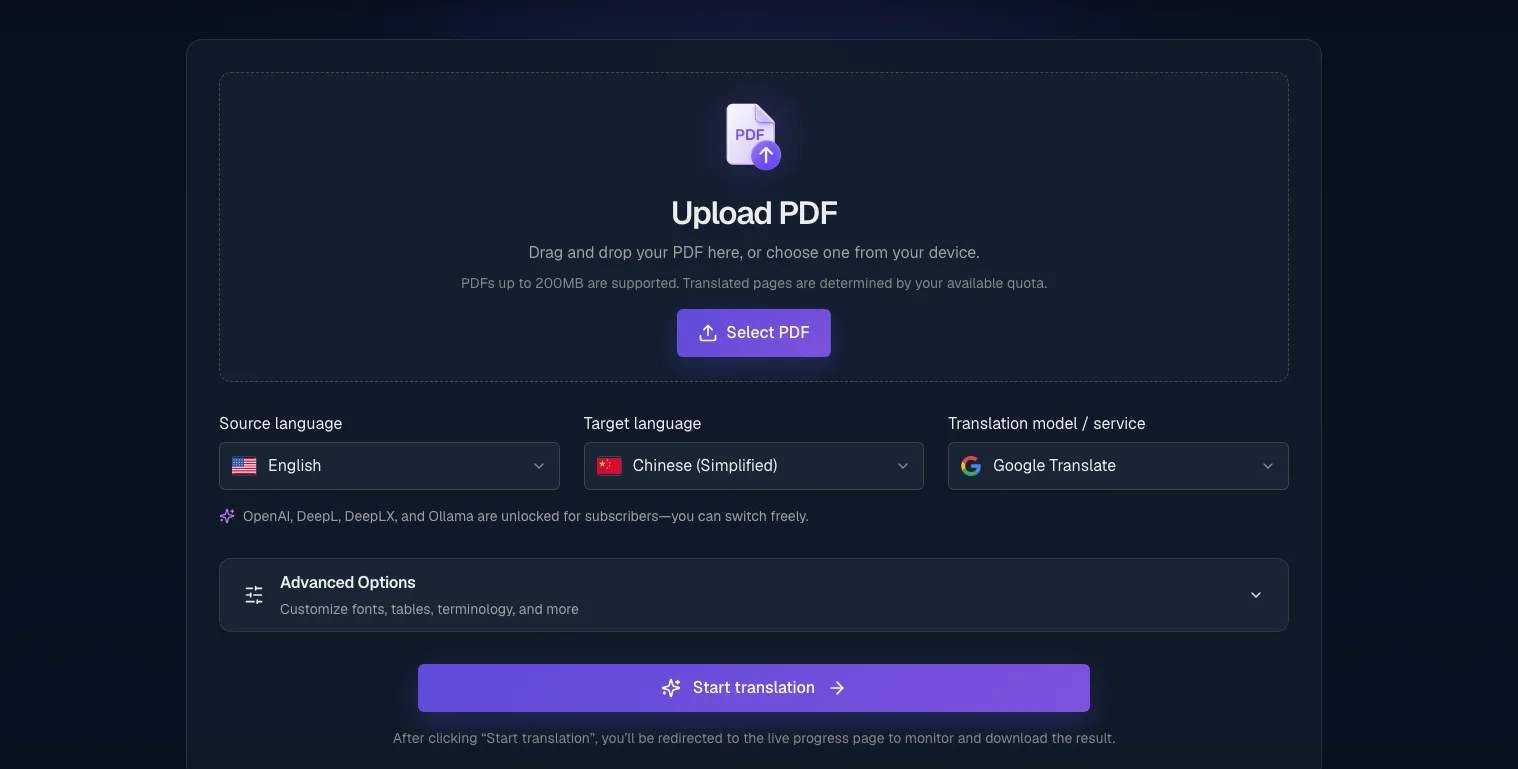
A browser-based AI PDF translator can combine several steps that were previously separate: reading digital text, recognising scanned pages through OCR, translating the document, preserving much of the original layout and producing a version that can be reviewed alongside the source.
Some systems now also add document summaries and question-answering.
That means a user does not necessarily have to begin by reading a complete translated report from page one.
They can first ask:
“What changed compared with the previous specification?”
“Which sections discuss payment terms?”
“Where are the safety requirements?”
“Which pages contain tables with financial data?”
The translation is still important, but it becomes part of an information-retrieval workflow.
This Matters Most for Documents Nobody Planned to Translate
Major contracts and customer-facing materials usually receive attention.
The larger opportunity is in documents that traditionally would not have been translated at all.
Consider:
Supplier documentation
A purchasing team may receive hundreds of pages of manuals, certifications, catalogues and technical updates.
Only a fraction will ever justify professional translation.
But almost every document may contain one fact that affects a decision.
Academic research
Researchers routinely encounter relevant studies outside their strongest language.
The problem is rarely the existence of translation technology. It is deciding whether a 30-page paper deserves careful reading in the first place.
Internal corporate documents
Regional offices create reports, meeting notes, policies and training materials that never reach a formal localization process.
Employees outside that region may simply ignore them.
Market intelligence
Industry reports from local publishers can contain information that never appears in English-language sources.
The challenge is filtering useful material from hundreds of pages.
In each case, fast document-level understanding can be more valuable than immediately producing a polished final translation.
Layout Preservation Is Really About Verification
Preserving the original PDF layout is often described as a convenience.
It is more important than that.
Layout helps the reader verify the information.
Consider a table showing revenue by region.
If the translated labels remain aligned with the original rows and columns, a reviewer can compare the values quickly.
If the table is converted into disconnected plain text, the reviewer has to reconstruct the relationship manually.
The same applies to:
- technical diagrams;
- figure captions;
- numbered procedures;
- legal clauses;
- equations;
- footnotes.
Layout is part of the evidence.
That is why side-by-side or dual-column output can be particularly useful during review.
A translated-only document is easier to read.
A bilingual document is easier to question.
OCR Introduces a Different Kind of Risk
Scanned PDFs create another challenge.
Before translation can begin, the text must be recognised from the page image.
A poor scan may cause OCR to confuse similar characters such as:
- O and 0;
- I and 1;
- decimal points and image noise;
- hyphens and minus signs.
A language model may then translate the incorrect source text perfectly.
The final sentence can sound natural even though the original number, name or product code was recognised incorrectly.
This is why scanned documents should not be judged only by the fluency of the translation.
Important values still need comparison against the original page.
The Best Workflow Depends on Risk
Not every translated document deserves the same level of review.
A useful internal classification is to divide documents by consequence.
Low-risk
General background information, industry articles and non-critical internal notes may only need a quick translation or summary.
Medium-risk
Supplier documents, market reports, training materials and research papers deserve closer review of important tables, terminology and numerical information.
High-risk
Contracts, regulatory filings, medical documents, financial disclosures and safety instructions require a much higher standard.
AI can help teams understand these documents faster, but it should not be confused with certified translation, legal advice or professional technical review.
The higher the consequence of an error, the more important source verification becomes.
A Better Multilingual Document Workflow
Instead of sending every foreign-language PDF into a separate translation process, teams can build translation into the normal document workflow.
A practical sequence looks like this:
1. Identify the document
Confirm the title, date, author, version and source.
Translating an outdated file efficiently is still wasted work.
2. Understand the structure
Use the table of contents, summary or document analysis to identify relevant sections.
3. Ask targeted questions
Find the information that affects the current decision.
4. Translate what deserves deeper review
This may be the complete document or only the sections that matter.
5. Review the source and translation together
Check names, numbers, requirements, terminology and high-risk statements.
6. Escalate when necessary
Legal, financial, medical and safety-critical material should still reach qualified reviewers.
For teams unfamiliar with the document-processing side of the problem, a practical PDF translation guide explains how OCR, layout detection, translation engines and bilingual output fit together.
The Bigger Shift Is From Translation to Document Intelligence
The interesting change is not that AI can translate another language.
Machine translation has existed for years.
What is changing is the ability to combine translation with the rest of the document workflow.
A user can increasingly move through a sequence like:
Upload → understand → search → translate → compare → decide
rather than:
Extract text → translate → rebuild document → start reading
That changes the economics of multilingual information.
Documents that were previously ignored because they were not important enough to justify a formal translation can become searchable and understandable much earlier.
The result is not simply more translated PDFs.
It is fewer documents sitting unused because nobody is confident enough to act on them.
Translation Speed Is Only One Metric
When evaluating document translation technology, speed and linguistic quality matter.
But businesses should also ask:
- How quickly can a reviewer locate the information they need?
- Can the original and translated content be compared easily?
- Are tables and figures still understandable?
- Can scanned pages be processed?
- Can terminology and protected codes be controlled?
- Can the team identify which pages require human review?
A system that translates a document in seconds but creates another hour of verification work may not actually be faster.
The better metric is time to confident decision.
Final Takeaway
Foreign-language documents rarely create dramatic failures.
They create hesitation.
A report sits unread. A specification waits for clarification. A useful research paper is skipped. An approval moves to tomorrow.
That accumulated hesitation is the real multilingual document backlog.
AI will not remove the need for translators, subject experts or professional review. What it can do is move basic understanding much earlier in the process.
And that may be the more important change.
The future of document translation is not simply about translating more pages.
It is about helping people reach the information inside those pages before language becomes a reason to delay the next decision.