For many small and medium-sized enterprises across the United Kingdom, growth is not being held back by a lack of ambition. It is being slowed by something far less obvious: inefficiency.
Business owners wear multiple hats every day. They answer enquiries between meetings, chase unpaid invoices, respond to customer emails late into the evening, and spend weekends catching up on administrative tasks. While these responsibilities may seem like part of running a business, they often come at a significant cost.
Every missed phone call could be a lost opportunity. Every delayed response to an enquiry may send a potential customer elsewhere. Every hour spent on repetitive tasks is an hour that could have been invested in strategy, innovation, or delivering exceptional service.
In an increasingly competitive market, the businesses that thrive are not necessarily those working the hardest. They are the ones building systems that allow them to work smarter.
This shift is driving growing interest in artificial intelligence among UK SMEs. Once considered the preserve of large corporations with substantial budgets, AI-powered tools are becoming more accessible to businesses of all sizes. Rather than replacing people, the most effective solutions remove the burden of routine work, allowing teams to focus on the areas where human expertise matters most.
This is where Ascendea is helping businesses rethink how they operate.
Founded by Rob Arnold, Ascendea.ai is a UK-based AI consultancy dedicated to helping SMEs implement practical AI solutions that address real operational challenges. Drawing on extensive experience, including delivering NHS Copilot training and participation in Ignite AI Labs at Warwick University, Arnold has focused the company on one central principle: technology should simplify business, not complicate it.
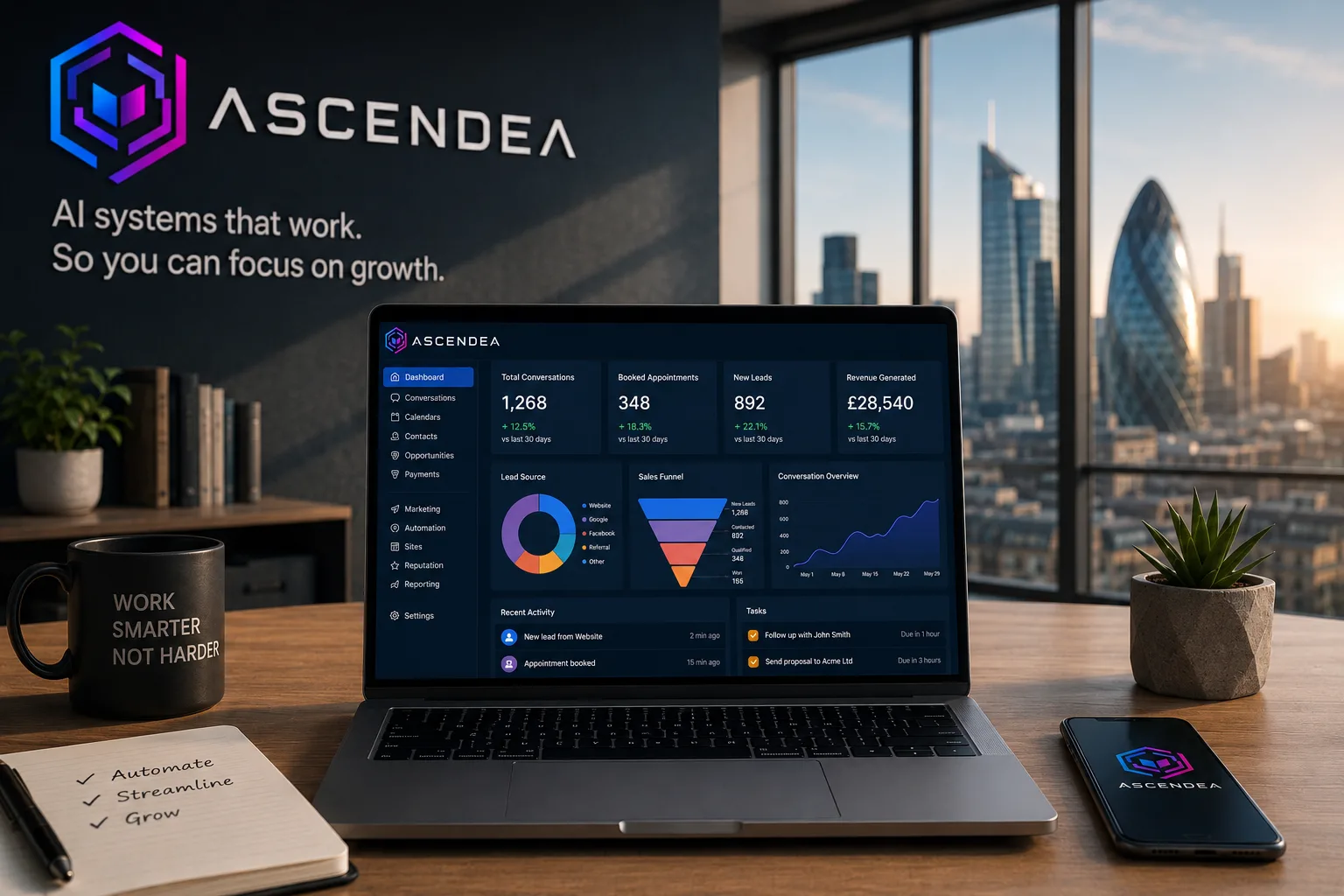
Ascendea provides a proprietary AI-powered platform designed to bring together the systems many businesses currently manage separately. Customer relationship management, marketing automation, AI voice agents, chatbots, email and SMS campaigns, workflow automation, appointment booking, and lead nurturing are integrated into a single environment.
The objective is straightforward: eliminate friction.
Consider the experience of a service-based business owner. A plumber on-site with a client cannot answer incoming calls. A consultant moving between meetings cannot immediately respond to website enquiries. Yet today's customers increasingly expect instant communication. Delays can create doubt and drive prospects towards competitors.
AI voice agents and chatbots help bridge that gap by responding to enquiries within seconds, twenty-four hours a day, seven days a week. Rather than replacing the business owner, they ensure that no opportunity is overlooked while professionals focus on delivering their expertise.
The challenge extends beyond first contact. Many businesses struggle with consistent follow-up. Quotes go unanswered, leads grow cold, and customer relationships weaken through lack of communication.
Automated email and SMS sequences offer a solution. By nurturing prospects through carefully timed touchpoints, businesses can maintain engagement without adding to their administrative workload. Follow-up becomes systematic rather than sporadic.
E-commerce businesses face a different set of pressures. Cart abandonment, repetitive customer service questions, and difficulties encouraging repeat purchases can erode profitability. Automated customer journeys and instant support provide a way to improve customer experience while reducing the strain on internal teams.
Creative professionals often encounter another dilemma entirely. Photographers, designers, and event planners enter their industries because they are passionate about their craft, yet many find themselves consumed by scheduling, onboarding, and administration. Automation can help restore balance, enabling them to devote more time to the work that inspired them to start their businesses in the first place.
Perhaps one of the greatest misconceptions surrounding AI is that it requires technical expertise to implement successfully. In reality, business owners are not seeking another complicated software platform to master. They are looking for outcomes: fewer missed opportunities, more efficient operations, and the ability to scale sustainably.
The conversation around artificial intelligence frequently focuses on what technology might achieve in the future. However, for many SMEs, the more pressing question is what it can solve today.
Can it ensure every lead receives a prompt response?
Can it reduce the hours spent on manual data entry and repetitive administration?
Can it help teams deliver a more consistent customer experience without increasing headcount?
For an increasing number of businesses, the answer is yes.
As economic pressures continue to challenge organisations across the United Kingdom, efficiency is no longer simply a desirable advantage. It has become a strategic necessity.
The businesses best positioned for the future may not be those with the largest teams or the longest working hours. They will be the organisations prepared to embrace systems that allow their people to focus on what humans do best: building relationships, solving problems, and creating value.
For SMEs ready to explore how AI and automation can support sustainable growth, Ascendea offers an opportunity to see what that future could look like.
Learn more or arrange a demonstration at: https://ascendea.ai/?am_id=benjamin2796