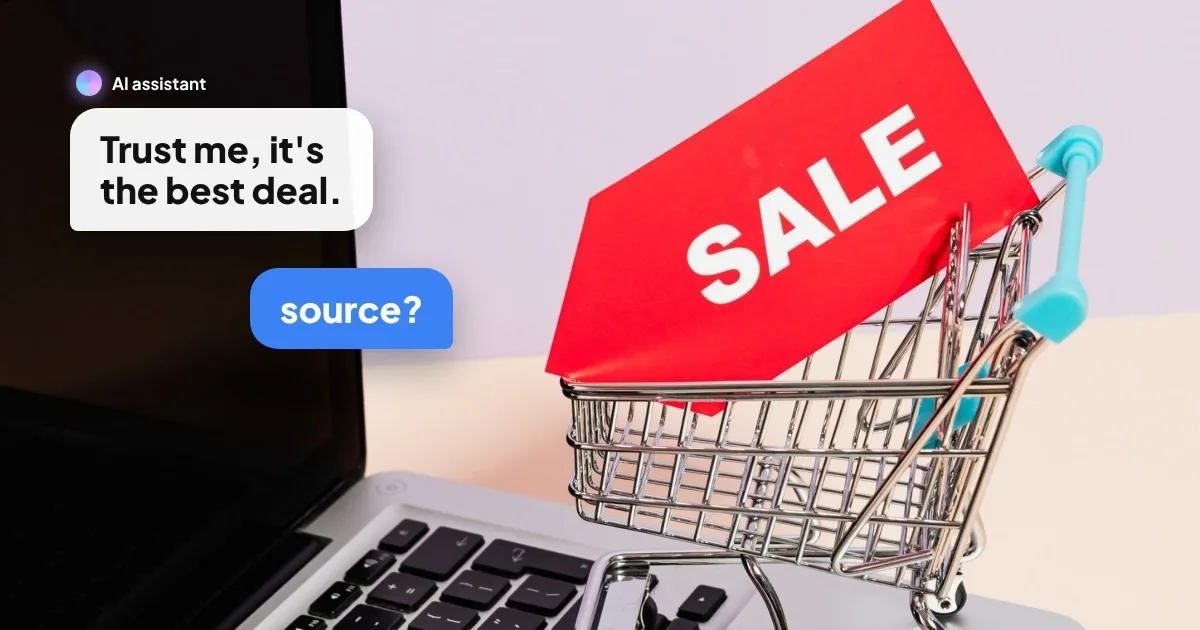
Last Black Friday, a lot of shopping started with a question typed into a chatbot. Adobe Analytics reported that AI-driven traffic to US retail sites jumped 805% on Black Friday 2025 compared with 2024, according to Reuters. Yet when Adobe surveyed more than 1,000 US shoppers who used AI that holiday season, only 46% said they actually trust AI-generated results. We are letting software shortlist our purchases while quietly doubting what it tells us.
A habit that grew in two seasons
The shift happened fast. Adobe recorded a 1,300% rise in AI referrals to retail sites during the 2024 holiday season, followed by another 693.4% across the 2025 season, with Cyber Monday 2025 up 670%. Adobe is careful to say the AI shopping audience is still modest compared with search, but the people who use it arrive ready to act. On Black Friday 2025, shoppers coming from an AI tool were 38% more likely to buy than visitors from other sources.
That readiness is the interesting part. By the time these shoppers reach a product page, the comparison has already happened inside a chat window. Whatever the answer chose to include, and whatever it left out, travels with them to checkout.
Why confidence isn't the same as accuracy
Black Friday is the hardest day of the year for an AI answer to be right. Prices change by the hour, stock disappears, and the same product can appear under several model numbers. Deal pages are also written to rush you, and an AI that summarises those pages can pass on the urgency without the context.
The numbers back this up. Salesforce found that discount levels on Black Friday 2025 were roughly the same as in 2024, while the average selling price rose 7% and units per checkout fell 2%. The deals felt bigger than they were. An answer that calls something "a great deal" is only as good as the price history behind it, and most chat answers don't show one.
What careful AI shoppers got right
This isn't an argument against using AI to shop. In the same Adobe research, 65% of AI shoppers said they felt more confident in their purchases, and 68% said they were less likely to return what they bought. Online holiday returns fell 1.2% in 2025, which Adobe partly credits to shoppers researching with AI first. Used with a bit of care, it clearly leads to better decisions.
The difference is in how people use it. Shoppers who treat the answer as a starting point, then check it, get the benefit without the regret. Shoppers who treat it as the final word are trusting a confident tone rather than evidence.
A five-minute routine before you pay
Start by writing down your budget before you see any sale banner, and note the current price of anything you're considering so you can spot a real discount later. Then ask a specific question that includes the budget and how you'll use the product, for example "which robot vacuum under $300 handles pet hair on hard floors, and what does each option give up?". Specific questions get comparisons, while vague ones get a single popular name.
Next, look at the trade-offs between two or three options rather than accepting one winner. Open the sources behind the answer and check the price, model number and key feature on the product page yourself. Finally, ask whether you would still want it at full price. If the honest answer is no, the discount is doing the deciding for you.
A tool designed around the decision
This routine is the thinking behind Ansi, the AI decision agent from Anslation. You ask one question and it builds a single page around your decision, with the short answer first, a shortlist within your budget and the trade-offs compared. When it searches the web, it links the sources it used, so the checking step takes seconds instead of minutes. It's free to try without an account, understands English, Hindi and Hinglish, and also works as a browser extension. Its own page is honest that answers can still be wrong, which is exactly why the sources are there.
Black Friday 2026 falls on 27 November. The shoppers who come out of it happiest won't be the ones who asked AI the most questions, but the ones who checked the answers before they paid.