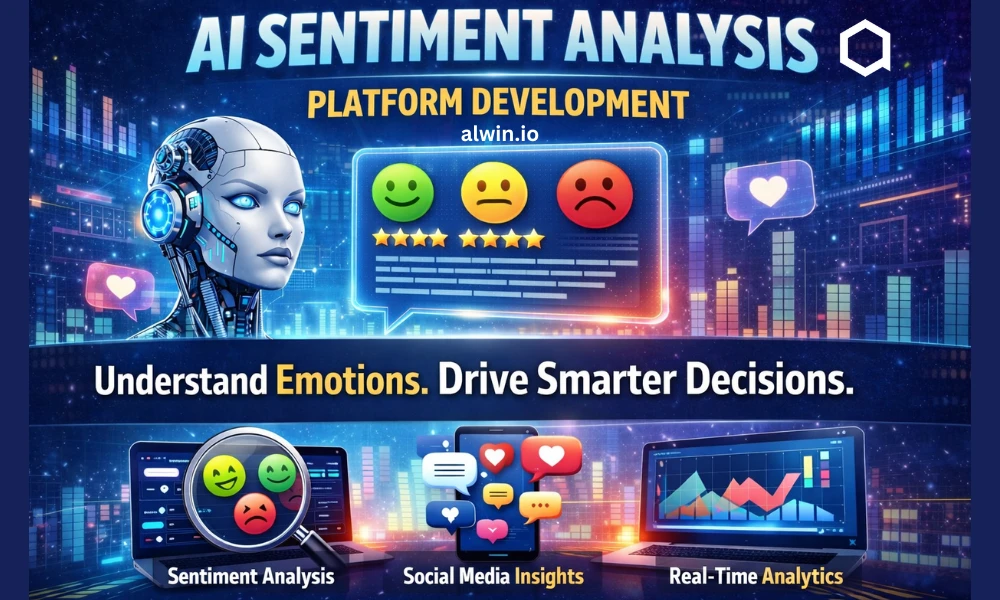
In a world where every click, comment, and conversation leaves a digital trace, businesses are no longer competing on products alone; they are competing on perception. The brands that win tomorrow will be the ones that understand how their customers feel today.
This is where AI sentiment analysis platform development becomes a game-changer.
As AI continues to evolve beyond automation into decision intelligence, modern enterprises are embracing intelligent ecosystems powered by an advanced AI development company. The future is not just predictive; it is perceptive. With the rise of agentic AI development, systems are no longer passive tools; they are intelligent agents capable of analysing, learning, adapting, and responding in real time.
And at the centre of this evolution lies sentiment intelligence.
The Shift from Data Collection to Emotional Intelligence
For years, companies focused on collecting customer data, reviews, survey responses, social media mentions, and support tickets. But raw data without emotional context is incomplete.
AI sentiment analysis bridges that gap. It goes beyond keywords and basic analytics to detect emotional tone, intent, and behavioural signals. Whether customers are expressing frustration, excitement, disappointment, or loyalty, sentiment analysis platforms translate unstructured text into structured intelligence.
This is not just analytics. This is emotional clarity at scale.
What is AI Sentiment Analysis Platform Development?
AI sentiment analysis platform development involves building intelligent systems that automatically analyze textual data to determine sentiment polarity (positive, negative, or neutral), emotional intensity, and contextual meaning.
But modern platforms do much more than classify emotions.
They integrate with:
Social media platforms
CRM systems
Customer support tools
E-commerce platforms
Chatbots and conversational AI
Through advanced Natural Language Processing (NLP) and machine learning models, these platforms continuously learn from evolving language patterns, slang, sarcasm, and industry-specific vocabulary.
When powered by , the platform can even trigger automated responses, escalate critical feedback, or adjust campaigns dynamically without waiting for human intervention.
Core Features of a Powerful Sentiment Analysis Platform
A future-ready sentiment analysis platform should include:
1. Real-Time Sentiment Detection
Instant analysis of reviews, comments, and conversations.
2. Emotion & Intent Recognition
Identifying deeper emotional layers such as anger, trust, joy, or urgency.
3. Multilingual Analysis
Understanding global customer conversations across languages.
4. Trend & Pattern Identification
Spotting recurring complaints or emerging positive feedback themes.
5. Custom Dashboards & Visual Reports
Transforming data into decision-ready insights.
6. API & System Integration
Seamless connectivity with enterprise ecosystems.
When developed strategically by an experienced AI development company, the platform becomes a centralized emotional intelligence engine for the entire organization.
Why Enterprises Need It Now
Speed defines survival in today’s market. A single negative review can influence thousands. A viral complaint can impact brand trust overnight.
AI sentiment analysis empowers enterprises to:
Protect brand reputation in real time
Improve customer experience strategies
Refine marketing campaigns based on emotional response
Identify churn risks early
Enhance product development decisions
Instead of reacting to crises, businesses can anticipate them.
Instead of guessing customer satisfaction, they can measure it.
The Role of Agentic AI in Sentiment Intelligence
Traditional systems analysis. Agentic systems act.
With Agentic AI development, sentiment platforms evolve from passive reporting tools into proactive decision systems. For example:
Automatically escalating high-risk negative sentiment to management
Triggering personalized retention offers
Adjusting ad campaigns based on emotional engagement
Recommending service improvements
This autonomous capability reduces operational delays and enhances responsiveness, giving enterprises a measurable competitive advantage.
From Insight to Impact
The real power of AI sentiment analysis platform development lies not in dashboards, but in transformation.
When organisations understand customer emotion:
Marketing becomes more human.
Customer service becomes more empathetic.
Product development becomes more aligned with real needs.
Leadership decisions become data-driven and emotionally intelligent.
In an era where customer loyalty is fragile and competition is fierce, emotional intelligence is no longer optional. It is a strategic infrastructure.
The Future: Emotion-Driven Enterprises
We are entering a phase where AI systems will not just process transactions; they will understand human nuance. Enterprises that invest in intelligent sentiment ecosystems today are building the emotional backbone of tomorrow’s digital economy.
AI is evolving. Businesses are evolving. Customer expectations are evolving even faster.
To lead in this landscape, organisations must move beyond basic analytics and embrace scalable, secure, and adaptive AI sentiment platforms designed for enterprise growth.
Because in the future of intelligent business, success will belong to those who don’t just collect data but truly understand the emotions behind it.