Artificial intelligence is transforming industries such as healthcare, autonomous vehicles, retail, agriculture, manufacturing, and security. However, even the most advanced AI models are only as effective as the data they are trained on. High-quality image annotation provides the labeled datasets that computer vision systems need to detect objects, classify images, segment scenes, and make accurate predictions.
As AI projects grow in complexity, many organizations realize that managing annotation internally can be expensive, time-consuming, and difficult to scale. This is why businesses increasingly turn to image annotation outsourcing to accelerate AI development while maintaining high data quality.
Partnering with an experienced image annotation company allows organizations to focus on innovation while leaving the labor-intensive annotation process to specialists. In this blog, we'll explore the key business benefits of outsourcing image annotation and why it has become a strategic advantage for modern AI initiatives.
Why Image Annotation Matters
Image annotation is the process of labeling visual data so machine learning algorithms can recognize and interpret objects, boundaries, activities, or patterns within images.
Common annotation techniques include:
- Bounding boxes
- Polygon annotation
- Semantic segmentation
- Instance segmentation
- Keypoint annotation
- Landmark annotation
- Cuboid (3D) annotation
These annotations are essential for building reliable computer vision applications across industries.
However, producing high-quality annotations requires trained annotators, quality assurance processes, annotation guidelines, and scalable infrastructure—all of which demand significant investment.
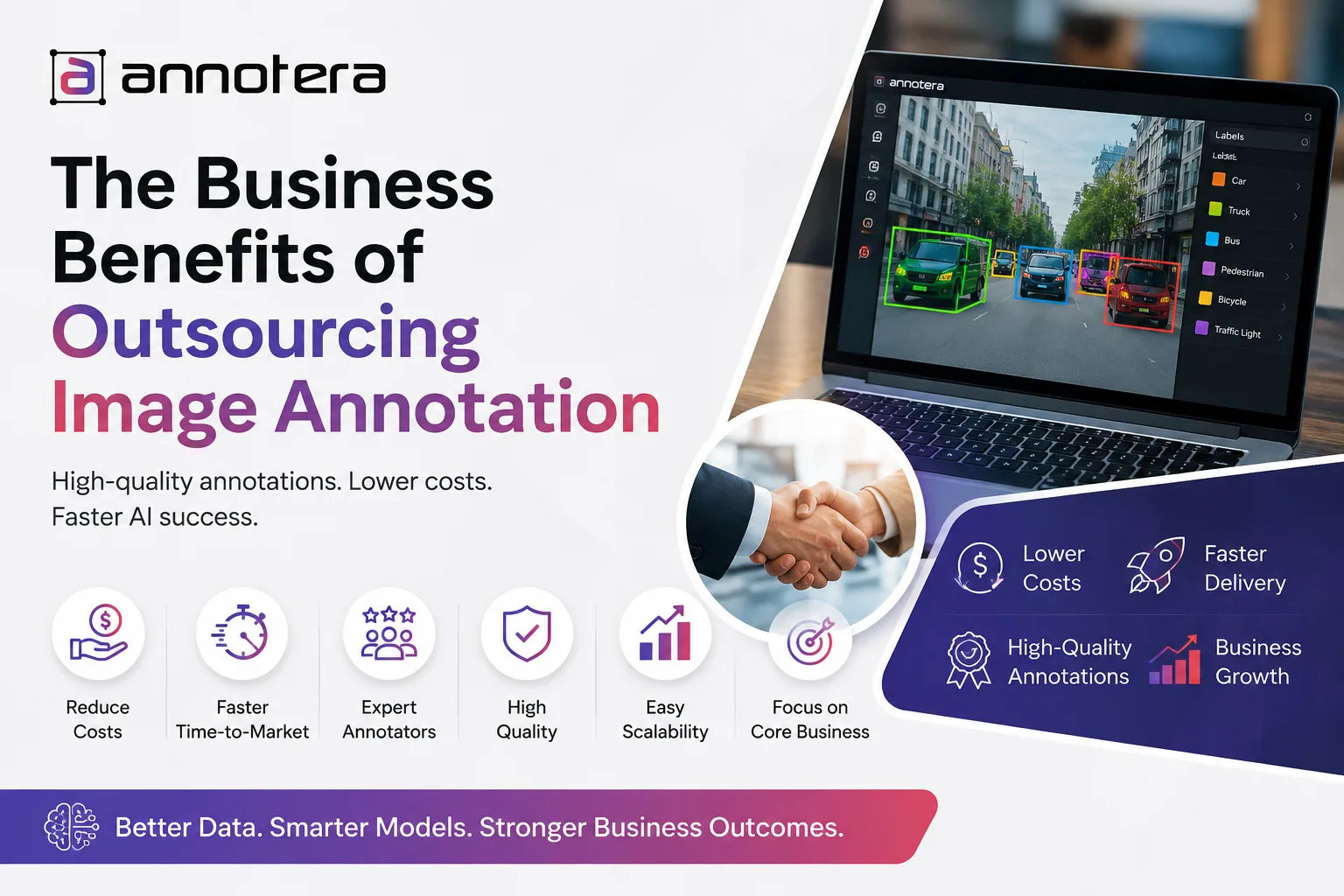
1. Reduce Operational Costs
One of the biggest reasons businesses choose image annotation outsourcing is cost efficiency.
Building an in-house annotation team involves:
- Hiring annotators
- Training employees
- Purchasing annotation tools
- Managing infrastructure
- Conducting quality audits
- Supervising production
These expenses grow rapidly as dataset sizes increase.
A professional data annotation company already has experienced teams, proven workflows, and quality management systems in place. Instead of making substantial capital investments, organizations only pay for the annotation services they require.
This significantly lowers operational costs while maintaining high-quality output.
2. Faster Time-to-Market
Speed is critical in AI development.
Delayed datasets often mean delayed model training, testing, and product launches.
An experienced image annotation company can quickly scale annotation teams to handle thousands—or even millions—of images simultaneously.
Benefits include:
- Faster dataset creation
- Quicker model iterations
- Reduced development bottlenecks
- Shorter AI deployment cycles
Businesses can release AI-powered products faster and respond more effectively to changing market demands.
3. Access to Skilled Annotation Experts
High-quality annotation requires more than simply drawing boxes around objects.
Professional annotators understand:
- Complex labeling guidelines
- Edge cases
- Occlusion handling
- Object boundaries
- Fine-grained classifications
- Multi-class annotation
Specialized industries such as healthcare, autonomous driving, manufacturing, and satellite imagery require domain expertise that many internal teams lack.
Choosing a reliable data annotation outsourcing partner gives organizations access to experienced professionals who understand industry-specific annotation requirements.
4. Consistent Data Quality
Poor-quality annotations directly reduce model performance.
Inconsistent labels can introduce:
- Model confusion
- Higher false positives
- Lower precision
- Reduced recall
- Poor generalization
Professional annotation providers implement multiple quality assurance processes, including:
- Multi-stage reviews
- Consensus labeling
- Automated validation
- Expert quality checks
- Continuous feedback loops
This structured workflow ensures datasets remain accurate and consistent throughout the project lifecycle.
5. Easy Scalability
AI datasets rarely remain small.
A pilot project containing 10,000 images may eventually require several million labeled images.
Scaling internal teams often involves:
- Hiring additional staff
- Training new employees
- Expanding infrastructure
- Increasing management overhead
With image annotation outsourcing, businesses can scale production up or down depending on project requirements.
Whether a project requires thousands or millions of annotations, experienced vendors can adjust resources quickly without disrupting delivery schedules.
6. Focus Internal Teams on Core Business Goals
Annotation is necessary—but it is not usually a company's core competency.
Data scientists, AI engineers, and software developers provide greater value by focusing on:
- Model development
- Algorithm optimization
- Product innovation
- AI strategy
- Performance evaluation
When annotation is outsourced, internal teams spend less time managing labeling operations and more time building competitive AI products.
This leads to greater productivity across the organization.
7. Access to Advanced Annotation Technologies
Leading annotation providers invest heavily in modern annotation platforms that include:
- AI-assisted labeling
- Active learning
- Auto-labeling
- Workflow automation
- Version control
- Dataset management
- Quality analytics
Rather than purchasing and maintaining expensive software internally, businesses benefit from these technologies through their outsourcing partner.
This improves efficiency while reducing infrastructure costs.
8. Better Support for Complex AI Projects
Modern computer vision applications increasingly require sophisticated annotations.
Examples include:
- Semantic segmentation
- Instance segmentation
- LiDAR image fusion
- Multi-camera annotation
- 3D cuboids
- Pose estimation
- Keypoint tracking
Handling these advanced annotation types demands specialized expertise.
A trusted image annotation company can support highly complex AI projects across multiple industries while maintaining annotation consistency and quality standards.
9. Improved Data Security and Compliance
Many AI projects involve sensitive information.
Examples include:
- Medical images
- Financial documents
- Industrial inspection data
- Government datasets
- Surveillance footage
Reputable annotation providers implement strong security measures such as:
- NDA agreements
- Role-based access control
- Secure cloud environments
- Data encryption
- Compliance with industry regulations
- Confidential project management
Working with a professional data annotation company helps organizations protect sensitive information while meeting compliance requirements.
10. Long-Term Business Flexibility
AI projects evolve rapidly.
Businesses may need to:
- Expand into new markets
- Launch new AI products
- Train updated models
- Handle seasonal demand
- Support multiple computer vision applications
Data annotation outsourcing offers the flexibility to adapt quickly without restructuring internal operations.
Organizations gain a long-term partner capable of supporting changing annotation requirements throughout the AI lifecycle.
How to Choose the Right Image Annotation Partner
Not every vendor offers the same level of expertise. Before selecting an outsourcing partner, consider the following:
- Proven experience across multiple industries
- Skilled annotation workforce
- Comprehensive quality assurance processes
- Ability to scale rapidly
- Secure data handling practices
- Support for multiple annotation types
- Flexible project management
- Transparent communication and reporting
Choosing the right image annotation company can significantly improve both project outcomes and long-term AI success.
Why Annotera Is Your Trusted Image Annotation Partner
At Annotera, we understand that successful AI begins with exceptional data quality. As a trusted data annotation company, we provide scalable, secure, and high-precision image annotation services tailored to your business objectives.
Our expert annotators support a wide range of computer vision use cases, including autonomous vehicles, healthcare, retail, manufacturing, agriculture, robotics, and smart city applications. We combine skilled human annotation with rigorous quality assurance workflows to deliver consistent, production-ready datasets.
Whether you need bounding boxes, semantic segmentation, polygon annotation, keypoint labeling, or other advanced annotation techniques, our image annotation outsourcing solutions are designed to accelerate AI development while reducing operational complexity.
Conclusion
Image annotation is one of the most critical components of successful AI development, but managing it internally can become expensive, resource-intensive, and difficult to scale. By embracing image annotation outsourcing, organizations gain access to specialized expertise, faster turnaround times, consistent quality, and the flexibility to grow alongside their AI initiatives.
Partnering with an experienced data annotation company enables businesses to reduce costs, improve model performance, and bring AI-powered solutions to market more quickly. As computer vision applications continue to expand across industries, outsourcing image annotation is no longer just a cost-saving measure—it is a strategic investment in building reliable, scalable, and high-performing AI systems.