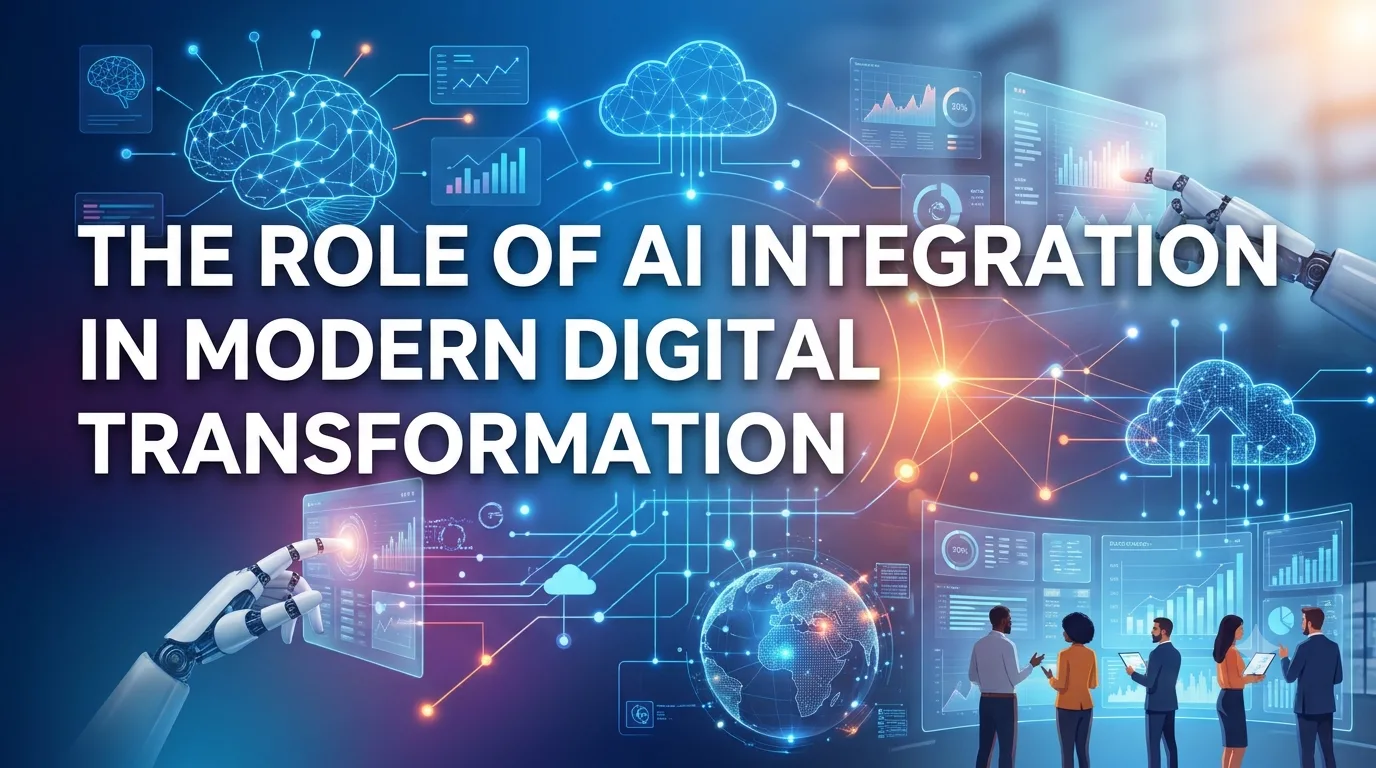
Digital transformation has become an important part of how businesses improve their operations, manage information, and deliver services. Organizations are increasingly adopting cloud platforms, enterprise applications, data analytics, and connected digital systems to make their processes more efficient. However, as business environments become more complex, simply adopting new technologies may not be enough.
Artificial intelligence (AI) is adding another dimension to digital transformation by helping businesses analyze information, identify patterns, automate selected activities, and support decision-making. When integrated into existing business systems, AI can extend the capabilities of digital platforms and help organizations make better use of their data.
AI integration is not just about adding an intelligent feature to an application. It involves connecting AI technologies with business software, databases, workflows, and operational processes in a way that supports specific organizational objectives.
Understanding how AI integration works, where it can be applied, and what businesses should consider before implementation can help organizations build more effective digital transformation strategies.
What Is AI Integration?
AI integration is the process of incorporating artificial intelligence capabilities into existing or newly developed software applications, business systems, and digital workflows.
Rather than operating as a separate tool, an integrated AI solution works alongside the technologies a business already uses. It can help process information, generate insights, interpret customer requests, and support activities across different departments.
For example, a company using a customer relationship management (CRM) platform may integrate AI capabilities to analyze customer interactions, categorize incoming inquiries, and help sales teams identify relevant follow-up opportunities.
Several technologies can be used during AI integration, depending on the intended application:
- Machine Learning: Helps systems identify patterns in data and generate predictions based on available information.
- Natural Language Processing: Enables applications to interpret and process written or spoken language.
- Generative AI: Supports the creation of text, summaries, responses, and other content based on user instructions and available context.
- Computer Vision: Allows systems to interpret information from images, scanned documents, and videos.
- Predictive Analytics: Uses historical and current data to identify trends and estimate possible future outcomes.
The appropriate technology depends on the business problem, available data, existing infrastructure, and expected outcomes.
Why AI Integration Is Important for Digital Transformation
Digital transformation involves improving how an organization operates through technology. AI integration can support this process by making existing systems more intelligent and responsive.
1. Making Better Use of Business Data
Businesses collect information from customer platforms, financial applications, enterprise resource planning systems, websites, and operational databases. However, having access to large amounts of data does not automatically produce useful insights.
AI integration can help organizations analyze information from relevant sources, identify patterns, and present insights that support business decisions.
For example, a retail company may integrate AI-powered analytics with its sales and inventory systems to examine purchasing patterns and identify changes in product demand. Managers can use these insights when reviewing inventory requirements and planning future activities.
2. Improving Existing Business Applications
Many organizations already depend on software applications to manage customer relationships, employee activities, finance, inventory, and communication.
AI integration can extend these applications by introducing capabilities such as intelligent search, automated classification, predictive analysis, and conversational interfaces.
For example, an enterprise application may include an AI-powered search feature that helps employees locate relevant information across approved internal documents. This can make information retrieval more convenient without requiring employees to search through multiple files manually.
3. Supporting More Efficient Workflows
Business workflows often involve several steps, departments, and software platforms. When these activities depend heavily on manual coordination, delays and inconsistencies can occur.
AI integration can help identify information, categorize requests, and trigger suitable workflow actions when connected with the relevant business applications.
An example is an invoice management process where AI extracts important details from documents and transfers them into an accounting workflow for verification and approval.
This approach can reduce repetitive work while keeping employees involved in financial checks and important decisions.
4. Enhancing Customer Experiences
Customers increasingly expect timely communication and relevant assistance when interacting with businesses.
AI capabilities integrated into websites, mobile applications, and customer support platforms can help organizations understand customer requests, provide relevant information, and direct inquiries to the appropriate teams.
For example, an AI-powered virtual assistant can respond to common questions using approved business information and transfer more complex requests to human representatives.
The quality of the experience depends on the accuracy of the information, the design of the interaction, and the availability of human support when needed.
5. Connecting Different Digital Systems
Organizations frequently use multiple applications that store and process different types of information. When these systems operate separately, employees may need to switch between platforms or manually transfer data.
AI integration, combined with suitable APIs and software integration methods, can help connect intelligent capabilities with relevant applications and workflows.
For instance, a business may connect its customer management platform with an AI-enabled reporting system to organize customer information and generate summaries for internal review.
This makes system compatibility and integration planning important parts of a successful digital transformation initiative.
Practical Applications of AI Integration Across Industries
AI integration can support different business requirements depending on industry operations, available data, and regulatory conditions.
Healthcare
Healthcare organizations manage patient information, appointment systems, administrative records, and clinical documentation. AI integration can support document organization, administrative workflows, and information retrieval.
For example, an AI-enabled system may help classify incoming documents and identify missing administrative information before staff review. Applications involving diagnosis or treatment require appropriate clinical validation and professional oversight.
Banking and Financial Services
Financial institutions work with large volumes of customer, transaction, and compliance-related information.
Integrating AI into financial platforms can support transaction monitoring, document processing, customer inquiry classification, and the identification of unusual activity for investigation.
Because these systems handle sensitive information, security, data privacy, transparency, and regulatory compliance must remain important considerations.
Manufacturing
Manufacturing companies use digital systems to coordinate production, inventory, equipment, and quality-related activities.
AI integration can help analyze equipment information, identify unusual patterns, support maintenance planning, and organize production data.
For example, an AI-enabled monitoring system may identify changes in equipment performance that require technical inspection.
Retail and E-commerce
Retail businesses manage product catalogs, customer information, orders, inventory, and online interactions.
AI capabilities integrated into retail platforms can support product recommendations, customer inquiry management, demand forecasting, and product categorization.
These applications can help businesses understand customer behavior and organize operations, provided that the underlying data is accurate and relevant.
Logistics and Transportation
Logistics organizations coordinate shipments, warehouse operations, delivery schedules, and customer updates.
AI integration can help process shipment information, analyze operational data, identify delivery exceptions, and support route-planning activities.
When connected with existing transportation management systems, these capabilities can help teams access relevant information and respond to operational changes.
Key Benefits of Integrating AI into Business Systems
When planned around clear business objectives, AI integration can provide several advantages:
- Improved information access: AI-powered search and classification can help employees locate relevant information more efficiently.
- Better operational insights: Intelligent analytics can help identify patterns and support data-driven decisions.
- Enhanced application capabilities: Existing software can gain additional features without requiring every business process to be replaced.
- More coordinated workflows: AI capabilities connected with business applications can reduce manual coordination across selected processes.
- Improved customer interactions: Integrated AI tools can support customer communication and help manage common inquiries.
- Adaptability: Well-designed solutions can evolve as business requirements and technology environments change.
The actual benefits depend on the use case, data quality, technical implementation, and ongoing system management.
Challenges Businesses Should Consider Before AI Integration
Although AI integration offers opportunities, organizations need to address several challenges before introducing it into their digital environment.
Data quality and availability: AI systems depend on relevant and reliable information. Inconsistent or incomplete data can reduce the usefulness of their outputs.
Legacy system compatibility: Older business applications may require additional development or integration work before supporting AI capabilities.
Data security and privacy: Businesses must establish suitable access controls and protect sensitive information throughout the integration process.
Implementation costs: Development, infrastructure, licensing, testing, and ongoing maintenance should be included in project planning.
Output accuracy: AI-generated information and recommendations may require validation, particularly when they influence important business decisions.
Employee adoption: Teams need appropriate training and clear processes to use integrated AI features effectively.
Ongoing maintenance: AI models, connected applications, and business requirements may change over time, making monitoring and updates necessary.
Evaluating these considerations early can help organizations reduce implementation risks and establish realistic expectations.
Steps to Integrate AI into a Digital Transformation Strategy
A structured approach can help businesses introduce AI capabilities without creating unnecessary complexity.
1. Identify Business Requirements
Start by reviewing existing processes and identifying areas where AI could address a specific challenge. Focus on practical requirements rather than adopting technology simply because it is available.
2. Evaluate Existing Systems and Data
Review the applications, databases, APIs, and infrastructure that may be involved in the integration. Assess whether the required data is accessible, reliable, and suitable for the intended use case.
3. Select Appropriate AI Technologies
Choose technologies according to the required functionality. A document processing application may need different AI capabilities from a predictive analytics platform or conversational assistant.
4. Plan System Integration
Determine how the AI solution will communicate with existing applications. Consider APIs, data flows, authentication, access permissions, and system compatibility.
5. Develop and Test the Solution
Build the required functionality and test it using realistic business scenarios. Evaluate output accuracy, performance, security, and how the solution handles unexpected inputs.
6. Introduce Human Oversight
Establish which activities can be handled automatically and which require employee approval. Important financial, operational, and customer-related decisions may need additional review.
7. Monitor and Improve Performance
After deployment, evaluate the solution using relevant measures such as processing time, output accuracy, user feedback, and workflow performance. Make improvements as business needs evolve.
How Software Development Supports AI Integration
AI integration often requires software development expertise because intelligent capabilities must work within an organization's existing technology environment.
Businesses may need to connect AI models with web applications, mobile platforms, enterprise software, databases, and third-party services. This involves designing suitable architecture, developing integrations, managing data exchange, and testing how different components work together.
For example, an organization planning to introduce AI-powered document processing may need a solution that connects document uploads, information extraction, internal databases, and employee approval workflows.
A well-planned development approach helps ensure that these components work together while considering security, scalability, maintainability, and business requirements.
NexusLink Services works in the software development and digital solutions space, supporting organizations that need technology solutions aligned with their business objectives. Businesses exploring AI integration should evaluate their existing systems, intended use cases, and technical requirements before selecting an implementation approach.
Frequently Asked Questions About AI Integration
1. What is AI integration in digital transformation?
AI integration involves incorporating artificial intelligence capabilities into business applications, databases, and workflows. It helps organizations use intelligent features within their existing digital environment.
2. How does AI integration improve business operations?
AI integration can support information processing, workflow coordination, predictive analysis, customer communication, and decision-making. Its impact depends on how effectively the solution addresses actual business requirements.
3. What is the difference between AI integration and AI development?
AI integration focuses on connecting AI capabilities with existing or newly developed applications and business systems. AI development involves creating or customizing AI-based solutions, models, or applications. Some projects require both.
4. Can AI be integrated into existing business software?
Yes. AI capabilities can often be connected to existing business software through APIs, custom development, and compatible integration methods. The feasibility depends on the application's architecture, available interfaces, and technical limitations.
5. Which industries can benefit from AI integration?
Healthcare, banking, manufacturing, retail, logistics, education, and other industries can benefit from suitable AI applications. The specific use cases depend on industry requirements and operational processes.
6. What are the main challenges of AI integration?
Common challenges include data quality, legacy system compatibility, security, privacy, implementation costs, output reliability, and employee adoption.
7. How long does AI integration take?
The timeline depends on project complexity, data readiness, existing infrastructure, integration requirements, and testing. A focused application integration may require less effort than a solution connecting multiple enterprise systems.
Conclusion
AI integration is becoming an important part of modern digital transformation because it allows businesses to extend existing technology with intelligent capabilities. From improving information access and supporting decision-making to coordinating workflows and enhancing customer interactions, integrated AI solutions can address a range of business requirements.
However, successful implementation requires more than selecting an AI technology. Organizations must understand their operational challenges, evaluate their existing systems, prepare reliable data, and plan for security, testing, and ongoing maintenance.
A practical approach is to begin with a clearly defined business use case, assess its technical requirements, and expand gradually as the organization evaluates the results. With suitable planning and software development support, AI integration can help businesses build more connected, adaptable, and effective digital operations.