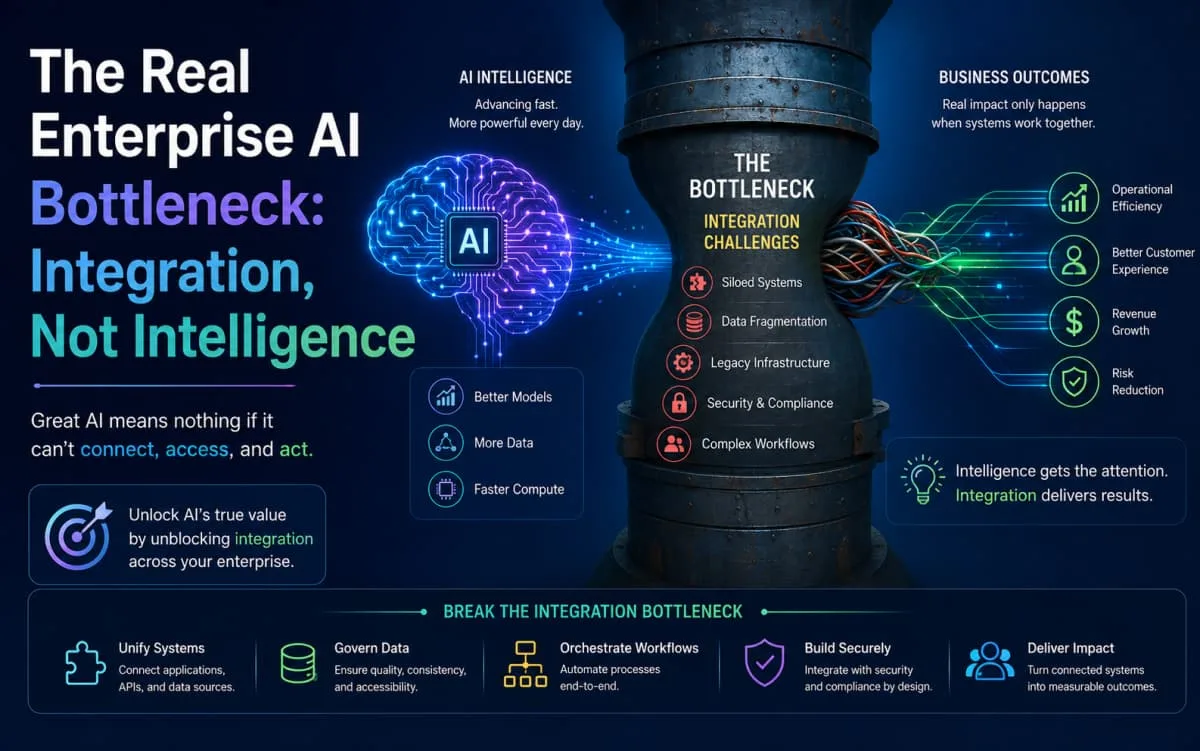
Roughly 95 percent of enterprise generative AI pilots deliver no measurable return, according to widely cited MIT NANDA research. Read that number carefully, because the reason behind it gets misdiagnosed constantly. The models were not too weak. The pilots stalled because the tools could not reach the data, remember context, or fit into the way work already flowed through the organization. That is an integration problem wearing an intelligence costume. Serious AI integration services exist precisely to close that gap, and the enterprises pulling ahead have figured this out while their competitors argue about benchmarks.
Consider what a modern model already does out of the box: it drafts, summarizes, classifies, extracts, reasons across long documents, and writes usable code. For the overwhelming majority of business tasks, raw capability stopped being the limiting factor some time ago. The limiting factor is whether that capability can see a customer record, honor a permission boundary, write back to a system of record, and trigger the next step. Mature AI integration solutions answer those questions. A leaderboard does not.
The Model Is Not the Constraint Anymore
Model selection feels like the important decision because it is the visible one. Vendors publish benchmarks, analysts rank providers, and every quarter a new release claims the top spot. So teams spend weeks debating which model to standardize on, run bake-offs, and treat the choice as strategic.
That instinct optimizes the least important variable. The gap between the leading models on any real enterprise task is narrow and shrinking, and a task that fails on one capable model rarely succeeds on another simply because the model changed. When a customer-service assistant gives wrong answers, the cause is almost never model reasoning. It is that the assistant cannot see the customer's account status, the current policy document, or last week's ticket history. Swapping providers does nothing to fix a context problem.
Artificial intelligence integration services shift attention to the layer that actually decides outcomes: the connective tissue between a capable model and the messy reality of enterprise data and process. That layer is unglamorous. It is also where the value is won or lost.
The evidence backs this up in a practical way. Move the same use case from a weaker model to a stronger one and the improvement is usually marginal. Give that same use case clean retrieval, correct permissions, and a working write-back path, and results jump. The lesson repeats across industries and company sizes: the returns on integration engineering dwarf the returns on shopping for a better model. A provider decision can be revisited in an afternoon. The connective layer, once built well, keeps delivering across every model release that follows, which is why the sequencing matters so much.
Where AI Integration Services Decide the Outcome
McKinsey's recent research surfaced a telling split. Nearly nine in ten organizations report using AI in some form, yet only about a fifth have redesigned any workflow around it, per McKinsey's State of AI. The rest layer a model on top of processes that were never built to include one. A chatbot bolted onto an unchanged call center produces a demo, not a result.
Redesigning the workflow is integration work. It means deciding where the model sits in a process, what it reads before it acts, what it is allowed to change, and who reviews its output. Answer those questions well and a pilot graduates to production. Answer them vaguely and it joins the 95 percent.
The practical difference shows up in a dozen small engineering decisions. How does the model receive fresh, relevant context on each request? What happens when a downstream system is slow or returns an error? Who does the model act as when it writes to a database? These are the questions an integration partner asks first, long before the model provider is chosen.
Connecting Models to the Data and Systems Where Work Happens
A model with no access to current, trustworthy data is a very articulate guesser. The single largest determinant of output quality in production is not the model. It is what the model is given to work with at the moment of the request.
Data Pipelines That Feed the Model the Right Context
Retrieval is where most enterprise projects quietly succeed or fail. The model needs the right document, the right record, and the right recent event, pulled in real time and shaped into something it can use. That requires pipelines: connectors into source systems, a way to keep an index current as data changes, chunking and embedding that respect how the business actually structures information, and ranking that surfaces the relevant passage rather than a plausible-looking wrong one.
Stale or noisy retrieval produces confident, wrong answers, and no upgrade to the model repairs it. Teams that invest in clean, well-governed, current data pipelines see accuracy climb without touching the model at all. That is the clearest signal that the bottleneck was never intelligence.
APIs and Middleware as the Wiring Between Model and Business Logic
A model call is one step. A useful feature is a chain of steps: authenticate the request, gather context, call the model, validate the response, act on it in a system of record, and handle the failure paths. APIs and middleware carry that chain.
Middleware is where reliability lives. It enforces timeouts and retries, caches expensive calls, normalizes responses into structured data the rest of the stack can trust, and shields business systems from a model that occasionally returns something unexpected. Skip this layer and the prototype works in a demo, then breaks the first time a real user does something unplanned. Enterprises that build the middleware treat the model as one component among many, which is exactly what it is.
Identity, Permissions, and the Question of What the Model Acts As
The moment an assistant can retrieve records or take action, a security question becomes unavoidable: whose permissions does it use? An assistant that answers on behalf of many users cannot be allowed to show one user data that belongs to another. Yet a model, left alone, has no concept of a permission boundary.
Integration has to carry identity through every step. The request should run with the acting user's entitlements, retrieval should filter to what that user is allowed to see, and any write-back should respect the same access controls the rest of the enterprise enforces. This is intricate work in organizations with layered roles, delegated access, and regulatory constraints on who sees what.
Get identity right and the assistant is trustworthy at scale. Get it wrong and a single well-phrased prompt turns into a data-exposure incident. No model choice prevents that failure, and no model choice earns that trust. Both come from the AI integration solutions wrapped around the model, which is why identity design cannot be deferred to a later phase.
Legacy Systems Set the Real Pace of Adoption
Most enterprise value is locked inside systems that predate the current wave of AI by decades: the mainframe running core transactions, the on-premise records platform, the vendor application exposing a brittle interface. AI has to meet those systems where they are.
That reality shapes the whole effort. Some systems offer a modern API. Others require a message queue, a nightly batch export, a screen-scraping bridge, or a custom adapter that a partner has to build and maintain. The engineering to connect a model to a 15-year-old claims platform frequently dwarfs the engineering around the model itself, and pretending otherwise is how timelines slip.
Teams that plan for this move faster in the end. They map the systems of record early, decide which need real-time access and which can tolerate a delay, and design adapters that isolate the model from each system's quirks. AI integration services for enterprises live or die on this legacy work, because the assistant is only as capable as the systems it can actually reach.
Orchestration Turns a Single Model Call into a Workflow
A meaningful business task rarely fits in one model call. Processing an invoice means reading the document, extracting fields, checking them against a purchase order, flagging discrepancies, routing exceptions to a person, and updating the finance system. That is a workflow, and something has to conduct it.
Orchestration is that conductor. It sequences steps, decides which need a model and which need plain code, manages state across a long-running process, and knows how to pause for human review and resume afterward. Good orchestration also fails gracefully: when a step errors, the work does not vanish, it routes to a fallback or a person with full context intact.
This is where multi-step agents either become dependable or become a liability. The difference is engineering discipline in the orchestration layer, not the intelligence of the underlying model. A capable model inside a sloppy workflow produces impressive failures. A capable model inside a well-orchestrated workflow produces outcomes a business can stake a process on.
Security and Governance Belong Inside the Pipeline
Governance often arrives late, as a review gate a finished system has to pass. By then the important decisions are already baked in, and retrofitting controls is slow and expensive. Governance belongs inside the integration itself, enforced automatically on every request.
Built into the pipeline, governance becomes concrete. Sensitive fields are redacted before a prompt ever reaches the model. Every request and response is logged for audit. Outputs are validated against policy before any action is taken. Rate limits and cost controls prevent a runaway process from doing damage. Data-residency rules decide where a request may be processed.
- Redaction and access filtering: strip or mask regulated data before it enters a prompt, and filter retrieval to the acting user's entitlements.
- Auditability: capture inputs, outputs, and decisions so a regulator or an internal reviewer can reconstruct what happened.
- Output validation: check responses against business rules and schemas before they touch a system of record.
- Cost and rate controls: cap spend and throughput so one misbehaving workflow cannot escalate quietly.
These controls are integration deliverables, not model features. An experienced integration partner treats governance as engineering, and dependable AI integration services design these controls into the connective layer from the first sprint. That discipline is what lets a promising pilot survive contact with a compliance team, clear an audit, and reach production without a costly rebuild.
The Advantage Goes to the Connected, Not the Clever
The enterprises pulling value from AI are not the ones running the newest model. They are the ones that connected a capable model to their data, their identity fabric, their legacy systems, and their governance rules, then redesigned the work around it. Reliable AI integration services turn that connective work into a repeatable engineering practice, and mature AI integration solutions are what carry a pilot across the line where most stall. For teams ready to move past the benchmark debate, purpose-built AI integration services for enterprises are the practical next step. The organizations that internalize this in 2026 will compound their lead, because integration capability, once built, keeps paying off across every model that follows.