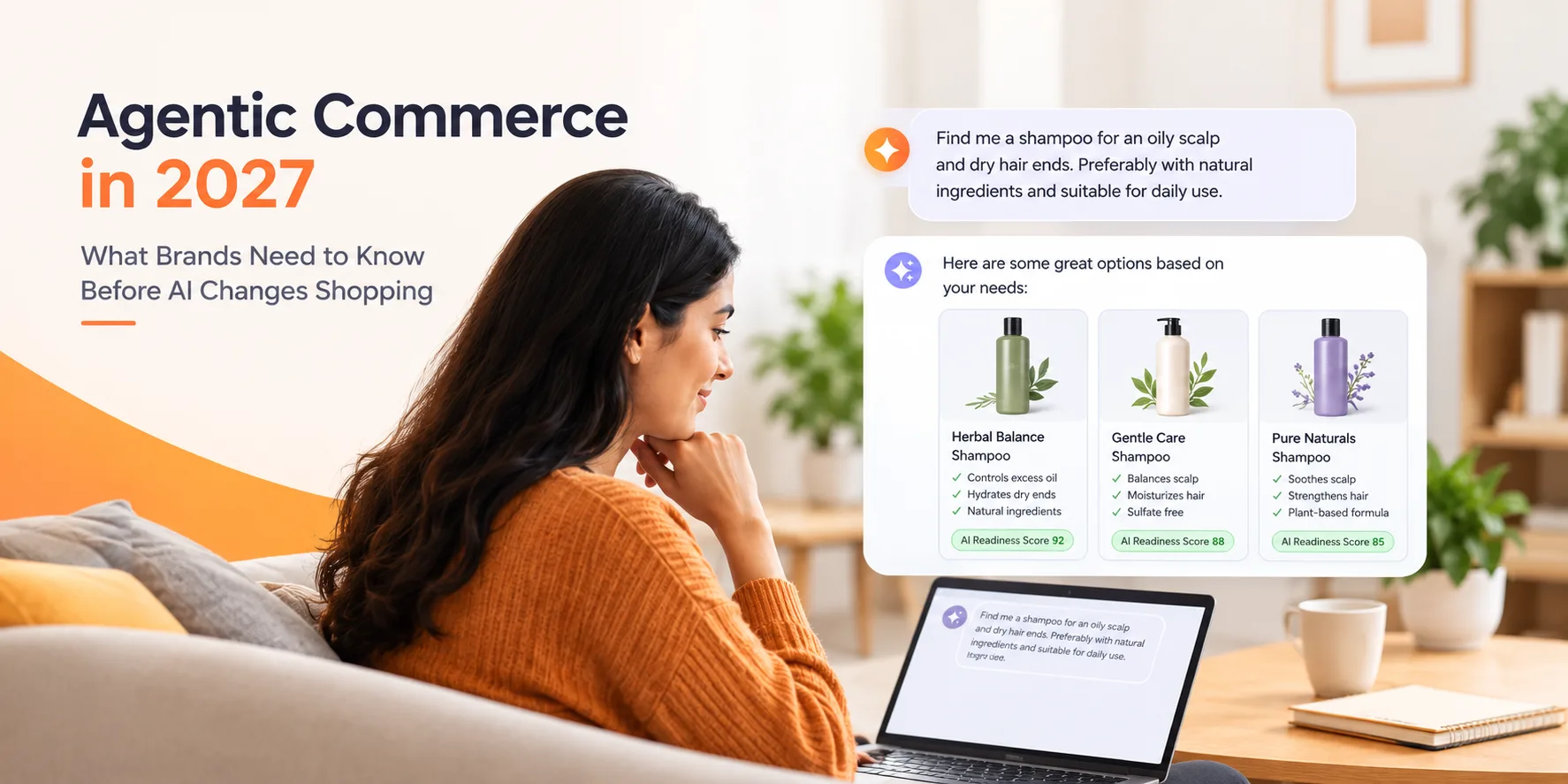

Online shopping is changing. eCommerce brands once focused on Google rankings, marketplaces, and driving shoppers to product pages. Now, shoppers are turning to AI to describe what they need and get recommendations. This is changing how products get discovered and how brands compete online in 2026.!
When a shopper asks an AI assistant to find the right running shoes, skincare product, laptop, or coffee machine, the AI has to understand what each product offers before it can make a recommendation. That means having a product listed online is no longer enough. Your product information needs to be detailed, accurate, and clear enough for AI to understand the product and match it with the right shopper.
Your Product Page Is More Than a Sales Page
Many product pages are written with the human shopper in mind, which is obviously important. But some descriptions still rely heavily on broad marketing language such as “premium quality,” “advanced technology,” or “designed for modern lifestyles.” These phrases may sound good, but they don't provide much useful information about the product.
Consider a moisturizer described simply as “a lightweight formula that provides long-lasting hydration.” A shopper looking for something specifically for oily skin may still have no idea whether it is suitable for them. A stronger product description would explain the skin type it is designed for, how it feels on the skin, whether it is intended for daytime use, and what makes it different from heavier moisturizers.
The same principle applies across categories. A laptop should communicate what type of work it is suitable for. A pair of running shoes should explain the type of runner and terrain they are designed for. A kitchen appliance should make its capacity, functions, and ideal use cases clear. The more relevant context your product provides, the easier it becomes to determine where it belongs.
AI Needs Context, Not Just Keywords
Traditional SEO has taught brands to think about keywords. While keywords still matter, AI-driven shopping requires a broader approach. An AI system needs to understand relationships between product attributes, customer needs, use cases, benefits, and alternatives.
For example, a product may contain the keyword “office chair” several times, but that alone doesn't tell an AI whether it is suitable for someone who works eight hours a day, needs lumbar support, is looking for a compact chair, or prefers a firm seat. Those details give the product meaning.
This is why brands should think beyond keyword placement and start thinking about product understanding. Your content should make it easy to answer practical questions about who the product is for, what problem it solves, how it should be used, and why someone might choose it over another option.
The Questions Customers Ask Are Your Best Content Ideas
One of the simplest ways to improve product content is to pay attention to customer questions. Support tickets, product reviews, sales conversations, search queries, and questions on marketplace listings can reveal exactly what information shoppers are missing.
If customers repeatedly ask whether a product is suitable for sensitive skin, that information deserves a clear place on the product page. If buyers frequently want to know whether a device works with a particular operating system, don't make them search through technical documentation to find the answer.
This approach also makes your content more useful for AI shopping. When important answers are clearly available in your product information, AI has more context to work with when matching products to specific requests.
Product Attributes Are Becoming More Valuable
Product attributes can seem like boring catalog information, but they are becoming increasingly important as shopping becomes more automated. Details such as dimensions, materials, ingredients, compatibility, size, capacity, performance specifications, certifications, and intended use can help distinguish one product from another.
Think about two products that appear almost identical at first glance. One clearly explains its compatibility, ideal customer, use cases, and limitations, while the other only has a short marketing description. A shopper may eventually discover the difference, but an AI system needs enough structured and descriptive information to evaluate both products properly.
This is why improving product data isn't simply a technical exercise. It can directly influence how easily your products can be understood and compared.
Agentic Commerce Changes the Goal
The rise of agentic commerce takes this shift even further. Instead of simply helping shoppers find websites or products, AI agents can increasingly help them evaluate options and move toward a purchase decision.
For brands, that means the goal is no longer just to get a click. Your product needs to be relevant to the shopper's request and understandable enough for an AI system to include it among the options.
This doesn't mean traditional SEO is disappearing. Search visibility, strong websites, reviews, brand authority, and good user experiences still matter. But product-level information is becoming another important part of digital commerce, particularly as AI becomes more involved in product discovery.
Start With Your Most Important Products
Brands don't need to overhaul thousands of product pages at once. A practical approach is to start with the products that generate the most revenue, have the strongest demand, or operate in highly competitive categories.
Review those products from the perspective of a shopper who knows nothing about them. Can they quickly understand what the product does, who it is for, and why it is different? Are important specifications easy to find? Are common objections addressed? Do the product title, description, attributes, reviews, and structured data tell a consistent story?
It is also worth checking whether your product information is consistent across your website, marketplaces, feeds, and other channels. Conflicting prices, specifications, availability, or product descriptions can create unnecessary confusion for both shoppers and automated systems.
The AI Shopping Shift Is an Opportunity
The AI shopping wave may feel like another challenge for eCommerce teams already managing SEO, paid advertising, marketplaces, social media, and conversion optimization. But it also creates an opportunity to fix something many catalogs have overlooked for years: the quality of their product information.
Better product content doesn't only help AI. It helps customers understand products faster, reduces uncertainty, supports better purchasing decisions, and can improve the overall shopping experience.
The brands that prepare early won't necessarily be the ones with the longest product descriptions. They will be the ones that make their products easiest to understand.
AI shopping is moving the conversation from “Can people find my product?” to “Can AI understand why my product is right for this shopper?”
That is the question worth answering before the next wave of eCommerce arrives.