The healthcare industry is becoming increasingly complex, with hospitals managing large volumes of patient information, appointments, medical records, billing, pharmacy operations, staff, inventory, and administrative activities every day. Managing these processes manually or through disconnected systems can lead to delays, data duplication, communication gaps, and operational inefficiencies. This is where Hospital Management ERP Software can make a significant difference.
A hospital ERP solution integrates multiple departments and business processes into a centralized platform, helping healthcare organizations manage their daily operations more efficiently. From patient registration and appointment scheduling to billing, inventory, pharmacy, and reporting, an integrated ERP system provides better visibility and control across the hospital.
What is Hospital Management ERP Software?
Hospital Management ERP Software is an integrated software solution designed to manage and automate various administrative, financial, and operational activities of a hospital or healthcare organization. Instead of maintaining separate systems for different departments, an ERP solution connects essential functions through a single platform.
A centralized system allows authorized users to access relevant information while maintaining better coordination between departments. Hospital administrators can monitor operations, track resources, manage finances, and generate reports from a unified system.
The objective of hospital ERP software is not only to digitize records but also to improve workflow efficiency, reduce manual work, and support better decision-making.
Why Do Hospitals Need ERP Software?
Hospitals deal with multiple interconnected processes every day. Patient information generated during registration may be required by doctors, billing teams, pharmacies, laboratories, and administration. When these departments work on isolated systems, information sharing can become difficult.
An ERP for Hospital Management Software connects these processes and helps create a more organized workflow.
Some important benefits include:
- Centralized management of hospital information
- Improved coordination between departments
- Reduced manual data entry
- Faster administrative processes
- Better financial and billing management
- Improved inventory visibility
- Easier reporting and analytics
- Better control over hospital resources
- Improved data accuracy
- Streamlined patient-related workflows
By bringing different functions onto one platform, hospitals can reduce operational complexity and improve overall productivity.
Key Features of ERP Software for Hospital Management
A comprehensive ERP software for hospital management can include several modules designed to support different hospital departments.
1. Patient Registration and Management
The system can help hospitals maintain centralized patient records, registration details, contact information, medical history, and other relevant information. This allows staff to access required information quickly and reduces repetitive data entry.
2. OPD Management
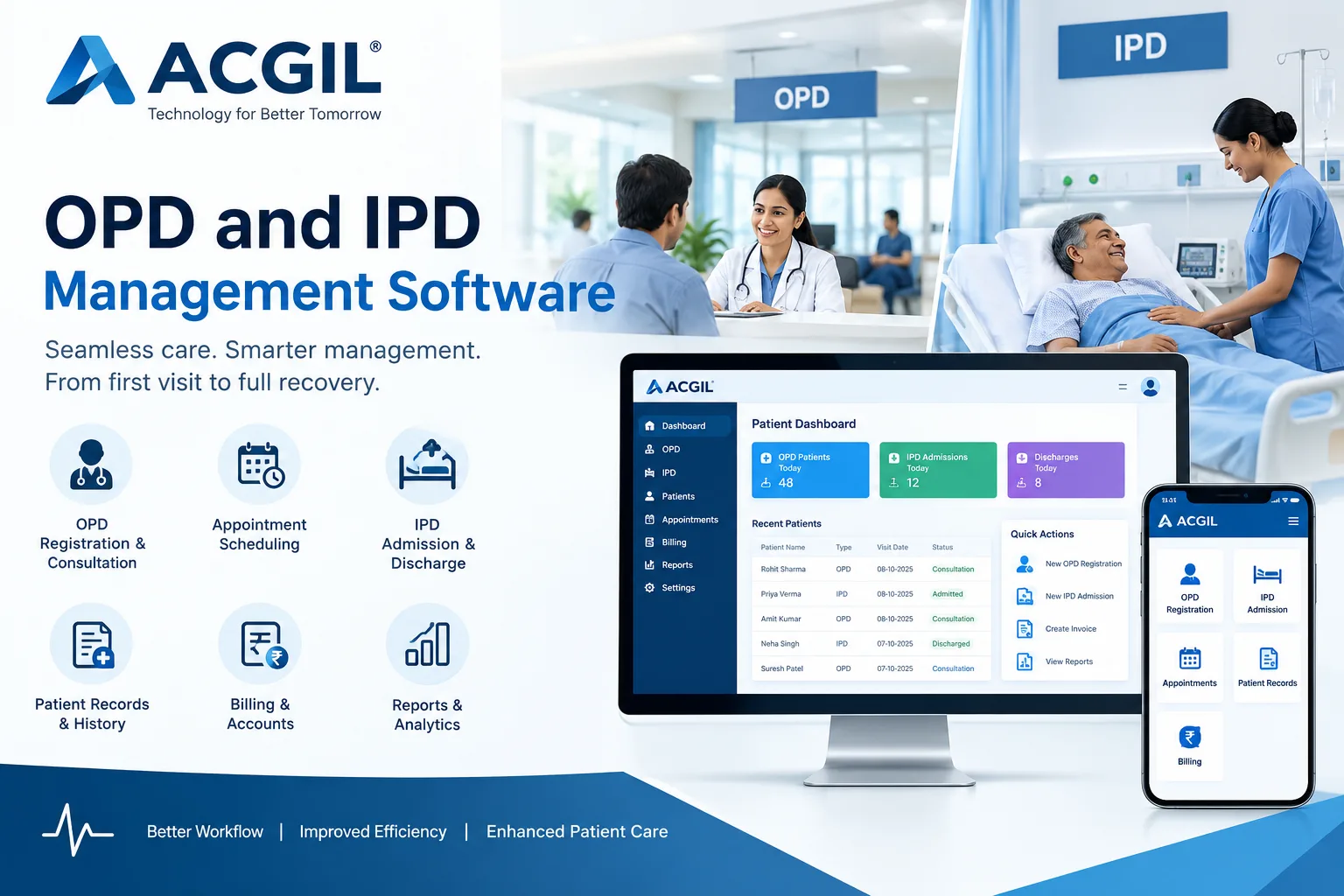
OPD operations involve patient registration, appointments, doctor consultations, prescriptions, billing, and follow-up activities. OPD and IPD management software can help hospitals organize these processes through a structured workflow.
Appointment scheduling can help reduce waiting times and make it easier for hospital staff to manage doctors' schedules and patient visits.
3. IPD Management
In-patient departments require coordination between admissions, doctors, nursing staff, billing, pharmacy, and other departments. IPD management functionality can help hospitals manage patient admissions, room or bed allocation, treatment-related information, discharge processes, and billing.
A centralized system makes it easier for authorized staff to track patient-related activities throughout the admission cycle.
4. Billing and Financial Management
Hospital billing involves consultation charges, room charges, diagnostic services, medicines, procedures, and other expenses. An integrated ERP system can bring these transactions together and support accurate billing.
Financial management features can also help hospital management monitor revenue, expenses, payments, outstanding amounts, and financial reports.
5. Pharmacy Management
Pharmacy operations require accurate inventory tracking and transaction management. Hospital ERP software can help manage medicine stock, purchases, sales, stock movements, and availability.
This can help reduce inventory discrepancies and provide better visibility into frequently used medicines and stock levels.
6. Inventory and Procurement Management
Hospitals need medicines, medical equipment, consumables, stationery, and other supplies. An ERP solution can help manage purchasing, vendors, stock levels, purchase orders, and inventory movement.
Better inventory control can help organizations avoid unnecessary overstocking while maintaining adequate availability of essential supplies.
7. Laboratory and Diagnostic Management
Hospitals may manage a large number of diagnostic tests and reports. Integrating laboratory-related processes with hospital management software can help organize test requests, processing, billing, and reporting.
This can improve coordination between doctors, laboratories, and patients.
Benefits of OPD and IPD Management Software
An integrated OPD and IPD management software solution can help hospitals manage both outpatient and inpatient workflows within a connected environment.
For OPD operations, the system can support appointments, registrations, consultations, billing, and follow-ups. For IPD operations, it can support admissions, bed management, patient services, discharge procedures, and related billing.
Managing both workflows through an integrated platform provides hospital administrators with better visibility across patient operations and departmental activities.
How ERP Improves Hospital Efficiency
One of the biggest advantages of implementing an ERP solution is the reduction of repetitive manual processes. When information is entered into multiple systems, the possibility of errors and inconsistencies increases.
With ERP for Hospital Management Software, information can be captured and shared across connected modules based on user permissions. This helps departments work with more consistent data and reduces unnecessary paperwork.
Hospital management can also use reports and dashboards to understand operational performance, financial activities, inventory status, and other important business indicators.
Choosing the Right Hospital ERP Solution
Before selecting Hospital Management ERP Software, healthcare organizations should evaluate their operational requirements carefully. The right solution should be scalable and flexible enough to support the hospital's current and future needs.
Important factors to consider include:
- Required hospital management modules
- OPD and IPD workflow requirements
- Billing and financial management
- Inventory and pharmacy management
- Reporting and analytics
- User access and security
- Integration capabilities
- Scalability
- Ease of use
Technical support and implementation services
A solution that can adapt to changing operational requirements can provide greater long-term value.
The Future of Hospital Management
Digital transformation is becoming increasingly important for healthcare organizations. Hospitals are looking for technologies that can help them improve operational efficiency while managing growing volumes of data and increasing administrative requirements.
Modern ERP software for hospital management provides a foundation for digital operations by connecting departments, centralizing information, and automating important workflows.
As hospitals continue adopting digital technologies, integrated ERP systems can play an important role in improving operational visibility, resource management, and administrative efficiency.
Conclusion
Managing a modern hospital requires coordination across multiple departments and processes. From patient registration and OPD services to IPD management, billing, pharmacy, inventory, and reporting, every function contributes to the overall efficiency of the organization.
Hospital Management ERP Software provides an integrated approach to managing these operations through a centralized platform. With features for OPD and IPD management, billing, inventory, pharmacy, reporting, and administration, ERP technology can help healthcare organizations streamline workflows and improve operational control.
For hospitals looking to reduce manual processes, improve departmental coordination, and build a more organized digital infrastructure, implementing reliable ERP software for hospital management can be an important step toward efficient and scalable healthcare operations.