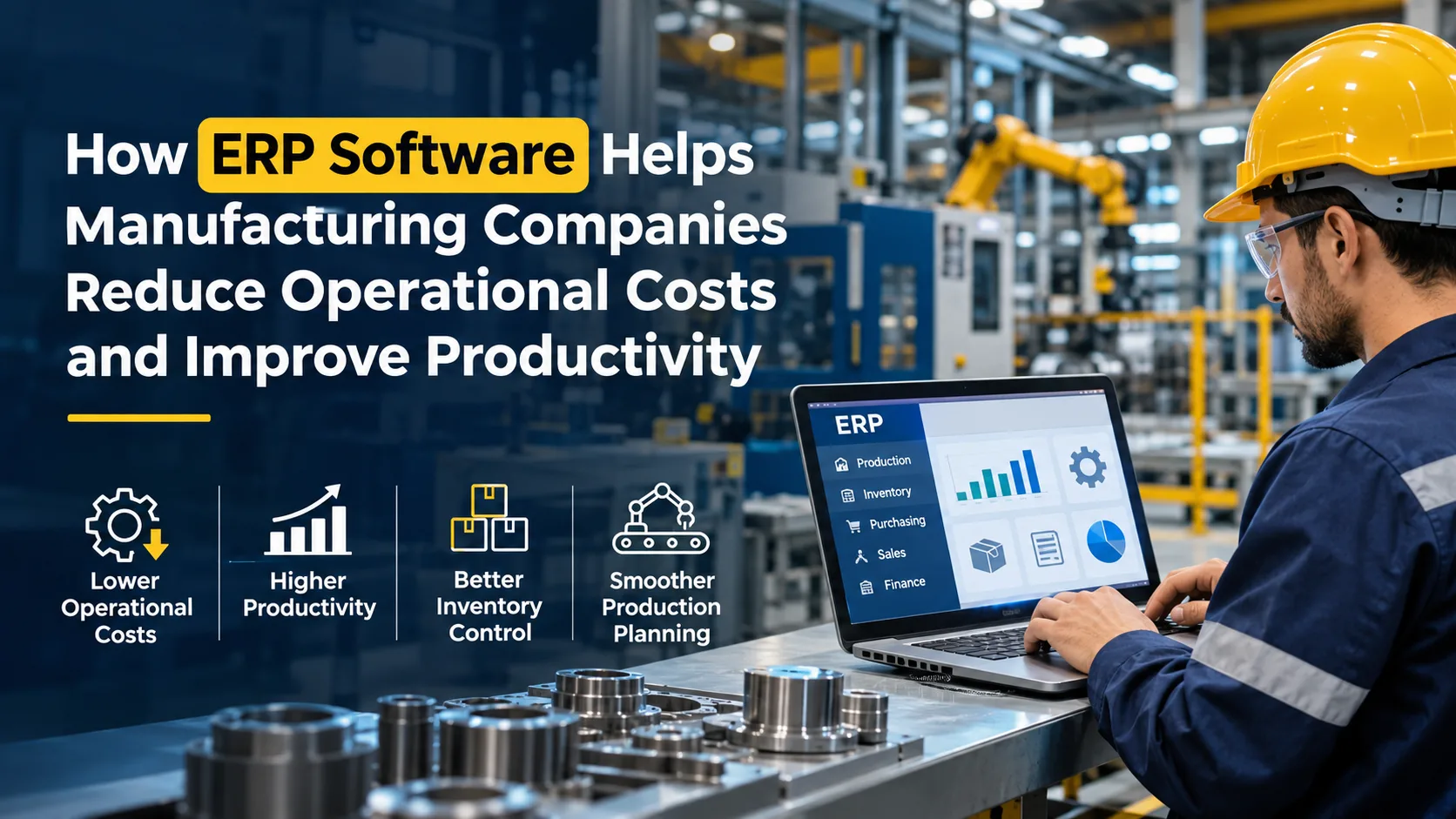
Manufacturing businesses operate in an environment where every decision matters. From purchasing raw materials and managing inventory to planning production and delivering finished products, even a small operational issue can affect costs, productivity, and customer satisfaction.
Many manufacturers still depend on spreadsheets, disconnected software, and manual processes to manage their daily operations. While these methods may work when a business is small, they often become difficult to manage as production volumes increase, product lines expand, and customer expectations change.
This is where Enterprise Resource Planning (ERP) software can make a meaningful difference.
An ERP system connects important business functions through a centralized platform, helping manufacturers gain better visibility into their operations, reduce unnecessary expenses, improve resource utilization, and make informed decisions.
But how exactly does ERP software help manufacturing companies control operational costs and improve productivity? Let's explore.
1. Better Inventory Management Reduces Unnecessary Costs
Inventory is one of the most important areas of manufacturing operations. Holding too much stock increases storage and carrying costs, while insufficient inventory can delay production and affect customer deliveries.
Without an integrated inventory management system, manufacturers may struggle to answer important questions:
- How much raw material is currently available?
- Which materials need to be reordered?
- Are there any slow-moving or excess inventory items?
- How much stock is reserved for upcoming production orders?
- Which materials are approaching their expiry or shelf-life limits?
ERP software provides a centralized view of inventory information, making it easier to monitor stock movements, track material availability, and plan purchases.
With more accurate inventory records, businesses can make better purchasing decisions, reduce avoidable stock accumulation, and minimize production delays caused by material shortages.
Practical example: A manufacturing company producing industrial components may use an ERP system to monitor raw material consumption. When stock reaches a defined reorder level, the purchasing team can review the requirement and plan replenishment before production is affected.
2. Improved Production Planning and Scheduling
Poor production planning can create several operational problems, including machine downtime, missed deadlines, idle workers, and inefficient resource utilization.
For manufacturers handling multiple products and customer orders, coordinating production activities manually can become increasingly complicated.
An ERP system helps bring production planning information together, allowing managers to coordinate:
- Production orders and schedules
- Raw material requirements
- Machine and equipment availability
- Workforce allocation
- Production progress
- Planned and actual production quantities
Manufacturing ERP solutions can also support material requirements planning (MRP), helping businesses calculate the materials needed for production based on demand, inventory levels, and production schedules.
This improves coordination between production and purchasing teams.
As a result, manufacturers can identify potential bottlenecks earlier, plan resources more effectively, and improve their ability to meet delivery commitments.
3. Reduced Material Waste and Better Cost Control
Material waste directly affects manufacturing profitability.
Waste can occur because of incorrect production planning, inaccurate material estimates, damaged inventory, poor quality control, or inefficient production processes.
When material consumption is not properly recorded, managers may find it difficult to understand where costs are increasing.
ERP software helps manufacturers monitor material requirements, record consumption, compare planned and actual usage, and maintain better visibility into production costs.
Depending on the ERP system and its configuration, businesses can also track:
- Bill of Materials (BOM)
- Material consumption per production order
- Scrap and rejected quantities
- Production variances
- Work-in-progress inventory
- Finished goods costs
For example, if a production order consistently consumes more raw material than expected, managers can investigate the reasons behind the difference.
The issue could be related to machine settings, production methods, material quality, or inaccurate planning.
Having reliable production data makes it easier to identify these problems and take corrective action.
4. Better Coordination Across Departments
Manufacturing operations depend on several departments working together.
Sales needs to communicate customer requirements. Purchasing must ensure materials are available. Production needs accurate schedules. Inventory teams must maintain stock records, while finance needs reliable cost information.
When these departments use disconnected systems, information gaps can create delays and misunderstandings.
ERP software connects these functions through shared business information.
For instance, when a sales order is confirmed, the relevant teams can access the information they need without repeatedly requesting updates through emails or spreadsheets.
This improves communication, reduces duplicate data entry, and helps employees spend less time searching for information.
More importantly, managers get a clearer picture of how different departments affect overall business performance.
5. Improved Quality Control and Traceability
Product quality plays a major role in customer satisfaction and manufacturing efficiency.
Poor quality can result in rework, rejected products, additional material consumption, and delayed deliveries.
An ERP system can help manufacturers maintain quality-related records at different stages of their operations.
Depending on the available functionality, businesses may track:
- Incoming raw material inspections
- In-process quality checks
- Finished product inspections
- Rejected and defective quantities
- Supplier quality records
- Batch and serial number information
These records help quality teams identify recurring issues and understand where corrective action may be required.
For industries where product traceability is important, batch and serial tracking can also help businesses identify the materials and production activities associated with a particular finished product.
ERP does not automatically eliminate quality problems. However, it provides better information and process visibility to support quality management.
6. More Accurate Financial Management and Cost Visibility
Manufacturing costs involve much more than the price of raw materials.
Businesses also need to consider labour, machine operating expenses, overheads, packaging, transportation, and other production-related costs.
When financial and operational information is maintained separately, calculating the actual cost of manufacturing can become difficult.
An integrated ERP system helps connect financial records with purchasing, inventory, sales, and production activities.
This can help management understand:
- Raw material costs
- Production-related expenses
- Inventory valuation
- Purchase price differences
- Manufacturing overheads
- Product and order profitability
- Budget versus actual performance
With better cost visibility, business owners can identify areas where expenses are increasing and evaluate opportunities to improve profitability.
Accurate costing also supports better pricing and financial planning decisions.
7. Automation Reduces Repetitive Manual Work
Many manufacturing businesses spend considerable time on routine administrative activities.
These may include updating inventory spreadsheets, preparing purchase orders, entering invoices, generating reports, and sharing production updates.
Manual work not only consumes employee time but can also increase the possibility of data-entry errors.
ERP software can automate or streamline several routine activities through configurable workflows.
Examples include:
- Purchase order approval workflows
- Inventory reorder notifications
- Automated invoice generation
- Sales order processing
- Production status updates
- Financial reporting
- Task and activity notifications
Automation allows employees to focus more on planning, problem-solving, quality improvement, and other activities that require human judgment.
The objective is not to replace employees but to help them work more efficiently.
8. Real-Time Reporting Supports Better Business Decisions
Manufacturing managers need accurate information to make timely decisions.
However, when reports are prepared manually using information from different departments, they may not provide a complete or up-to-date picture of business performance.
ERP dashboards and reporting tools help bring important operational information together.
Depending on the system, managers can monitor indicators such as:
- Production output
- Inventory levels
- Purchase orders
- Order fulfilment status
- Production costs
- Sales performance
- Outstanding payments
- Operational expenses
For example, if production output is falling while material consumption remains high, managers can investigate whether there is a scheduling, quality, or resource utilization issue.
Access to reliable business information supports faster and more informed decision-making.
9. How to Choose the Right ERP Software for Your Manufacturing Business
Selecting an ERP system is an important business decision. The right solution should support your current operations while providing room for future growth.
Before selecting an ERP platform, manufacturing companies should evaluate the following factors.
1. Understand your business requirements
Identify the processes that need improvement. These may include inventory management, production planning, purchasing, accounting, quality control, or supply chain management.
2. Check manufacturing-specific functionality
Look for features such as Bill of Materials, MRP, work orders, production scheduling, inventory tracking, and quality management.
3. Evaluate integration capabilities
The ERP system should be able to connect relevant business functions and, where required, integrate with existing applications, equipment, or third-party platforms.
4. Consider scalability
Choose a system that can support increasing transaction volumes, additional users, new locations, and changing business requirements.
5. Evaluate customization and flexibility
Different manufacturers have different workflows. Consider whether the system can accommodate your processes without creating unnecessary complexity.
6. Assess implementation and support
ERP implementation involves more than installing software. Data migration, configuration, employee training, testing, and ongoing support all contribute to a successful implementation.
7. Calculate the total cost of ownership
Evaluate licensing, implementation, customization, integration, training, maintenance, and support costs before making a decision.
Popular platforms such as Odoo ERP and Microsoft Dynamics 365 offer business management capabilities that can support different manufacturing requirements. The right choice depends on the organization's size, operational complexity, budget, and long-term objectives.
10. Why ERP Implementation Matters as Much as ERP Selection
Choosing suitable ERP software is only the beginning.
Even a feature-rich ERP system may fail to deliver the expected business value if it is poorly implemented.
Common ERP implementation challenges include:
- Incomplete business requirement analysis
- Poor data migration
- Lack of employee involvement
- Insufficient training
- Unnecessary customization
- Inadequate testing
- Weak change management
Manufacturers should begin with a clear understanding of their existing processes and identify the improvements they expect from the new system.
A structured implementation approach generally includes requirement analysis, solution planning, system configuration, data migration, testing, employee training, and post-launch support.
Working with an experienced ERP implementation partner can help businesses manage these activities and align the system with their operational requirements.
Conclusion: Build a More Efficient Manufacturing Business with ERP
Manufacturing efficiency depends on how effectively a business manages its people, materials, machines, finances, and information.
When these activities operate in disconnected systems, businesses may experience unnecessary expenses, production delays, inventory inaccuracies, and limited visibility into their operations.
ERP software helps bring these processes together, making it easier to manage resources, monitor costs, improve coordination, and make informed business decisions.
However, successful ERP adoption requires more than choosing a software platform. Businesses need the right implementation strategy, suitable configurations, employee involvement, and ongoing support.
For manufacturing companies in India, the USA, the UK, and Canada, investing in the right ERP solution can be an important step towards building more connected, efficient, and scalable operations.
If your manufacturing business is exploring ways to improve operational efficiency, manage production, or gain better control over inventory and costs, Cloudmonte Technologies can help you understand ERP solutions that align with your business requirements.
Explore ERP consulting and implementation services at Cloudmonte Technologies.
Frequently Asked Questions (FAQs)
1. How does ERP software reduce manufacturing costs?
ERP software helps reduce manufacturing costs by improving inventory control, production planning, purchasing, resource utilization, and financial visibility. It helps businesses identify inefficiencies and make better operational decisions.
2. What are the most important features of manufacturing ERP software?
Important features include inventory management, Bill of Materials (BOM), Material Requirements Planning (MRP), production scheduling, work order management, quality control, purchasing, accounting, and reporting.
3. Can ERP software improve manufacturing productivity?
Yes. ERP software can improve productivity by connecting departments, reducing repetitive administrative tasks, improving production coordination, and providing access to accurate operational information.
4. Is ERP software suitable for small and medium-sized manufacturers?
Yes. Many ERP solutions offer flexible modules and deployment options suitable for small and medium-sized manufacturers. The right solution depends on business requirements, operational complexity, and budget.
5. Which ERP software is suitable for manufacturing companies?
Odoo ERP and Microsoft Dynamics 365 are two options businesses can evaluate. The best choice depends on manufacturing processes, production requirements, integration needs, scalability, and implementation costs.
6. How long does ERP implementation take for a manufacturing company?
Implementation timelines vary depending on business size, process complexity, data migration, integrations, customization, and employee readiness. A clearly defined implementation scope helps establish a realistic timeline.
7. What should manufacturers consider before implementing ERP software?
Manufacturers should assess their current processes, identify business requirements, define implementation goals, evaluate software capabilities, prepare data, plan employee training, and select an appropriate implementation partner.