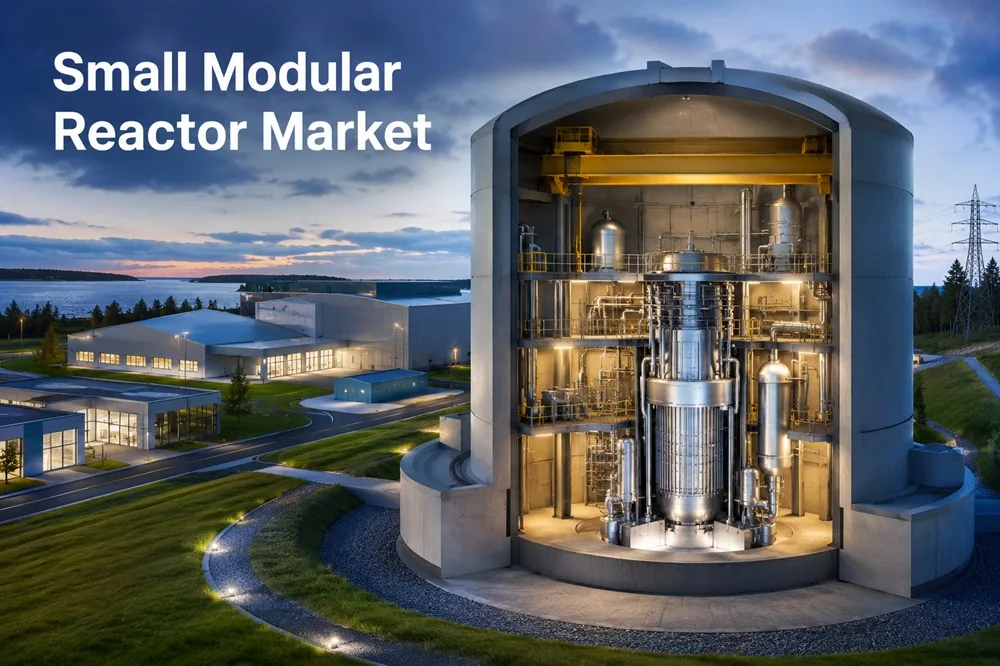
The Small Modular Reactor Market is gaining significant attention as countries pursue reliable, low-carbon energy solutions to strengthen energy security and meet decarburization goals. Unlike conventional nuclear plants, small modular reactors (SMRs) offer scalable deployment, enhanced safety features, and lower capital requirements. Ongoing technological advancements and supportive government initiatives are accelerating commercial adoption across power generation and industrial applications.
The small modular reactor market was valued at $159.4 million in 2024 and is projected to grow at a CAGR of 42.31%, reaching $5,179.6 million by 2035.
What is Driving the Growth of the Small Modular Reactor Market?
- Increasing global demand for clean and reliable baseload electricity to support net-zero emission targets.
- Growing government investments, funding programmes, and policy support for advanced nuclear technologies.
- Rising need for flexible power generation in remote regions, industrial facilities, and off-grid locations.
- Continuous advancements in modular reactor design, passive safety systems, and factory-based manufacturing that reduce construction timelines and project risks.
Get A Sample for Small Modular Reactor Market - Focus on Application Type, Product Type, and Region Analysis and Forecast, 2025-2035
What are the Emerging Trends in the Small Modular Reactor Market?
- Growing partnerships between technology developers, utilities, and government agencies to accelerate SMR commercialization.
- Increasing focus on integrating SMRs with hydrogen production, district heating, and industrial process heat applications.
- Rising investment in Generation IV reactor technologies to improve efficiency, sustainability, and operational safety.
- Expansion of public and private sector funding to support demonstration projects and first-of-a-kind reactor deployments.
How is the Small Modular Reactor Market Segmented?
The Small Modular Reactor Market is segmented by reactor type, power capacity, deployment model, application, and end user. Light water reactors continue to dominate commercial development due to their technological maturity, while advanced reactor concepts are gaining momentum for specialized applications. Key end users include electric utilities, industrial facilities, government organizations, and remote communities seeking dependable, low-carbon energy solutions.
Which Regions are Leading the Small Modular Reactor Market?
North America leads the Small Modular Reactor Market, supported by strong government funding, active demonstration projects, and an established nuclear industry. Europe continues to expand investments in advanced nuclear energy to support energy transition goals. Meanwhile, Asia-Pacific is witnessing substantial growth as countries including China, South Korea, and Japan invest in SMR development to strengthen long-term energy security and diversify electricity generation.
What Challenges and Opportunities Shape the Market?
Commercial deployment of SMRs faces challenges related to regulatory approvals, high initial development costs, financing requirements, and public acceptance of nuclear technologies. Supply chain readiness and skilled workforce availability also remain important considerations. However, increasing global demand for carbon-free electricity, technological innovation, standardized reactor manufacturing, and expanding applications in hydrogen production and industrial decarburization present substantial long-term growth opportunities.
Click Here to Download the ToC
Conclusion
The Small Modular Reactor Market is positioned to play an increasingly important role in the global clean energy transition. With enhanced safety, modular construction, and flexible deployment capabilities, SMRs offer an attractive alternative to conventional nuclear power generation. As regulatory frameworks mature and commercial projects progress, the market is expected to experience sustained growth, supporting reliable, low-carbon energy production across diverse industries and regions.