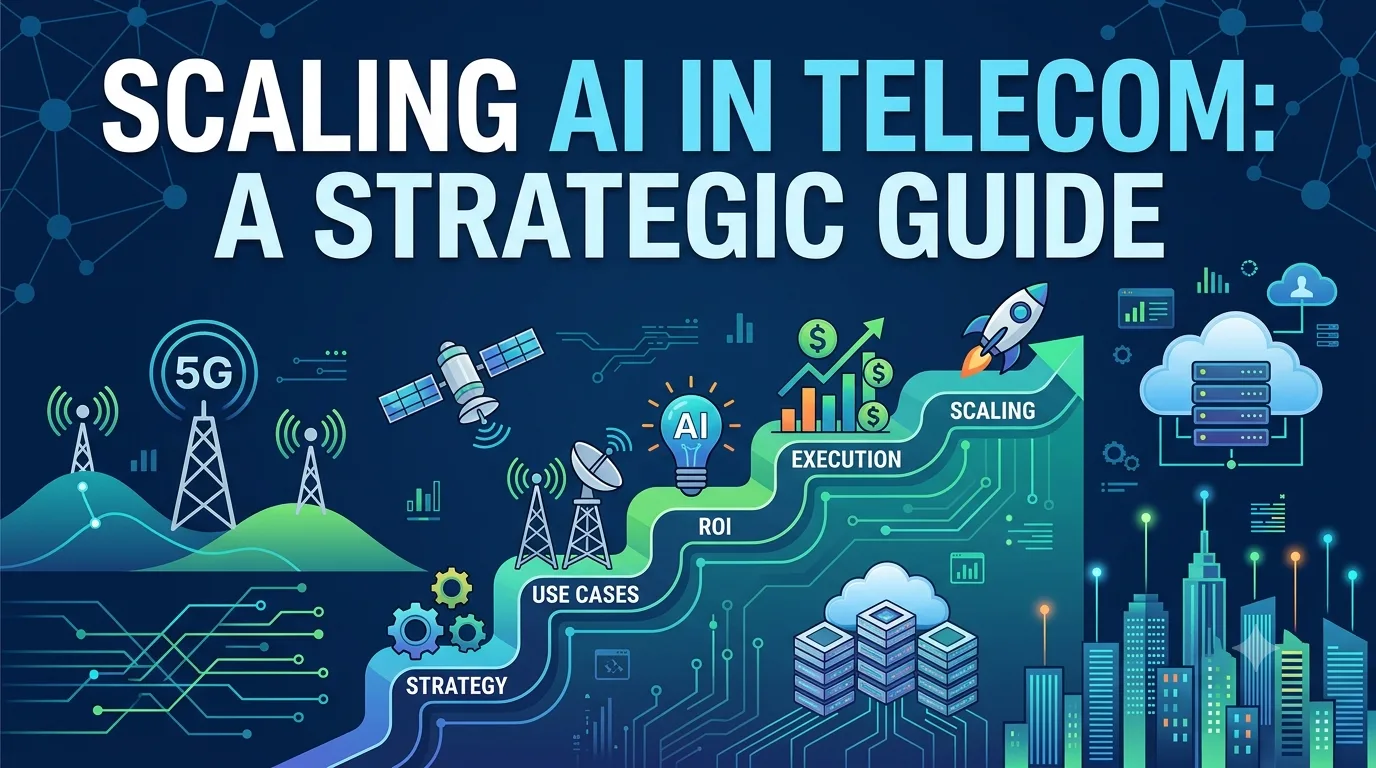
Where should telecom operators deploy AI first to ensure maximum ROI? Communications Service Providers (CSPs) achieve the highest initial return on investment by starting with Customer Experience (CX) and Contact Center Automation—specifically real-time agent assist, automated call summarization, and self-service voicebots. These front-office applications require lower integration effort, present minimal operational risk, and deliver measurable cost reductions within 3 to 6 months. Operators with mature data lakes and automated BSS/OSS can concurrently explore Predictive Network Maintenance to reduce unplanned downtime and lower network OpEx.
Ecosmob's strategic guide on where AI should be implemented first in a telecom business.
1. The Strategic Imperative for AI in Telecommunications
Telecommunications companies face a compounding operational squeeze: massive capital expenditure requirements for 5G and fiber rollouts, combined with flat ARPU (Average Revenue Per User) and surging subscriber demand for instant, faultless service. Integrating Artificial Intelligence across telecom operations is no longer an optional innovation project—it is a core strategy for maintaining margin viability.
However, many operators fall into the "pilot trap," deploying disconnected AI tools that fail to scale across legacy enterprise systems. Achieving sustained enterprise-wide impact requires selecting initial use cases based on data readiness, API accessibility, and clear operational risk boundaries.
2. Strategic Selection: Customer Experience vs. Network Operations
Selecting the right entry point determines whether your AI initiative succeeds or stalls. Telecom leaders generally evaluate two primary operational pathways:
Path A: Customer Contact Center & Support (Recommended First Step)
- Core Objective: Reduce Average Handle Time (AHT), increase First Contact Resolution (FCR), and lower cost-per-call.
- Technical Integration: Connects to existing Contact Center as a Service (CCaaS), CRM, and billing systems via standard APIs.
- Time-to-Value: 3 to 6 months to achieve validated financial returns.
- Risk Profile: Low. Allows human-in-the-loop validation where AI assists human agents before granting system autonomy.
Path B: Network Operations & Infrastructure Management (Advanced Step)
- Core Objective: Prevent network outages, optimize base station power consumption, and automate root-cause ticket routing.
- Technical Integration: Requires deep integration with streaming telemetry, legacy BSS/OSS layers, and element management hardware.
- Time-to-Value: 6 to 12+ months for full operational deployment.
- Risk Profile: High. Misconfigurations can trigger service outages and SLA penalties if guardrails are insufficient.
To explore how to audit your internal readiness for these implementations, review Ecosmob's analysis on where AI should be implemented first in a telecom business.
3. High-Impact Telecom AI Use Cases
1. Agent Assist & Live Support Copilots
- Mechanism: Listens to active customer calls via SIP/RTP audio streams, transcribes speech in real time, determines caller intent, and surfaces recommended solutions directly on the agent's screen.
- Impact: Reduces agent training time by up to 50% while shaving 15% to 25% off Average Handle Time across contact center operations.
2. Automated Post-Call Summarization
- Mechanism: Automatically generates concise post-interaction summaries, assigns sentiment scores, and updates CRM disposition codes instantly when a call ends.
- Impact: Eliminates 1 to 3 minutes of manual administrative work per agent call, driving significant labor cost savings.
3. Predictive Network Maintenance & Anomaly Detection
- Mechanism: Machine learning models process real-time telemetry from cell sites, fiber nodes, and core hardware to identify micro-anomalies signaling imminent component failure.
- Impact: Shifts field engineering from reactive emergency repairs to planned, low-cost maintenance windows, minimizing network downtime.
4. Real-Time Fraud Mitigation & Revenue Assurance
- Mechanism: Monitors Call Detail Records (CDRs) and authentication requests in near-real-time to flag patterns indicating International Revenue Share Fraud (IRSF) or SIM swap attempts.
- Impact: Blocks unauthorized network access within seconds, preventing major financial leakage and regulatory compliance fines.
5. Intelligent Voicebots for Routine Self-Service
- Mechanism: Handles high-volume, repetitive inquiries—such as plan modifications, bill payments, and basic connectivity troubleshooting—using natural language understanding and sub-300ms audio synthesis.
- Impact: Deflects 20% to 40% of routine call volume away from human support queues, opening capacity for complex escalations.
4. Technical Architecture & Data Readiness Requirements
Successfully deploying enterprise AI models within telecom environments requires satisfying fundamental architectural standards:
- Data Governance & PII Masking: Ingest interaction data, CDRs, and telemetry into centralized cloud repositories (such as Snowflake or BigQuery) while enforcing automatic PII masking to comply with GDPR, CCPA, and regional telecom security frameworks.
- Ultra-Low Voice Latency: For interactive voice applications, the end-to-end processing loop—from Automatic Speech Recognition (ASR) to model inference and Text-to-Speech (TTS)—must operate under 300 milliseconds to maintain human-grade conversational cadence.
- Open API Architecture: Utilize standard open telecom APIs (such as TM Forum specifications) to connect AI platforms with legacy BSS/OSS and CRM environments, avoiding proprietary vendor lock-in.
- Model Observability: Implement real-time monitoring tools to continuously track inference accuracy, model drift, API error rates, and system fallback frequencies.
5. Measuring Success: Key Telecom AI Metrics
To justify ongoing investment and expand AI initiatives enterprise-wide, track performance across three core business vectors:
- Financial Value: Measure direct reductions in cost-per-contact, overall contact center OpEx savings, and intercepted revenue loss from fraud monitoring.
- Operational Efficiency: Track reductions in Average Handle Time (AHT), improvements in First Contact Resolution (FCR), and reductions in Mean Time to Repair (MTTR) for network engineering teams.
- Customer Retention: Evaluate overall Net Promoter Score (NPS), Customer Satisfaction (CSAT) metrics, and changes in subscriber churn rates among cohorts interacting with AI-assisted workflows.
6. Overcoming Primary Implementation Pitfalls
- Breaking Down Data Silos: AI applications fail when constrained by isolated data pools. Unify customer records, billing data, and operational logs through real-time API integrations prior to model training.
- Avoiding Overscoped Initial Pilots: Attempting end-to-end autonomous network control during your first project introduces unacceptable operational risk. Begin with supervised, human-in-the-loop workflows before expanding autonomy.
- Proactive Change Management: Support agents and field engineers may resist automated tools. Involve end-users early in application interface design to build trust and encourage daily tool adoption.
7. Phased 12-Month AI Implementation Roadmap
- Months 1–3: Scope Definition & Infrastructure Setup
- Identify a targeted, high-volume use case (such as Agent Assist or Call Summarization).
- Establish baseline data masking, security controls, and governance frameworks.
- Define explicit KPI targets for handle time reduction, FCR gains, and initial ROI.
- Months 4–6: MVP Deployment & Technical Validation
- Deploy a Minimum Viable Product (MVP) to a selected pilot group or regional contact team.
- Connect AI pipelines to active CCaaS and CRM systems using standard REST APIs.
- Benchmark system latency, transcript accuracy, and agent feedback.
- Months 7–10: Enterprise Expansion & Scaling
- Expand deployment across all customer support departments or regional operations centers.
- Activate automated monitoring pipelines to catch model drift and latency bottlenecks.
- Refine agent training programs based on operational usage patterns.
- Months 11–12: Advanced Automation & Portfolio Growth
- Transition stable workflows from human-assisted guidance to supervised autonomous execution.
- Reinvest measured operational savings into secondary priorities, such as Predictive Network Maintenance.
- Scale cross-departmental data pipelines to support future AI initiatives.
Frequently Asked Questions
What is the fastest AI use case to implement for a regional telecom operator?
Automated call summarization and real-time agent assist offer the fastest timelines. These tools integrate directly into modern CRM and CCaaS platforms via standard APIs without requiring complex core network modifications, achieving production deployment in 12 to 16 weeks.
How does AI directly reduce network operational expenditures?
AI lowers network OpEx by evaluating real-time traffic patterns to dynamically power down unused 5G cell tower capacity during off-peak hours, and by predicting hardware component failures before expensive outage-related dispatches occur.
Can legacy telecom systems support modern real-time AI solutions?
Yes. Modern AI platforms operate as an orchestration layer on top of legacy BSS/OSS infrastructure, using middleware pipelines, telemetry adapters, and open RESTful APIs to exchange data without requiring complete legacy system replacements.