
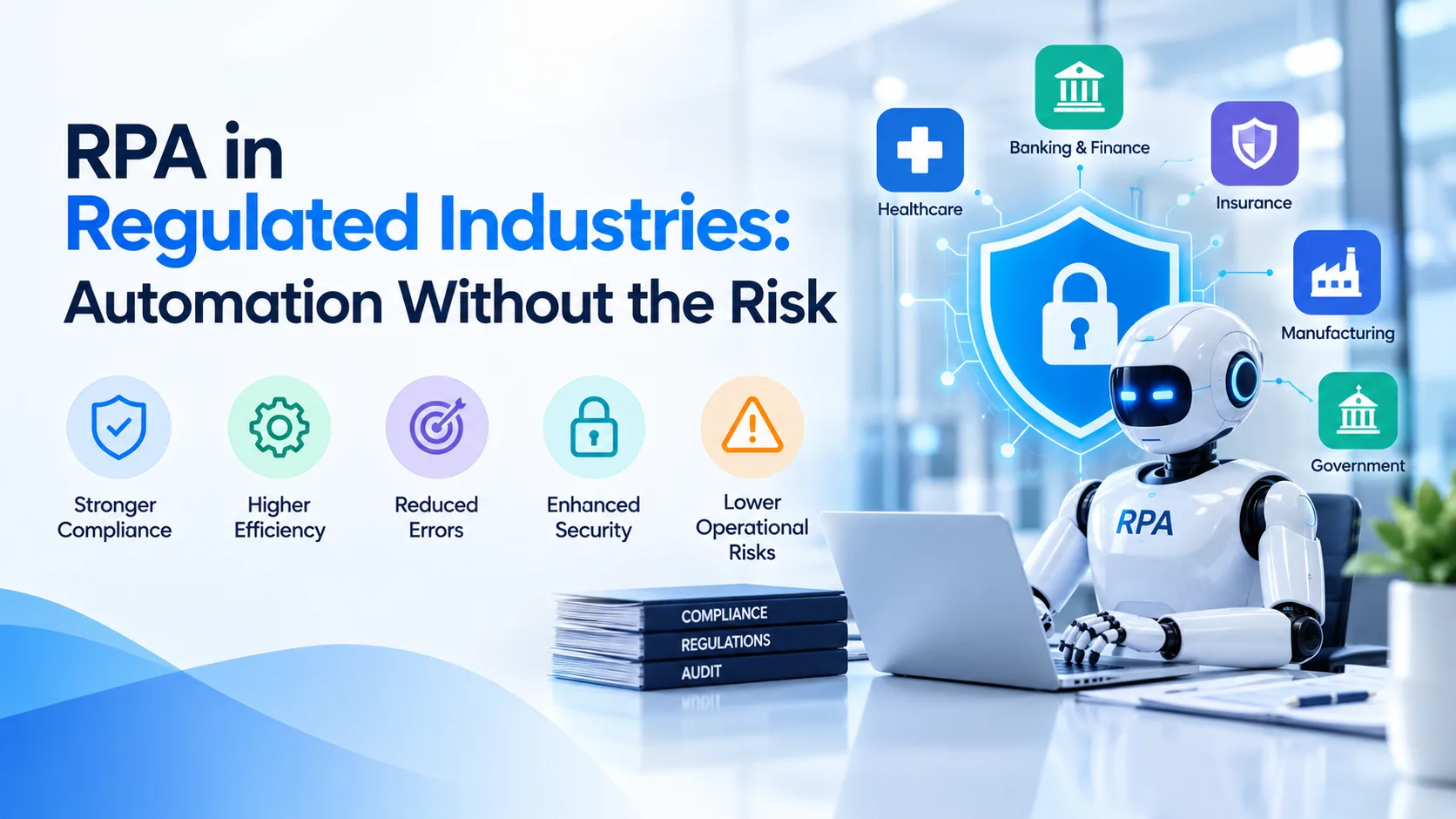
Regulated industries may require greater attention to security, accuracy, and control to ensure both compliance and quality. Such fields as finance, healthcare, insurance, and pharmaceuticals tend to have increased expectations regarding employee performance. A minor error in a report or documentation might have significant consequences.
Applying RPA — robotic process automation — might appear an effective way to make repetitive operations more efficient in regulated industries. However, the use of such programs should consider relevant constraints and limitations concerning security and control issues.
Regulated Industry and RPA Concepts in Detail
Robotic process automation (RPA) refers to the application of various technologies that enable robots to perform repetitive operations normally undertaken by employees. It implies software-mediated instruction following, data input, and application maintenance.
Processes subject to automation should therefore be standardized, documented, and approved, with particular regard to the necessary security and control checks. Common examples of regulated RPA processes include transaction processing, customer communication, documentation validation, and report preparation. All such operations involve a consistent set of instructions, data verification, and application of documented procedures for effective execution and auditor control.
Regulated Industry and RPA Compliance
The described approach provides the required efficiency but does not account for all necessary constraints. Normally, such applications are not designed to address control and compliance requirements by default. Even a well-documented process might result in unauthorized robot activities, errors, and system malfunctions.
Therefore, it is essential to establish control environments, audits, and access rights before implementing the bots in operations. Each industry has specific compliance rules; therefore, it is recommended to analyze all available instructions and constraints. It is particularly important to secure the documents, records, and personal information contained within the applications being processed by the robots. The three main elements of regulation analysis when considering RPA in regulated industries are access rights, process validation, and regulatory compliance.
Organizations working with experienced providers of AI software development services often find it easier to embed compliance controls directly into their automation frameworks, ensuring that regulatory requirements are met from the ground up rather than retrofitted afterward.
RPA Use Cases in Different Industries
In general, RPA applications have already proven their effectiveness in addressing various business-related issues. However, a more profound analysis should cover the peculiarities of automation within a specific industry or field of operations.
Banking and Financial Services
Financial services and banking provide clear examples of automated audit-ready transaction processing, which takes place in accordance with documented instructions. Normally, such bots manage to accomplish the regular transaction routine while providing adequate controls and approvals. For instance, a banking RPA application might request evidence of the required customer documents before the application is sent for approval.
Healthcare and Pharmaceuticals
This field of industry concerns patient-related operations, which are mostly supported by RPA bots. Processes like scheduling, billing, claims processing, and documentation are subject to transformation. Another common example is pharmaceutical industry applications, which concern evidence recording and report organization.
Insurance
This area is another example of RPA application in regulated industries, where bots handle transaction processing, customer communication, document management, and routine operations.
Common Challenges and Concerns Regarding RPA Application
Implementation Risks
A fundamental question regarding the application of RPA in different settings is always about risks and possible sources of failure. The first issue to be considered is the choice of the automation project itself. Operations that are ideally suited for RPA implementation are relatively straightforward and repetitive, with clearly defined instructions.
It is better to choose such processes with particular regard to the likelihood of associated compliance and security risks. Another crucial step towards risk minimization is the establishment of the necessary controls before the actual RPA application. Thoughtful RPA development — with compliance and control built in from the start — significantly reduces the risk of process failures and regulatory breaches in high-stakes environments.
Threats, Opportunities, and Control Measures
Implementation Plan
It is therefore essential to design a series of recommendations for an RPA project concerning regulated processes. Such guidelines might include the selection of the appropriate procedures, documentation, and instructions, followed by staff training, control testing, and implementation. Other crucial aspects to receive sufficient consideration are the necessary access and approvals, required documentation, and special staff training.
Teams leveraging Artificial Intelligence development services alongside RPA can further strengthen their implementation plans by introducing intelligent decision-making layers — enabling systems to handle exceptions and edge cases that rule-based bots alone cannot manage effectively.
Compliance Audits
In addition to staff qualification, it is also essential to conduct regular reviews of the automated processes. This step aids in examining possible sources of failure, including robotic malfunction, process complexity, insufficient instructions, access breaches, human errors, and control inadequacy. All these aspects should therefore be thoroughly considered when designing the key elements of the RPA application.
Security and Access Controls
This concept concerns two main aspects: the level of access a bot requires to perform a set of documented operations. Another crucial consideration is the possibility of applying the principles of least privilege, which implies limiting the degree of automation. A wide range of factors might influence the chances of RPA use in a particular setting, and all such circumstances should be analyzed to increase the likelihood of positive implementation outcomes.
Organizations building compliance-focused automation tools frequently turn to AI app development services to integrate intelligent access monitoring, anomaly detection, and audit logging directly into their automated workflows — adding an essential layer of oversight beyond what standard RPA bots provide.
General Recommendations Regarding RPA and Regulation
RPA concepts are mostly applied when a company has multiple identical processes performed regularly in accordance with standardized sets of instructions. When choosing the procedures to be subject to automation, it is essential to thoroughly analyze compliance and security risks associated with the selection.
At the same time, it is worth acknowledging the most effective aspects of RPA application, including control establishment, regulatory compliance, and audit readiness, and minimizing the likelihood of operational failures when using the programs. A well-structured RPA strategy should therefore indicate the necessary aspects of control, regulation, and compliance, along with audit and access management, staff qualification and training, and continuous improvement of the automation processes.
Conclusion
In summary, RPA applications might be successfully implemented in diverse settings. From an ethical perspective, they tend to make a better impression and offer more extensive possibilities in terms of process improvement than other methods of refinement. Automation is therefore used in businesses to address a wide range of routine operations, from transaction processing to documentation and staff management. However, all such programs are accompanied by certain limitations and challenges, specifically in terms of compliance, regulation, and security.
When applying such programs in various fields, it is usually beneficial from both a legal and an operational perspective to ensure the necessary access controls to minimize risks, as well as design appropriate staff qualification requirements and conduct relevant audits, reviews, and access analyses. These concepts are especially vital in regulated industries, where additional considerations concern access rights, process validation, and regulatory compliance. In general, a comprehensive comprehension of the essential elements of RPA utilization — namely, RPA and process refinement, regulation compliance, security and access control, staff qualification and audits — is the primary condition of positive outcomes in automating previously non-automated processes.