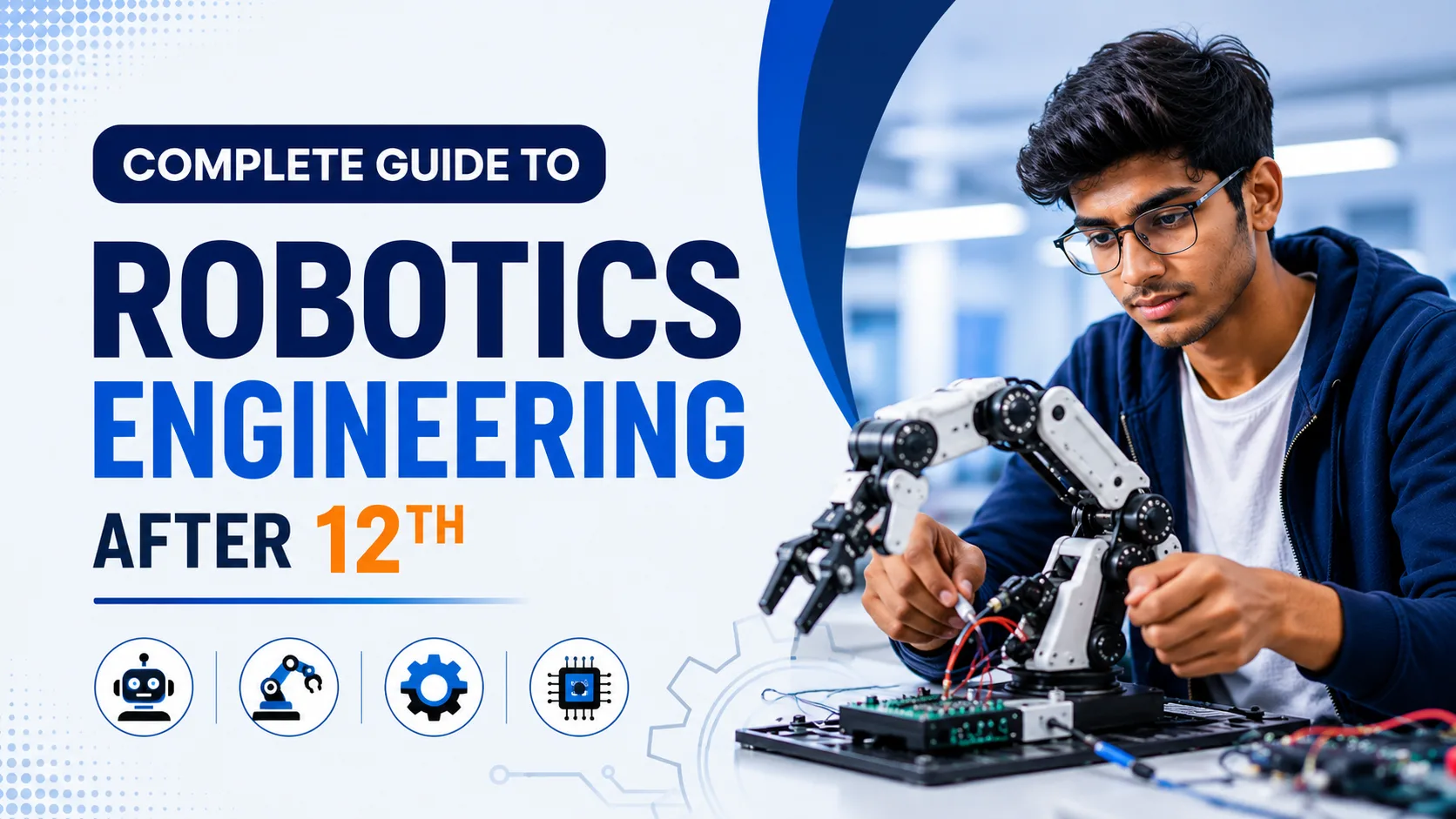
The technology field is moving fast. Traditional engineering fields are shifting as industries like manufacturing, healthcare, logistics, and electric vehicle production rapidly transition to intelligent automation. If you are a science student completing your high school education, choosing robotics engineering after 12th is one of the most strategic ways to future-proof your career.
At MH Cognition, we analyse industrial hiring trends continuously. Modern automation requires engineers who understand how hardware mechanics interact with intelligent software. Moving beyond traditional computer science to specialise in robotics means learning how to build machines that can physically sense, move, and decide on their own.
What is Modern AI and Robotics Engineering?
Before jumping into a course, it is crucial to understand what the domain actually involves. Many students make the mistake of thinking robotics is purely mechanical assembly or basic coding.
In reality, modern robotics relies on intelligent automation. To understand how this works at a structural level, you can explore our detailed breakdown of what is AI and robotics.
True robotics engineering requires a unified understanding of three distinct systems:
- Mechanics & Kinematics: Designing the physical frame, joints, actuators, and structural mobility of the machine.
- Electronics & Embedded Control: Integrating microcontrollers, sensors (LiDAR, ultrasonic, cameras), and wiring configurations to manage electrical signals.
- The AI Decision Layer: Writing machine learning, computer vision, and path-planning algorithms that process sensor data so the machine can adapt to its environment.
Academic Pathways After 12th Grade
If you have completed your 10+2 with Physics, Chemistry, and Mathematics (PCM), you can bypass generic computational streams and jump straight into advanced systems engineering.
1. The Core 4-Year Professional Degree
The most comprehensive pathway into the industry is a dedicated undergraduate engineering program. Enrolling in a formal B.Tech Robotics and AI program exposes you to physical robotics labs, simulation environments, and system architecture right from your first semester.
2. Evaluating the Educational Environment in India
When mapping out your colleges, you need to understand the structural demands of the local market. Reading an industry-aligned guide like B.Tech Robotics and AI in India will help you understand the academic landscape, admission pathways (like JEE Main and State CETs), and the absolute necessity of rigorous lab infrastructure over textbook learning.
3. Understanding the Training Framework
What does a dedicated automation syllabus actually look like? Before finalising your choice, review the foundational modules in our comprehensive breakdown of a robotics engineering course. A competitive curriculum should focus heavily on the Robot Operating System (ROS), embedded systems, C++ for real-time hardware control, and Python for machine learning.
Core Skills Every Aspiring Robotics Engineer Needs
Surviving and thriving in a robotics program requires consistent, hands-on engagement. The students who succeed focus heavily on building functional prototypes rather than just memorising engineering formulas.
1. Hardware Debugging
Writing code on a screen is clean; deploying it to a physical robotic arm is messy. You will spend hours diagnosing sensor noise, calibrating actuators, and fixing wiring faults. This requires patience and analytical troubleshooting skills.
2. Advanced Mathematical Modelling
Control systems and autonomous motion rely heavily on linear algebra, calculus, and spatial coordinates. If you want to program an autonomous vehicle to navigate an obstacle course, you will need a solid foundation in coordinate transformations and statistical analysis.
3. Software Proficiency
You must be fluent in both high-level and low-level software frameworks. Python is the gold standard for integrating computer vision and deep learning models, while C++ is essential for low-latency, real-time hardware execution.
Career Horizons and Salary Expectations
Choosing a specialised degree path opens doors across several deep-tech industries. Graduates are no longer confined to traditional manufacturing assembly lines. Instead, they are being hired to design surgical robotics, autonomous warehouse fleets, drone delivery networks, and smart agricultural systems.
Because these skills are highly technical and intersectional, employers are willing to pay a premium for engineers who can confidently build, test, and debug hardware-software systems. To see exactly how the market values these skills, you can check out our salary tracker on the AI robotics engineer salary in India to understand realistic entry-level packages, mid-career growth charts, and what portfolio elements drive top-tier compensation.
Take the Next Step with MH Cognition
Robotics engineering after 12th is a rigorous academic route, but it yields incredible dividends for students who love solving tangible, real-world problems.
At MH Cognition, we partner directly with leading institutions, serving as an academic Knowledge Partner to provide industry-aligned curricula, cloud lab access, and system-level project mentoring. Explore our premier B.Tech Robotics and AI academic track today, and start building the future of automated technology.
Visit: https://mhcognition.com/blogs/robotics-courses-after-12th